Vue lecture

Ukraine’s dismissed army chief departs with claim: he’s handing his successor army on offensive, with 700 km² liberated this year
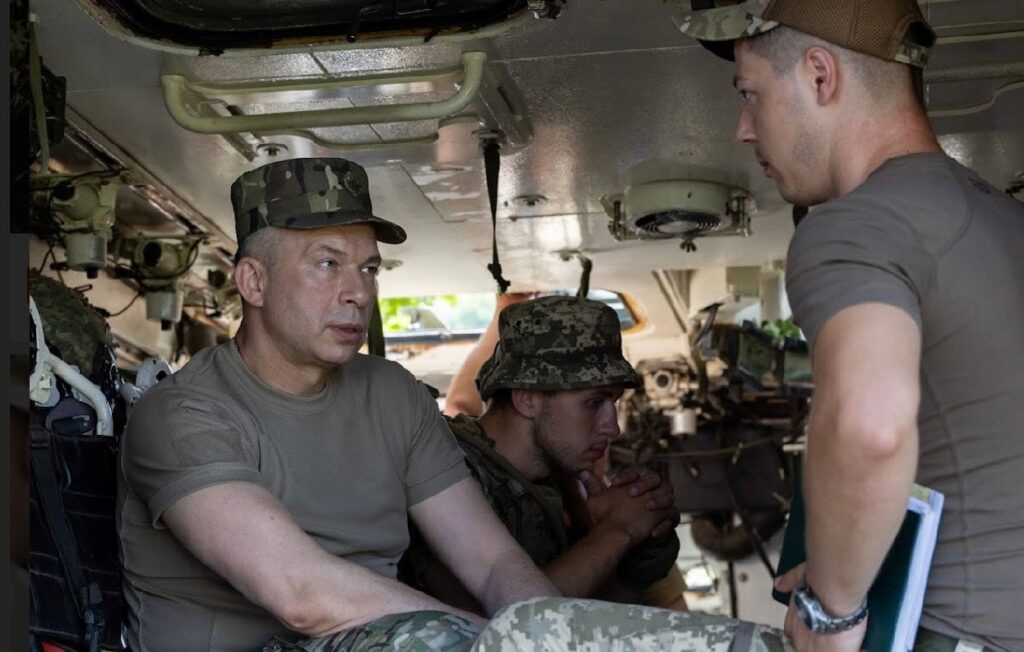
Russian losses hit 421,000 in 2024 - highest of war, Ukraine's top general says

Former Commander-in-Chief Oleksandr Syrskyi said in a statement on the morning of 22 July that he is passing on to his successor an army that not only holds the defense but is also on the offensive. He has seen this war "from its first day in 2014," he wrote, has "lived the front," and knows the price of every liberated kilometer of Ukrainian land.

The statement is Syrskyi's own account of his tenure, published the morning after Zelenskyy replaced him with Mykhailo Drapatyi following six days of protests.

Syrskyi claimed that 700 square kilometers of Ukrainian land were liberated this year under his command, and an army that two years ago fought a hard defense now attacking "with initiative, with structure, with people who know how to strike the enemy."

"I sincerely hope this offensive will be continued. Everything for it is in place," Syrskyi wrote.

"Destruction of most combat-capable part of Russian army"

In February-March 2022, Syrskyi said he had the honor of commanding the defense of Kyiv, and the capital held. That spring, the threat of a full siege of Kharkiv was lifted, too.

Then came the Kharkiv counteroffensive, when Balakliia, Izium, and Kupiansk were liberated in a matter of weeks, and later, in Donetsk Oblast, what he called the destruction of the most combat-capable part of the Russian army, the Wagner private military company, happened.

He took command in February 2024 "at a very difficult time," with Avdiivka's defenders standing half-encircled. One of his first orders was the organized withdrawal from the city.

"It was a hard decision. But I made it, because for me one main priority applied: preserving people's lives," he wrote.

Then, he said, came "a year that changed the course of this war": stopping the Russian offensive in Kharkiv Oblast, preempting the one aimed at Sumy, and conducting the Kursk operation. This was the first transfer of combat operations onto enemy territory in this war. 

The goal was never to occupy foreign land, he stressed, but to derail the prepared Russian offensive on Sumy and Kharkiv, draw off Russia's most capable troops, and replenish the exchange fund to bring Ukrainians home from captivity. All of it, he said, was accomplished.

He lists structural changes alongside battles

Syrskyi claimed the army's transformation as well as its operations.

Ukraine became the first country in the world to create a separate branch of unmanned systems forces, he noted, growing them "from individual units to a system that today makes the enemy feel it has no safe rear."

A new air defense was built: a separate command for unmanned air-defense systems, staffed interceptor-drone crews, and an echeloned shield over the rear.

"What was recently the experiment of enthusiasts today shoots down every night what was considered undownable," he said.

He cited the closure of the Black Sea port of Novorossiysk, the systematic destruction of Russia's shadow fleet, the army's transition to a corps structure, and combat officers arriving on staff, with a new rule that "the path to leadership positions runs through the front."

This year's Dobropillia operation and the offensive on the Oleksandrivka direction, he said, continue. Of some operations, he still has no right to speak: "History will tell of them. I will say only: the enemy remembers them."
  •  

From “flying BMP” to commander-in-chief: Ukraine’s new army leader stopped Russia at Kryvyi Rih and held Vovchansk

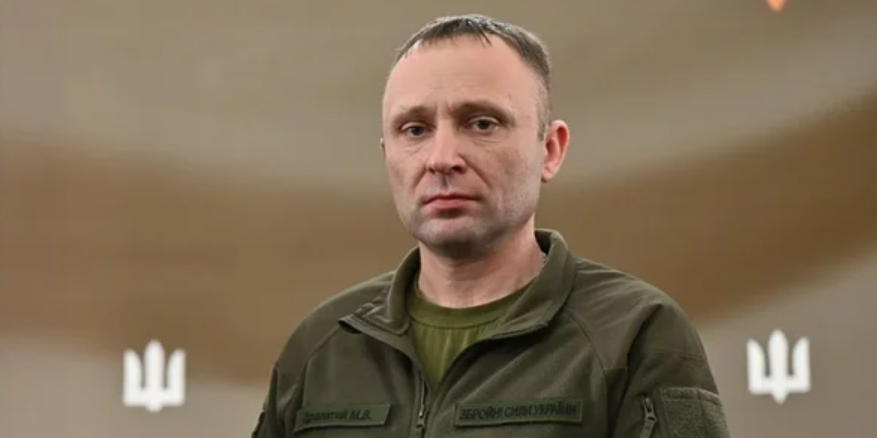
Major General Mykhailo Drapatyi, a new Ukrainian top commander. Source: The Ukrainian Defense Ministry

"Serving Ukraine has always been an honor for me, and during a war for independence, it means absolute responsibility." These words appeared in Major General Mykhailo Drapatyi's first statement after his appointment as Ukraine's new commander-in-chief.  

His appointment came after six days of protests against the resignation of Defense Minister Mykhailo Fedorov and in support of the dismissal of Oleksandr Syrskyi, who has been criticized for his Soviet-rooted command style.

"I thank the President of Ukraine for the trust, the Defense Minister for the support, and the Defense Forces for a new stage of service," Drapatyi wrote.

He also said that he is grateful to Commander-in-Chief of the Armed Forces of Ukraine Oleksandr Syrskyi for his consistent efforts to strengthen the Ukrainian army.

"I grew up in it. I will work responsibly, with focus, and with respect for the people who defend our state today. Glory to the nation. Death to the enemies," he claimed.

Zelenskyy announced the appointment on 21 July, the most significant shake-up of Ukraine's military leadership since the full-scale invasion began. The 43-year-old Drapatyi was the protesters' favored candidate — and his biography explains why.

Drapatyi's full-scale war began inside flying BMP

Drapatyi's path started in the 72nd Separate Mechanized Brigade. In May 2014, at the start of Russia's aggression, he commanded the brigade's 2nd Battalion during the operation to free hostages in Mariupol, per RBC-Ukraine.

The famous "flying BMP" video comes from that fight with an infantry fighting vehicle that rammed a barricade of pro-Russian militants at speed and leaped over it. Drapatyi gave the order for that assault from inside the vehicle.

That summer, his unit was caught in a fire pocket near the border in Luhansk Oblast. Under prolonged artillery fire from Russian territory, Drapatyi took responsibility and led 260 soldiers and more than 30 vehicles out of the "Izvaryne cauldron", covering 160 kilometers under fire.

He later commanded the 58th Separate Motorized Infantry Brigade in Avdiivka and on the Bakhmut highway, and was awarded the British Queen's transferable sword as the best graduate of the National Defense University.

He stopped Russia at Kryvyi Rih and helped free Kherson

In March 2022, he took over the "South" operational grouping, which stopped the Russian advance on Kryvyi Rih. In the fall of 2022, he led the "Kherson" grouping during the successful operation to liberate the right bank of Kherson Oblast.

In May 2024, he took command of the "Kharkiv" operational-tactical group as Russia opened its new offensive and stopped the threat near Vovchansk. Then, Zelenskyy singled him out when appointing him commander of the Land Forces in November 2024.

Under his later Joint Forces command, Ukrainian units, including the Khartiia Brigade, recaptured swathes of territory around Kupiansk.

He once resigned to take responsibility for the killed soldiers. In June 2025, Drapatyi submitted his resignation as Land Forces commander after Russian strikes on Ukrainian training centers hit the defenders. But after a conversation with the president, he moved to command the Joint Forces instead.

  •  

Former Ukraine’s commander has words for Ukraine’s new army chief: It will be “much harder than he imagines”

The image shows former Commander-in-Chief of the Armed Forces of Ukraine Oleksandr Syrskyi and former Commander-in-Chief of the Armed Forces of Ukraine Valerii Zaluzhnyi. Source: Zaluzhnyi

Valerii Zaluzhnyi, Ukraine's ambassador to the United Kingdom and former commander-in-chief of the Armed Forces, commented on Telegram on the appointment of Major General Mykhailo Drapatyi as commander-in-chief.

On 21 July, Ukrainian President Volodymyr Zelenskyy announced that Drapatyi will replace Oleksandr Syrskyi, with the General Staff's configuration to be renewed in the most significant shake-up of Ukraine's military leadership since the full-scale war began, following six days of nationwide protests.

A person's calling, Zaluzhnyi wrote, is filled above all with moral principles and values that form honor, "which is dearer than any posts and awards." Those who think and act otherwise, he added, "will always, sooner or later, receive shame."

The words carry the weight of the author's own history. Zaluzhnyi was himself dismissed as commander-in-chief by Zelenskyy in February 2024, at the height of his popularity with no public explanation, and replaced by Syrskyi — the man now removed. He commented on the change from London, where Zelenskyy sent him as ambassador to the UK.

"Much harder than he imagines"

Zaluzhnyi's message to his successor's successor is a warning wrapped in confidence.

"It will be very hard for the new commander-in-chief of the Armed Forces of Ukraine. Much harder than he imagines. But Mykhailo will certainly never be ashamed. A man of honor has no idol, so he has nothing to lose. The only thing he has is duty," Zaluzhnyi wrote.

Honor, he said, "creates ideas and seeks ways to realize them. And it is this that drives one to seek people who will carry their heavy cross with you, with honor."

Drapatyi inherits reformist mandate and strained army

Drapatyi, 43, arrives as the protesters' candidate. Demonstrators, soldiers, and veterans widely viewed the Joint Forces Commander and former Land Forces chief as the leading choice to replace Syrskyi, whose centralized, Soviet-rooted command style drew criticism for micromanagement and, some soldiers said, unjustifiably high losses.

Drapatyi is seen as a general of a new generation.

He had also aligned himself publicly with the reform camp whose defeat triggered the crisis. Drapatyi praised dismissed Defense Minister Mykhailo Fedorov's six months at the ministry as a genuine effort to change long-standing military rules. 

"The military needs change, but without justice, no change will make sense to the people who carry this war on their shoulders every day," he warned.

Zelenskyy thanked Syrskyi for delivering results in the defense of Kyiv, the Kharkiv counteroffensive, and the Kursk operation. The protests that ran from 16 to 21 July had demanded both Fedorov's reinstatement and Syrskyi's removal. Whether the first follows remains the open question of the reshuffle.

  •  
❌