Connexion

Voting in 2026 Is Getting an AI Slop 'I Voted' Sticker
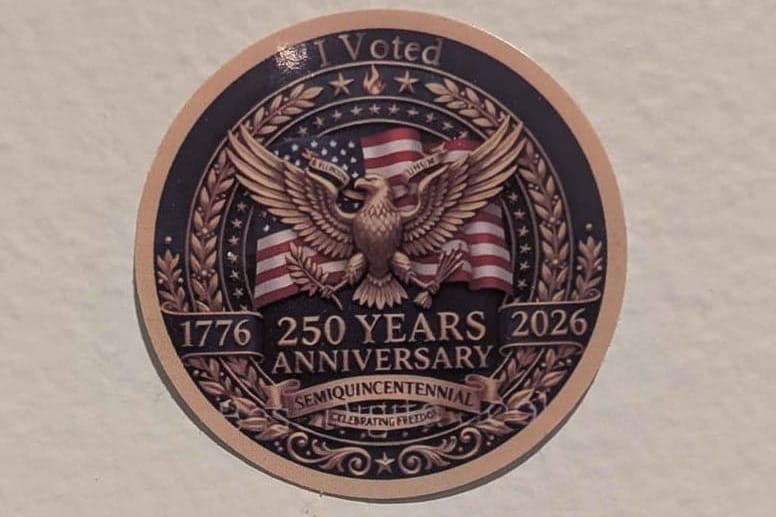
It’s a small pleasure, but receiving an “I Voted” sticker after casting my ballot is one of my favorite parts of the whole voting process. I slap the sticker on my chest and spend the rest of the day feeling like I accomplished a little something. I participated in democracy and everyone who sees me will know it. Artificial intelligence robbed me of that small joy this year and replaced it with a small horror. My “I Voted” sticker is AI-generated slop.
Getting a little sticker when you vote has been a tradition in the US since the 1980s. It’s a symbol of the election cycle. People take selfies and post them or share them with friends. It’s a celebration of democracy and a small way to pressure people into going to the ballot box.
The voting sticker has been subject to every kind of discourse imaginable. Are “I Voted” stickers worth the cost? Wondered Marketplace in 2020. A cemetery in New York has spent time and money tending to the grave of Susan B Anthony because voters coat it in stickers during voting season. In 2008, companies like Starbucks and Ben and Jerry’s ran afoul of election laws for offering free treats to people who showed their “I Voted” stickers.
It’s appropriate but depressing that I got an AI slop “I Voted” sticker in 2026, the year it feels like the mainstream began to reckon with AI.
My sticker is ugly. It’s a busy circular nightmare. “I Voted” is spelled out in small bronze text at the top of the ring. Bronze laurels encircle a bronze bald eagle that stretches atop the American flag. Below this is more text: “250 YEARS ANNIVERSARY” and "SEMIQUENCENTENNIAL.” Below that, another line reads — as best I can tell — “CEKEVPATIVG EDELDOA.” I assume this was meant to say “CELEBRATING FREEDOM," but whoever churned out this slop wasn’t using the latest models and the fine detail is lost.
I put the sticker on reluctantly, but I was not proud. I sent a photo of the offending sticker to journalist friends with my face cropped out. They immediately noticed it was AI-generated. I did not post my sticker online. I shared it with no one else. My democratic joy turned to shame.
A few hours later, a friend sent me a selfie. He’d just left the voting booth. His sticker was beautiful, tasteful, a testament to the subtle art of the “I Voted” sticker. A red ring enclosed a blue field. The crescent and palmetto (symbols of South Carolina) sat elegantly behind a bold white “I VOTED.”
His sticker catches the eye. Passers-by will know exactly what the sticker says. They know he voted. Anyone looking at my sticker will wonder how I spilled some bronze paint on my chest. I trembled with indignation. One town over from me they’re giving out the good stickers and I’m stuck with slop. First my town of 12,000 installs 33 Flock cameras and now this?
I spent some time scrolling through social media to see other “I Voted” stickers. So many are so beautiful. Michigan runs a contest where students can submit their own idea for a sticker and the state will print up the winners. Kentucky, Albany, and several other places around the country do the same. Louisiana commissions local artists to produce gorgeous stickers. My mouth hung up in a jealous scowl as I stared at pictures of New Orleanians bedecked with a sticker showing a hand drawn trumpet blasting out “I Voted” alongside Mardi Gras beads.
Only Denton, Texas (another place I’ve lived, weirdly) seems to also have AI-generated slop stickers. Denton’s sticker is, at least, personalized. The city’s court house is in the corner looking more or less correct. The “I Voted” is large and centered in the sticker itself. Like mine, the image is too busy. Too much text, too many fireworks, and the inclusion of the Liberty Bell clutters the whole thing up. The central message — “I Voted” — is bright white. It doesn’t sink into a busy bronze soup like on my sticker.
Complaining about AI-slop “I Voted” stickers may seem trivial in a world where AIs are choosing targets in warzones and vibecoders are reverse-engineering every piece of software ever written. But these little things are important. These small annoyances pile up until things like ChatGPT flyers are so ubiquitous that you don’t notice them anymore. The AI drive-thru works well enough and one day you stop worrying about it so much. You get an ugly AI slop “I Voted” sticker and you slap it on or toss it out. Enough of these build up until you don’t notice that AI all around you. And then, one day, it’s all normal.
Right now we’re figuring out where our AI lines are. Society is negotiating what the future will look like. We’re fighting data centers, figuring out how to burn tokens to keep our bosses happy, and learning what we will and won’t abide.
Me? I draw the line at AI-generated “I Voted” stickers.