Vue normale

  • ✇Euromaidan Press
  • One pilot, five bombers: Ukraine’s Lasar’s Group ties whole raid to single operator to save manpower
    Ukraine's army doesn't have as extensive human resources as Russia, so it is teaching its machines to do more of the work on their own. Ukrainian developers are building autonomy into aerial and ground drones so the systems take over tasks the operator once did, the defense outlet Oboronka reported. Across reconnaissance, bombing, interception, and ground robots, Ukrainian firms are automating the steps that once tied up a pilot, allowing a single operator to run multip
     

One pilot, five bombers: Ukraine’s Lasar’s Group ties whole raid to single operator to save manpower

22 août 2026 à 16:51

The Droid TW 12.7. Credti: Devdroid

Ukraine's army doesn't have as extensive human resources as Russia, so it is teaching its machines to do more of the work on their own. Ukrainian developers are building autonomy into aerial and ground drones so the systems take over tasks the operator once did, the defense outlet Oboronka reported.

Across reconnaissance, bombing, interception, and ground robots, Ukrainian firms are automating the steps that once tied up a pilot, allowing a single operator to run multiple drones at once.

Automating reconnaissance and mission planning

The heaviest early demand for autonomy is in reconnaissance. Farsight Vision's FSV Platform builds real-time 3D terrain maps from drone imagery for planning assaults and strikes, and models where enemy electronic warfare and radio dead zones lie, so FPV pilots can avoid losing their link.

Meanwhile, Sine Engineering offers "autonomy modules" that let a drone navigate on its own. A Mavic flies to an observation point, works for 30 to 40 minutes, and returns, with the pilot only turning the camera, so one operator can run several drones.

"70 to 80% of the need for autonomy right now is reconnaissance," Sine Engineering CEO Andrii Chulyk said.

Autonomy for bombers and FPVs

Heavy bomber drones waste most of a pilot's time in transit. A bomber's target can sit 35 to 60 kilometers from launch, over 25 minutes each way, and a mass raid needs a pilot per drone, so Lasar's Group uses route-planning software to tie up to five bombers to one pilot, who connects for a few minutes to line up each strike.

A single pilot can carry out bombing runs one after another with a group of bombers, preserving personnel for other missions.

Autonomous FPVs are pricier but far more capable: Chulyk estimated an AI drone that finds and destroys a target in a swarm would cost $2,000 to $3,000, against about $700 for a pilot-flown night FPV with auto-capture.

Sine Engineering argues one automated FPV can replace up to ten simpler drones in hard missions, while The Fourth Law's Maksym Savanevskyi favors adding auto-capture to cheap existing drones, which he says makes a radio-controlled drone two to four times more effective.

"Fire and forget" for interceptors and robots

The hardest problem for interceptor drones is the "last mile", spotting a small target against open sky. The Fourth Law's TFL Anti-Shahed module scans the sky and detects targets at twice the range of the human eye, marking a Shahed so the pilot knows where to fly.

Savanevskyi predicts Ukrainian makers will field automatic Shahed-killing solutions by year's end. That points toward "fire and forget" interception, said Yevhen Lesin of the 412th Nemesis unmanned-systems brigade, though he warned against autonomy for its own sake, noting automated launch from ground robots creates technical problems and needs more people, not fewer.

Ground-robot autopilots remain among the field's hardest tasks: DevDroid's Oleh Fedoryshyn noted it took Tesla ten years to make the car autopilot work. At the same time, frontline dirt roads, cratered and unmarked, are nothing like marked highways, so DevDroid's robots now cross only short link-dead stretches on their own before the operator resumes control.
  • ✇Euromaidan Press
  • Ukraine is buying jam-proof fiber-optic drones for first time to single standard, so any maker can compete
    Ukraine is buying the strike drones that Russian jamming cannot touch, and for the first time, to a common standard. The Defense Procurement Agency (DOT) has announced its first purchase of fiber-optic FPV kamikaze drones built to specifications defined by the Defense Ministry, the ministry announced. By defining the specifications a fiber-optic FPV must meet, the Defense Ministry lets any maker compete by hitting that standard rather than having each model approved ind
     

Ukraine is buying jam-proof fiber-optic drones for first time to single standard, so any maker can compete

22 août 2026 à 01:07

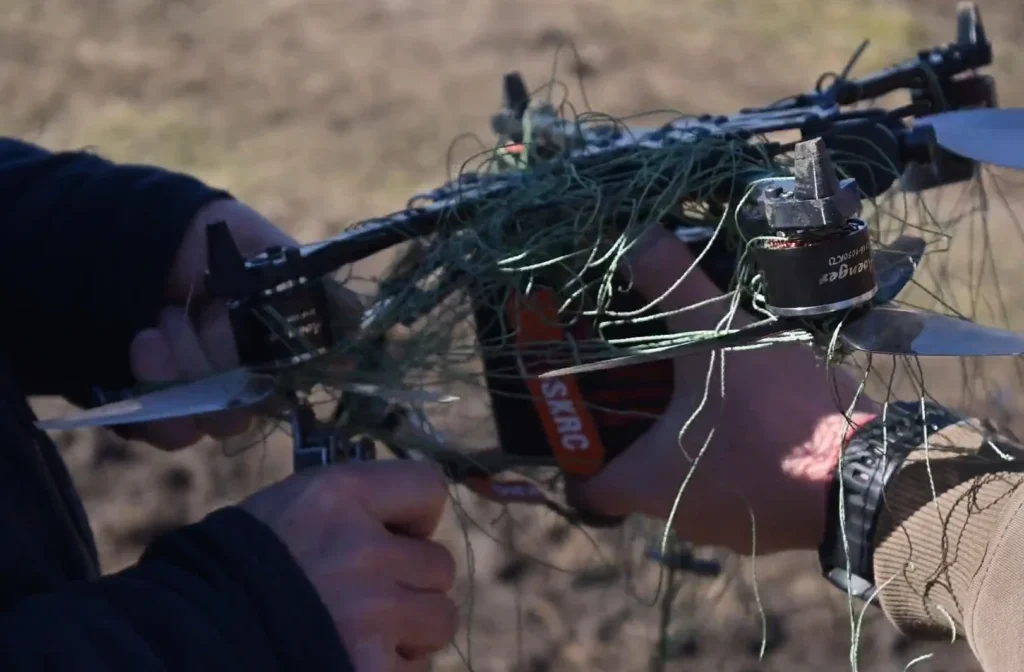
An FPV drone snared by a net fired from a Chipa net gun, developed by BlueBird Tech. Photo: BlueBird Tech via Defense Blog

Ukraine is buying the strike drones that Russian jamming cannot touch, and for the first time, to a common standard. The Defense Procurement Agency (DOT) has announced its first purchase of fiber-optic FPV kamikaze drones built to specifications defined by the Defense Ministry, the ministry announced.

By defining the specifications a fiber-optic FPV must meet, the Defense Ministry lets any maker compete by hitting that standard rather than having each model approved individually.

That is what makes it possible to split the purchase into competing lots among many suppliers, both large and mid-sized, and to buy the jam-proof drones at scale without relying on any single producer.

Why fiber-optic drones matter

The Ukrainian Defense Ministry is looking for a specific type of drone. They use a fiber-optic cable to connect to the operator, and unlike ordinary FPV drones that need a radio signal for control and video, these fiber-optic drones do not depend on the radio channel, so they work far better in the presence of active electronic warfare.

Fiber-optic drones let an operator keep control where radio-controlled drones lose their signal, and Defense Minister Yevhenii Khmara said the drones give Ukraine's forces added ability to disrupt Russian assaults and conduct their own operations, striking enemy manpower.

The standard opens the field to any maker

The buy is not tailored to one producer. It is not conducted for a specific manufacturer or model, and producers can offer their own drones if they meet the defined characteristics, with the drones sorted into classes by parameters such as range (the length of the fiber-optic cable) and camera type.

The lot structure spreads the orders

Deputy Defense Minister Mstyslav Banik said the tender is structured so that various suppliers can participate. Each tender is divided into lots, with four lots per class of fiber-optic FPVs, and no participant may win more than 50% of a class's total volume.

That structure guards supply while also driving competition.

"This creates an environment for healthy competition among manufacturers, and at the same time minimizes the risks of supply disruptions," Banik added.

❌