Vue normale

  • ✇Euromaidan Press
  • One pilot, five bombers: Ukraine’s Lasar’s Group ties whole raid to single operator to save manpower
    Ukraine's army doesn't have as extensive human resources as Russia, so it is teaching its machines to do more of the work on their own. Ukrainian developers are building autonomy into aerial and ground drones so the systems take over tasks the operator once did, the defense outlet Oboronka reported. Across reconnaissance, bombing, interception, and ground robots, Ukrainian firms are automating the steps that once tied up a pilot, allowing a single operator to run multip
     

One pilot, five bombers: Ukraine’s Lasar’s Group ties whole raid to single operator to save manpower

22 août 2026 à 16:51

The Droid TW 12.7. Credti: Devdroid

Ukraine's army doesn't have as extensive human resources as Russia, so it is teaching its machines to do more of the work on their own. Ukrainian developers are building autonomy into aerial and ground drones so the systems take over tasks the operator once did, the defense outlet Oboronka reported.

Across reconnaissance, bombing, interception, and ground robots, Ukrainian firms are automating the steps that once tied up a pilot, allowing a single operator to run multiple drones at once.

Automating reconnaissance and mission planning

The heaviest early demand for autonomy is in reconnaissance. Farsight Vision's FSV Platform builds real-time 3D terrain maps from drone imagery for planning assaults and strikes, and models where enemy electronic warfare and radio dead zones lie, so FPV pilots can avoid losing their link.

Meanwhile, Sine Engineering offers "autonomy modules" that let a drone navigate on its own. A Mavic flies to an observation point, works for 30 to 40 minutes, and returns, with the pilot only turning the camera, so one operator can run several drones.

"70 to 80% of the need for autonomy right now is reconnaissance," Sine Engineering CEO Andrii Chulyk said.

Autonomy for bombers and FPVs

Heavy bomber drones waste most of a pilot's time in transit. A bomber's target can sit 35 to 60 kilometers from launch, over 25 minutes each way, and a mass raid needs a pilot per drone, so Lasar's Group uses route-planning software to tie up to five bombers to one pilot, who connects for a few minutes to line up each strike.

A single pilot can carry out bombing runs one after another with a group of bombers, preserving personnel for other missions.

Autonomous FPVs are pricier but far more capable: Chulyk estimated an AI drone that finds and destroys a target in a swarm would cost $2,000 to $3,000, against about $700 for a pilot-flown night FPV with auto-capture.

Sine Engineering argues one automated FPV can replace up to ten simpler drones in hard missions, while The Fourth Law's Maksym Savanevskyi favors adding auto-capture to cheap existing drones, which he says makes a radio-controlled drone two to four times more effective.

"Fire and forget" for interceptors and robots

The hardest problem for interceptor drones is the "last mile", spotting a small target against open sky. The Fourth Law's TFL Anti-Shahed module scans the sky and detects targets at twice the range of the human eye, marking a Shahed so the pilot knows where to fly.

Savanevskyi predicts Ukrainian makers will field automatic Shahed-killing solutions by year's end. That points toward "fire and forget" interception, said Yevhen Lesin of the 412th Nemesis unmanned-systems brigade, though he warned against autonomy for its own sake, noting automated launch from ground robots creates technical problems and needs more people, not fewer.

Ground-robot autopilots remain among the field's hardest tasks: DevDroid's Oleh Fedoryshyn noted it took Tesla ten years to make the car autopilot work. At the same time, frontline dirt roads, cratered and unmarked, are nothing like marked highways, so DevDroid's robots now cross only short link-dead stretches on their own before the operator resumes control.
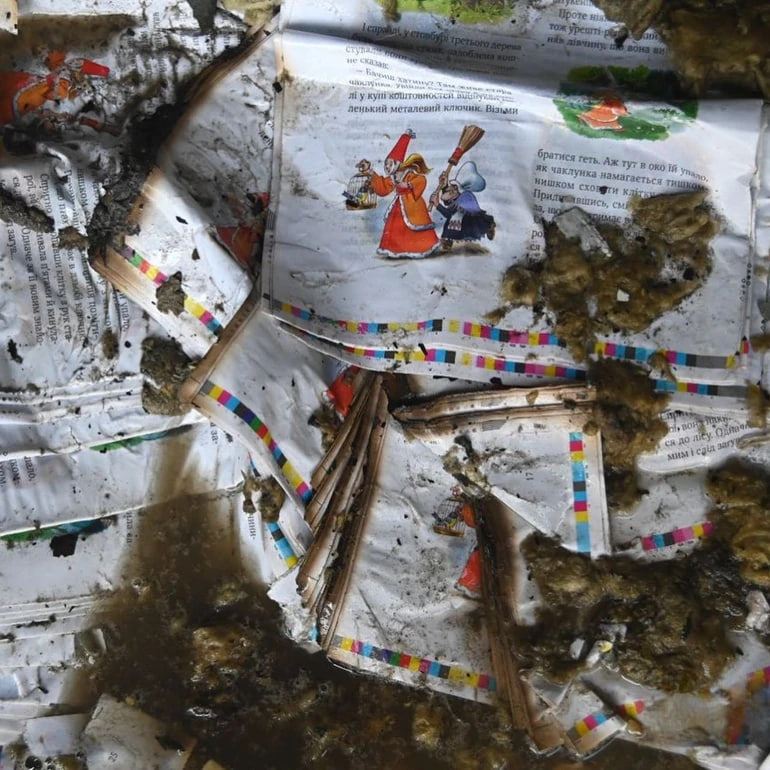
Russia has burned 13 million Ukrainian books in three months, nearly third of everything country printed in 2025

22 août 2026 à 08:31

The burnt books in Kharkiv may 2024

Russia has destroyed so many Ukrainian books this summer that the industry says it is fighting to survive. Russia has burned about 13 million books in three months, and the Ukrainian Publishing Association has asked President Volodymyr Zelenskyy to convene a meeting of the National Security and Defense Council on the state and recovery of the publishing industry, association head Artem Bidenko said.

The number of books lost amounts to nearly a third of the 33.21 million copies Ukrainian publishers printed in all of 2025. The whole book market turns over about to $169–193 million a year, roughly the revenue of a single mid-sized shopping mall, so strikes have pushed a small, vulnerable sector toward collapse.

The strikes have become systematic

Russia has hit Ukraine's printing capacity repeatedly. On 23 May 2024, a Russian missile struck the Faktor-Druk printing house in Kharkiv, killing seven workers as they printed children's books at a plant that produced roughly a third of all books in Ukraine, and earlier strikes destroyed the capacity of Pobutelektrotekhnika, one of Ukraine's largest printers.

This summer, the attacks have turned systematic. Russian strikes destroyed the Konvi printing house, and another hit a Kharkiv warehouse storing products of the Ranok publisher and the KnyhoLend chain, destroying about 8 million books, including 620,000 textbooks, with damage from that single strike estimated at $24 million. Direct losses to the industry now stand at at least $29 million, which the association believes understates the real figure.

The damage runs across the whole market

The strikes have hit retailers and publishers alike. This year, Russian attacks damaged Kyiv's Pochaina book market, the Alpaka bookstore, a Knyharnia Ye store in Podil, and Ranok's Kyiv logistics, and harmed the publishers Nash Format, Laboratoria, and BookChef, among others.

The sector was already tiny. As of August 2026, the total floor space of all of Ukraine's brick-and-mortar bookstores only slightly exceeds the area of six football fields, according to the Ukrainian Book Institute, and the industry projects that total print runs may fall by 15% this year and sales by a quarter.

After a fire at the RNK-Ranok warehouses on 1 August, the institute estimated that total losses amounted to about 30% of Ukraine's annual book output.

Publishers say existing support does not reach them

The association says current mechanisms miss the industry's main asset. A war-risk compensation program in effect since 1 January 2026 covers real estate but not goods in circulation or finished products. For publishers, this means the book print runs that are among their principal assets. The program only compensates property destroyed after a firm joined the program in higher-risk areas.

The association asked for measures it says need no billions and face no legal obstacle:

  • war-risk insurance extended to book stocks
  • affordable loans to rebuild printing capacity
  • restored state purchasing of books for libraries, suspended in 2022.

For 2026, only $627,000 was allocated to fund up to 75 books, while libraries in only about 21% of communities are refreshed annually, and Russian-language books still account for more than 40% of library holdings.

If Ukrainian publishers disappear, the association warns, foreign companies focused on commerce could take their place, ending the support for Ukrainian authors and identity that domestic publishing provides.

❌