
 Connexion
The Marta effect: Ukraine’s tennis players are doing what its diplomats can’t
Only a couple of days after the Russian invasion in February 2022, a group of Ukrainian female tennis players – Elina Svitolina, Marta Kostyuk, Lesia Tsurenko and Dayana Yastremska - published an open letter harshly criticizing the Women's Tennis Association (WTA).
That was the first step in a campaign against tennis and the world conducting business as usual with Russia after its invasion of Ukraine.
"By 2026, a combination of sporting excellence, authenticity, and modern media influence has made the Ukrainian female tennis players possibly Ukraine's most effective unofficial ambassadors."
Back in 2022, the Ukrainian women players called for stronger sanctions, a condemnation of the invasion, and declared that they would not play any Russian or Belarusian players unless the WTA made them compete as neutral athletes - no flags, no promotion of Russia or Belarus.
At that point, only Elina Svitolina – with a ranking as number 15 in the world – was an established star, the rest hovered between 50 and 150, young and inconsistent.
This coordinated and very public action from the Ukrainian players directly prompted the WTA and the ATP – in charge of men’s tennis - to change their policy within 24 hours.
Soon after, the Ukrainians also made it clear that they would not be doing the customary pre-match handshake with Russian and Belarusian players.
"What would Ukraine soldiers think if I shook hands with Russians?”, as Elina Svitolina formulated it.
Since then – for almost four-and-a-half years - there has been no handshakes – nor love lost – between Ukrainian and Russian/Belarusian tennis players.
Letting Russia back in
The outrage against the shocking Russia invasion was strong in most places around the world at that point. In 2022.
Since then, slowly but certainly – naturally, perhaps - the war in Ukraine has slipped down the international agenda. And Russian athletes are now, slowly but surely, being welcomed back by many international sports federations—such as gymnastics, aquatics, skating and weightlifting. Despite that fact that nothing has changed - Russia is still occupying close to 20% of Ukraine and bombing the rest of the country almost every night.
Vladimir Putin himself has said Russia is planning to intensify the attacks to force Kyiv to surrender. The last few weeks have seen the war’s worst missile attacks on Ukraine, with 31 people being killed in Kyiv on 1-2 July.
Nevertheless, this past weekend, The International Olympic Committee (IOC) cleared the way for Russian athletes to return to Olympic competition.
But this Spring and Summer have seen a striking campaign of the Ukrainian tennis women against this normalization of the Russian invasion. A campaign that in some ways is a continuation of their initial protests in 2022.
Their renewed campaign is more sophisticated and directed against the idea that neutrality in the face of war crimes can be acceptable.
A combination of sporting excellence, authenticity, and modern media influence has made the Ukrainian female tennis players possibly Ukraine's most effective unofficial ambassadors. Against the backdrop of an ugly, old, corrupt dictator who keeps murdering innocent Ukrainians.
The best example is the 24-year old Marta Kostyuk who Wednesday qualified for the semifinals at Wimbledon.
But before we get to Marta, let us look at how these young Ukrainian women became the country’s most efficient spokes people.
More Russian bombs = attention
Timing is everything - not just in sport, but also if you want to attract attention, to use your platform, to have a political impact.
This Spring was the deadliest months for Ukrainian civilians, with April and May recording the highest civilian casualty toll since April 2022, according to the UN.
At least 274 civilians were killed and 1,763 injured in Ukraine in May 2026, and 238 were killed in April.
So when the tennis world number one, the Belarusian Aryna Sabalenko, strives to stay neutral – “"Nobody supports war. If we could stop it, we would. Unfortunately, it's not in our hands" – it does not fall well with her Ukrainian opponents, least of all with Marta Kostyuk:
"She has a big platform... and she's rejecting her responsibility."
"I feel like journalists should change the questions that you ask these athletes because the war is already there."
In May, when Ukraine's Oleksandra Oliynykova – number 50 in the world rankings - faced Russia's Diana Shnaider at the French Open, we witnessed a very public collision between two visions of what sport is supposed to be during wartime.
A couple of days earlier, as a result of a Russian attack at least 22 people had been killed across Ukraine. Diana Shnaider shied away from any comments on anything but tennis, but her Ukrainian opponent was not having it.
Before the match, Oliynykova criticised Shnaider's appearance at a Gazprom-sponsored exhibition match in Russia last year, and she pointed out Shnaider's social media activity—what Oliynykova described as liking "pro-Kremlin" and "pro-war" posts.
Oliynykova described Gazprom as "a company which is financing war crimes" and compared playing at such an event to "playing in Nazi Germany for Gestapo officers, on the tournament organized by a company which built Auschwitz."
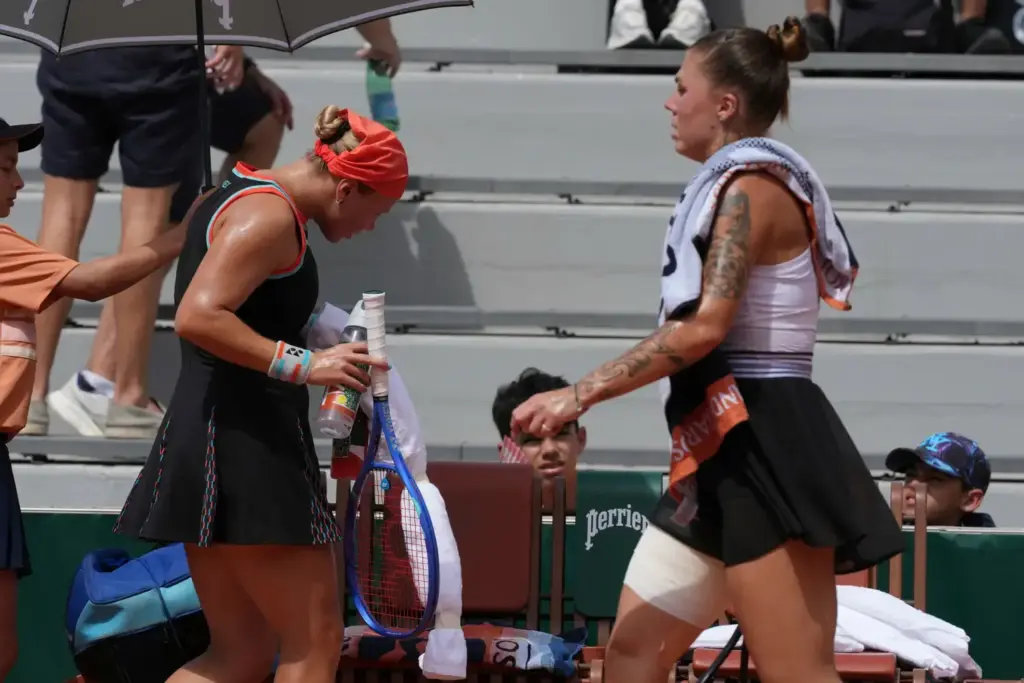
No love lost between Ukraine's Oleksandra Oliynykova and Russia's Diana Shnaider during The French Open tennis tournament in Paris, Saturday, 30 May 2026. AP Photo/Thibault Camus/Eastnews
Oliynykova continues to live and train in Kyiv. Her father and her boyfriend have both volunteered for the Ukrainian army.
"My home is being attacked by Gazprom money," she said.
Talent gives you a platform
Another essential factor has been the fact that the Ukrainian women right now are storming the world rankings.
Using your platform for politics is somewhat easier when you are playing finals and semifinals.
Elina Svitolina is ranked 8th in the world, Marta Kostyuk – with her success these past two weeks at Wimbledon – is now 10th, and Ukraine has a further 5 players in top 100.
But journalists get tired of writing the same story again and again, repeating the same questions. Even to the best in the world. So flamboyant tattoos, fashionable tennis outfits and flair for using social media helps.
And, again, against the backdrop of a Russian dictator who keeps killing innocent Ukrainians sleeping in their beds.
And nope, the point here is not that these women “use” their beauty to get attention. Not at all.
The point is that these young Ukrainian women are using the “weapons” they have at their disposal, very, very efficiently:
The athlete as diplomat: By consistently refusing symbolic gestures such as handshakes with Russian and Belarusian, forcing the tennis world—and viewers—to confront questions it often prefers to avoid.
A new generation of Ukrainian identity: these women have grown up and had their career during wartime. (I hope I don’t have to remind you that Putin, in fact, first invaded Ukraine in 2014.) Their public identity isn't simply "she is a tennis player from Ukraine" – no, being Ukrainian is absolutely central to how they present themselves.
The complete modern package: Tennis alone rarely creates global influence today. These Ukrainian players combine:
- elite athletic ability
- youth
- media fluency
- fashion appeal
- a strong social media presence
- and a willingness to express political opinions
- humanizing Ukraine beyond headlines. Rather than speaking as a politician, they speak as women in their twenties whose peers around the world follow them
That is a combination that brands, journalists, and audiences notice.
The Marta Effect
Nobody illustrates this coming together of factors better than 24-year old Marta Kostyuk.
She is using her “weapons”, her position on the tennis stage and industry, to openly criticize tennis’ governing bodies, she questions the neutrality policies, and she challenges fellow players to take a stand.
Journalists know she'll give substantive answers, and that makes her newsworthy.
Kostyuk was, in fact, a teenage prodigy - reaching the third round of the Australian Open at the age of only 15. But injuries, inconsistency and, of course, the Russian invasion of her country have held her back. She spent several years fluctuating outside the elite, typically between the top 30 and top 70 in the world.
She showed flashes of brilliance but lacked the consistency to break through.
This year, Kostyuk has finally fulfilled the promise many believed was inevitable. Kostyuk won her first WTA 1000 title in Madrid in April and reached her first Grand Slam semifinal at the French Open in May, and has now followed that up at Wimbledon.
Her tennis credentials cannot be questioned. But add to this that she is approachable, attractive and charming, with flawless English.
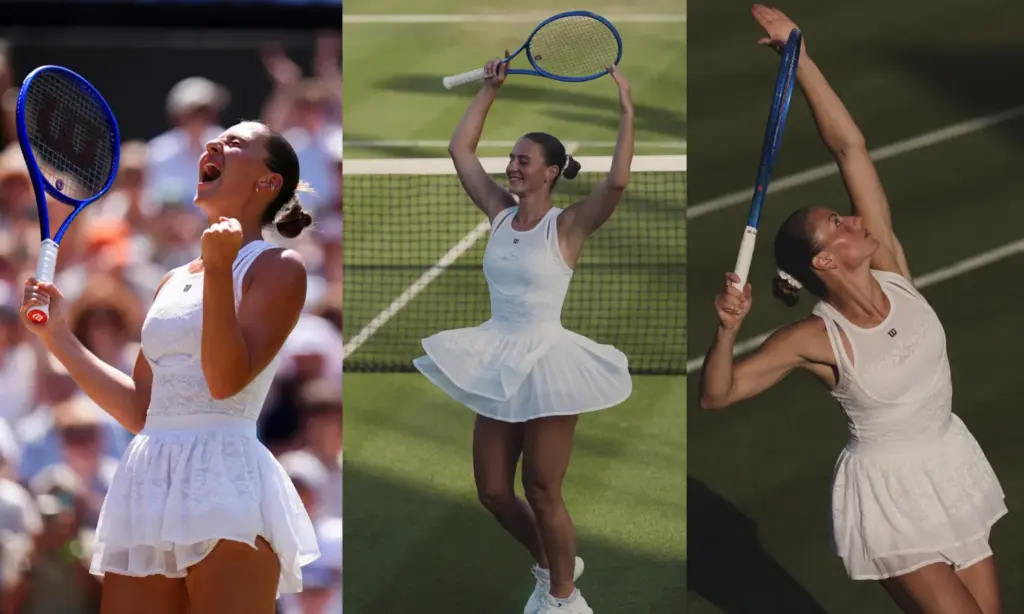
Last week, as Wimbledon started, Marta entered the Centre Court – the holiest of the holiest grounds in tennis – twirling, demonstrating a haute couture tennis outfit modelled on her wedding dress.
Kostyuk twirling has now become “her thing” – but then she proceeds to the packed press conference where she invariably thunders against the Russian invasion of her country, and lambasts those who pretend to be neutral.
In May, Kostyuk reached the semi-final in Paris - after a win over Elina Svitolina - at 31 “the grand old lady of Ukrainian tennis - in what was the first all-Ukrainian women's quarter-final at a Grand Slam.
Kostyuk did her on-court interview with tears running down her cheeks. She dedicated the win to Ukraine, referring directly to the previous night's Russian attack on Kyiv:
"So many people are dead," she said. "I want to give this to the Ukrainian people."
At her press conference the next day, asked about her Russian opponents, she went further:
"They are all grown-ups. They know what's going on. They have phones. They have Instagram. They have news… I wish there was some more clear stance on what's going on, especially when your country is killing other people.”
“I don't know how you can sleep at night peacefully when you know that this is going on, and you have nothing to say about it."
After her quarter-final triumph over Jasmine Paolini on Wednesday, Kostyuk again spoke extensively about the war in Ukraine during her post-match press conference.
She now plays her first Wimbledon semifinal, Thursday, against Linda Noskova of the Czech Republic.
Asked about the decision of The International Olympic Committee to let Russians compete at the Los Angeles Olympics in 2028, Kostyuk did not mince her words:
“It is terrible and I think it is very, very far from fair play…. I 100% do not agree with this decision, but a lot of people spoke out on this issue and they (IOC) obviously don’t agree as well. I don’t think anything is going to change. I just want to go out there and hopefully beat every single Russian I play in the Olympics and that’s it.”
Again, her remarks figured prominently in international media.
Kostyuk wants to use her platform, she told reporters in Paris, to make sure that the world does not get to look at Russia’s invasion of her country as “normal”:
"The biggest thing I can do is sit here and talk about it so more people can find out about it so they don't get used to this terrible life."
In another era, Marta Kostyuk might simply have become an excellent tennis player. In the age of Instagram, 24-hour news and digital diplomacy, she has become something else: a sporting icon whose talent, intelligence, elegance and uncompromising advocacy combine to make her one of Ukraine's most effective unofficial ambassadors.
That is the Marta Effect.
