Vue normale

  • ✇Euromaidan Press
  • Storm Shadow maker MBDA to help develop new Neptune cruise missile with Ukraine
    MBDA, the developer of the Storm Shadow cruise missile, will help Ukraine develop a next-generation Neptune cruise missile, the company announced in a press release.  Modified Neptune anti-ship missiles famously sank the Russian Black Sea Fleet flagship, the Moskva, in April 2022. These were later upgraded for use against land targets, greatly boosting their range and payload size. Ukraine has extensively used Storm Shadow (or SCALP) missiles to strike Russian targets t
     

Storm Shadow maker MBDA to help develop new Neptune cruise missile with Ukraine

17 juin 2026 à 06:58

Russo-Ukrainian war Romania intends to collaborate with Ukraine on developing R-360 Neptune anti-ship missiles. The partnership aims to control Black Sea waters post-war.

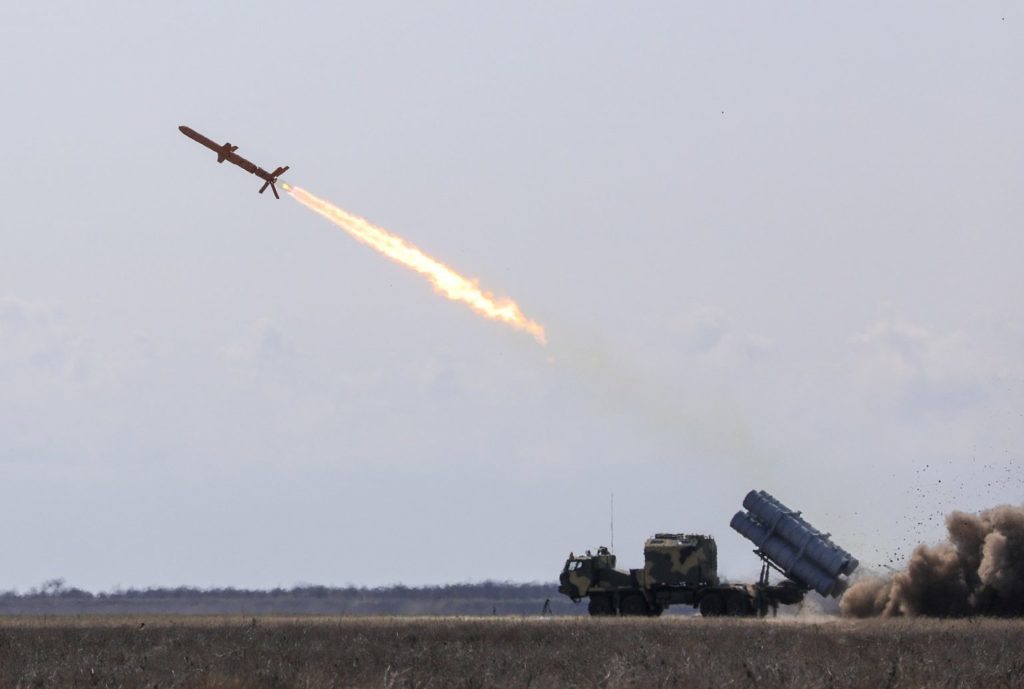
MBDA, the developer of the Storm Shadow cruise missile, will help Ukraine develop a next-generation Neptune cruise missile, the company announced in a press release. 

Modified Neptune anti-ship missiles famously sank the Russian Black Sea Fleet flagship, the Moskva, in April 2022. These were later upgraded for use against land targets, greatly boosting their range and payload size. Ukraine has extensively used Storm Shadow (or SCALP) missiles to strike Russian targets throughout the full-scale war. 

The Neptune’s producer, the Luch Design Bureau, signed a memorandum of understanding with MBDA on 16 June to “pursue disruptive innovation to develop the deep strike capability for Neptune 2 while advancing strategic defence cooperation with Ukraine.” 

The announcement comes at a time when Ukraine continues to ramp up long-range strikes against Russian air defenses, logistics hubs, refineries, military factories, and other targets that enable the invasion, while building up and scaling its drone and missile strike options.  

Luch produces a range of guided missiles for anti-ship, anti-tank, anti-air, and anti-ground roles, as well as the components that go into them.

MBDA is a multinational European defense contractor, which has its hands in two dozen families of missiles in its portfolio, from the tactical Brimstone to the SAMP/T air defense platform produced jointly with Thales. 

Neptune cruise missile

The original Neptune has a reported range of 280 kilometers, able to carry a 150-kilogram warhead. The "Long Neptune" has a reported range of over 1,000 kilometers, with a 260-kilogram warhead, able to hit targets on both land and sea.   

Just as importantly, this newer version is reportedly capable of hugging even hilly terrain and close to its targets without satellite navigation, which makes it harder to bring down.

In October, Ukraine's Defense Ministry also presented a newer version equipped with what appear to be additional fuel reservoirs.

The memorandum announcement did not mention any details about what the next-gen Neptune 2 might look like. However, if developed and proves to be effective, it may add another tool into Ukraine’s arsenal to strike at Russia’s economic and military pressure points to disable its war machine by acupuncture. 
  • ✇Euromaidan Press
  • Ukraine develops blackout missile that plunges onto Russian grids from high-altitude balloons
    Ukraine already flies high-altitude aerostats over Russia and now a company has developed a new missile to drop from them onto Russian infrastructure.  The DART missile, designed by Ukrainian company Center of Innovative Technologies Program, is designed to plummet from an altitude of 12-18 km, guided by an onboard navigation system until it reaches 6 km.  At this point, the navigation shuts down, the solid fuel engine activates, and the missile burns towards the tar
     

Ukraine develops blackout missile that plunges onto Russian grids from high-altitude balloons

17 juin 2026 à 05:58

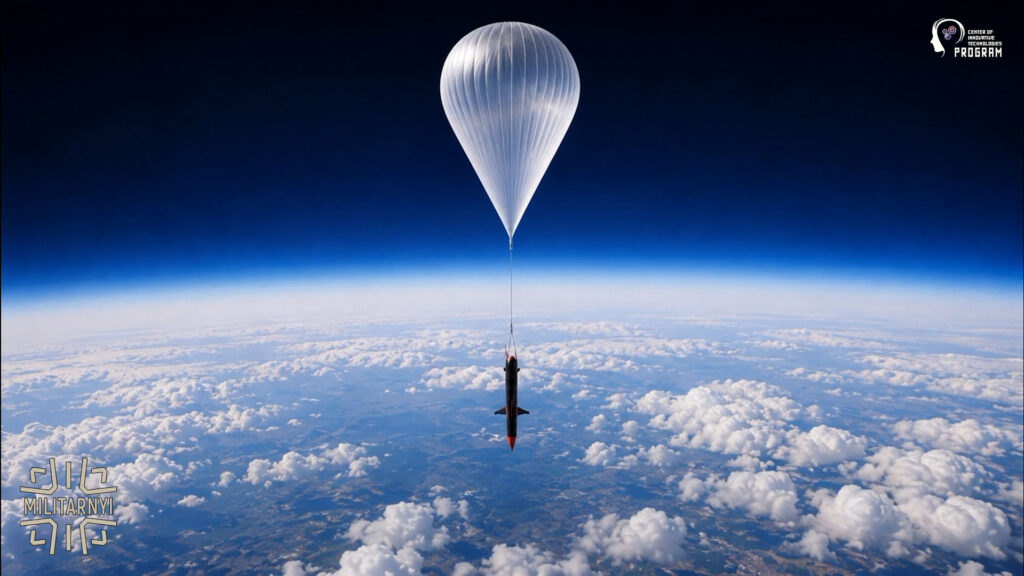
Illustrative render of the DART missile via aerostat. (Rendering: Center of Innovative Technologies Program)

Ukraine already flies high-altitude aerostats over Russia and now a company has developed a new missile to drop from them onto Russian infrastructure. 

The DART missile, designed by Ukrainian company Center of Innovative Technologies Program, is designed to plummet from an altitude of 12-18 km, guided by an onboard navigation system until it reaches 6 km. 

At this point, the navigation shuts down, the solid fuel engine activates, and the missile burns towards the target without changing course. This is meant to prevent interference from electronic warfare. 

The payload reportedly masses up to 10 kilograms and uses “graphite elements.” This likely means that the DART is a kind of graphite bomb, which disperses electrically conductive filaments that are meant to short out electrical grids. 

In April, Russian sources claimed that Ukrainians used graphite payloads mounted on drones to attack infrastructure in occupied areas, which Ukrainian forces neither confirmed nor denied.

The missile has not yet passed codification, but is reportedly due for trials “in the near future.” 

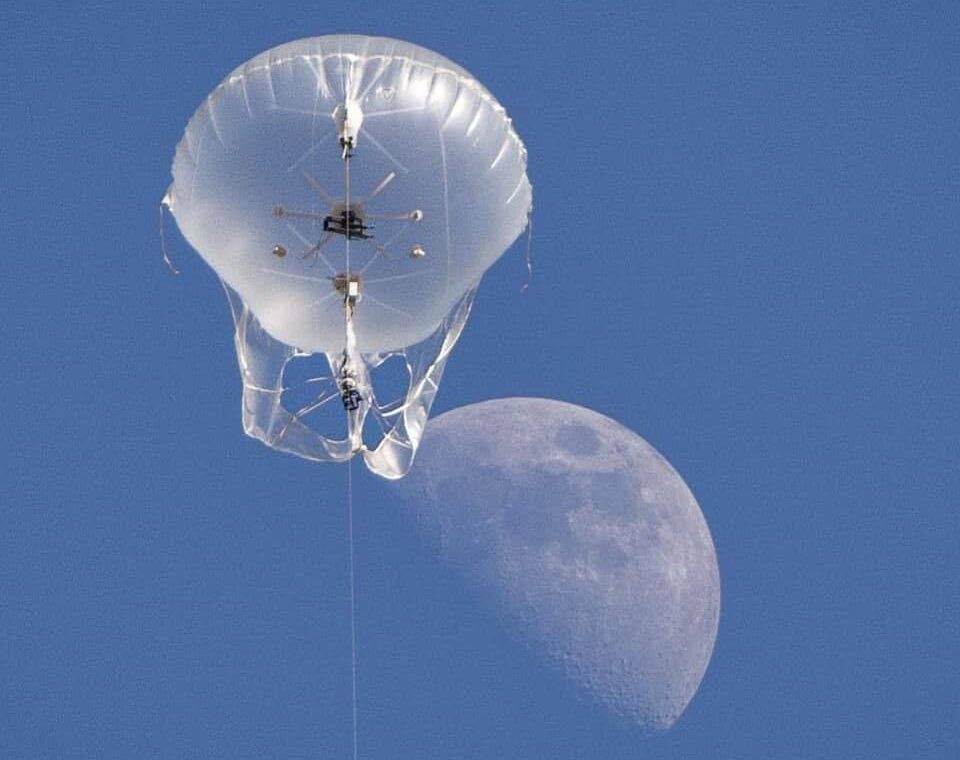
Aerobavovna aerostats
Explore further

Weaponizing the Westerlies: Ukrainian balloons sow havoc over Russia

Aerostats as launch platforms

Untethered aerostats have participated in strikes on the deep rear of Russia since 2024, but have become ever more active in 2025-2026, targeting refineries, railways, and other infrastructure. The words “aerostat notice” appeared hundreds of times on Russian Telegram channels that monitor Ukrainian air threats from Fall 2025 through Spring 2026. 

They are cheap, easy to deploy, are carried into Russia by prevailing winds, and can reach extremely high altitudes, making them difficult to shoot down, not that the Russians aren’t trying. One source told Euromaidan Press that once the Russians detect an aerostat, they fire everything at it, from Pantsirs, Tors and Buks, to even their S-300 and S-400 missiles.

The balloons can carry signal repeaters that extend over 100 kilometers, which can be daisy chained together to provide continual control for long-range weapons. Alternatively, they can carry drones and missiles like the DART deep into Russia’s rear, to then strike targets from any direction.

Being at the mercy of the wind does make the initial launch location somewhat unpredictable, but sources told Euromaidan Press that sufficient meteorological modeling exists to make them viable platforms for surveying or attacking Russia.

❌