Vue normale

  • ✇Coda Story
  • The AI-powered ‘forever wars’ start now
    Between them, the United States and Israel struck more than 2,000 targets within the first 24 hours of their war with Iran. For even the largest militaries, it is an almost impossible task to identify, select and then precisely locate such a high volume of targets. But the U.S. military had some help. Claude, the “next generation AI assistant” built by Anthropic, was used in the planning of ‘Operation Epic Fury’. This, even though the Department of War recently labeled Anthropic a “supply cha
     

The AI-powered ‘forever wars’ start now

6 mars 2026 à 08:55

Between them, the United States and Israel struck more than 2,000 targets within the first 24 hours of their war with Iran.

For even the largest militaries, it is an almost impossible task to identify, select and then precisely locate such a high volume of targets. But the U.S. military had some help. Claude, the “next generation AI assistant” built by Anthropic, was used in the planning of ‘Operation Epic Fury’. This, even though the Department of War recently labeled Anthropic a “supply chain risk”.

Anthropic is one of the world’s leading AI companies. Together with Palantir, another Big Tech company, it has been working since 2024 with the Pentagon to embed its systems in military decision-making – creating what is arguably the operating platform of present-day U.S. warfare and intelligence. Even though secretary of defense Pete Hegseth said the company “delivered a master class in arrogance and betrayal” and that the government would “cease all use of Anthropic's technology,” the company is too integrated into modern U.S. warfare for it not to be essential to the U.S. attack on Iran. The question might be not whether companies like Anthropic can ringfence their tech but whether the Pentagon might just commandeer it. 

Craig Jones, an academic who studies automated kill chains at the University of Newcastle, has told reporters that “the AI machine is making recommendations for what to target, which is actually much quicker in some ways than the speed of thought.” Similar AI systems have been used by Israel to coordinate its bombing campaign in Gaza, which is among the most destructive in human history. 

Among the first hits in the United States and Israel’s aerial bombardment of Iran was the Shajarah Tayyebeh primary school for girls, in the southern town of Minab. It was a Saturday morning, and school was in session. According to Iranian state media, at least 165 people were killed, mostly young girls between the ages of seven and 12. Another 96 were severely injured. Eyewitness and open source intelligence reports corroborate the claims of mass civilian casualties. Both Iran and Israel have denied responsibility. The United States has said it is “looking into” allegations that the school was destroyed by one of its missiles. Maybe, given the volume of the bombardment, they’ve lost track. 

It is too soon to know why the school was targeted – or whether it was an error. Either way, the U.S. military’s reliance on AI raises difficult questions.

AIs get things wrong all the time. Maybe it’s an extra finger in an AI-generated image, or a ‘hallucinated’ reference in a research report. Or, maybe, an algorithm sends a missile to the wrong address. That’s why Anthropic CEO Dario Amodei has said that weapons “that take humans out of the loop entirely and automate selecting and engaging targets” are simply not reliable enough. That position — along with Anthropic’s refusal to allow Claude to be used for mass domestic surveillance (although they are just fine with foreign surveillance) — led to the Pentagon cancelling a $200-million contract with the company on Friday, the day before the attacks on Iran began. The Department of War immediately signed a new deal, minus any ethical guardrails, with OpenAI.

Anthropic’s confrontation with the Pentagon has burnished its reputation as an “ethical” AI company. But it may have found its ethical backbone too late. Critics argue that even within Anthropic’s “red lines”, there is enormous potential for abuse, while a “human in the loop” does not necessarily prevent mistakes — raising questions about who, exactly, is responsible when these mistakes result in fatalities. Francesca Albanese, the United Nations special rapporteur for Palestine, accused Amazon, Google and Microsoft in a 2025 of being “complicit in genocide” for providing cloud storage systems to the Israeli military. Anthropic’s integration into the U.S. military has been much deeper.

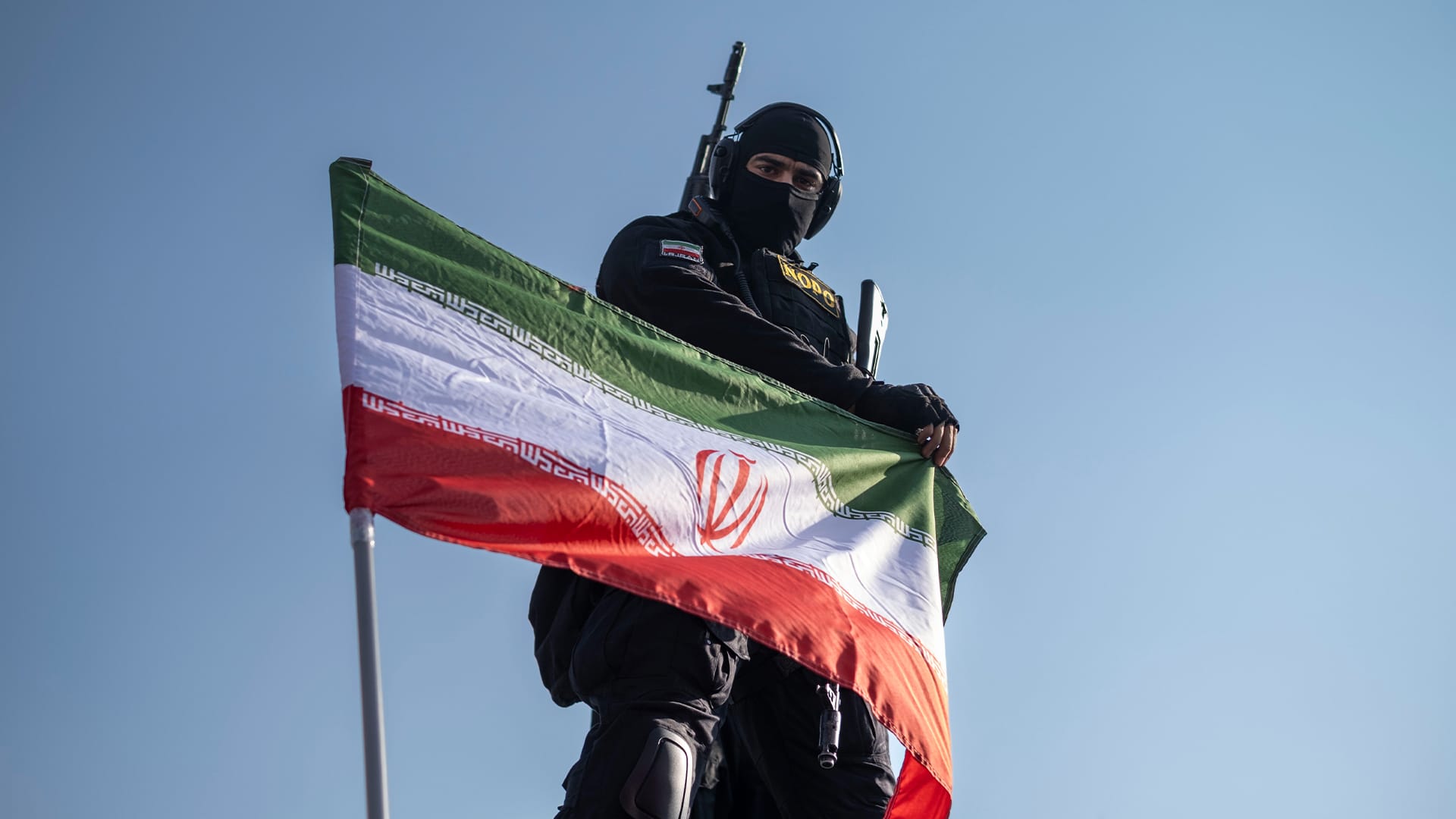
While Israel and the U.S. are waging an AI-powered war, Iran is responding with a technological revolution of its own. The Islamic Republic has pioneered the production of low-cost one-way attack drones, most notably the Shahed-136, which costs just $34,000 to produce and as much as $4 million to shoot down. These are battle-tested: Russia has launched an estimated 57,000 Shahed-type drones in its war against Ukraine. Despite U.S. reliance on its own high-tech AI-powered systems, an American version of the Shahed also made its debut, alongside Claude, in the attack on Iran. 

In response, Iran has aimed more than 1000 drones at neighboring Gulf states since the war broke out on Saturday. Hundreds have been shot down, but even the most sophisticated air defences struggle with this sheer volume, and dozens have struck their targets, threatening to prolong this war and cause more damage to U.S. allies than anticipated. It is significant that these targets included at least three Amazon data centers in Dubai and Bahrain. Just last month, Amazon announced that it was making Anthropic’s Claude available to its Middle Eastern customers. Claude experienced two global outages this week — it is not clear if these were related to the data center attacks. 

Tech evangelists promise that artificial intelligence will, one day, cure cancer, end poverty and greatly increase our quality of life. But the new technology’s most obvious impact has been on warfare. For those with access to them, AI systems like Claude make it dramatically easier to bomb hundreds of targets at the same time — and much harder to figure out who is accountable when something goes wrong. On Truth Social, Donald Trump — who has promised to stop wars, not start them — posted approvingly that technology and munitions now mean Wars “can be fought ‘forever,’ and very successfully.” 

As the bombing of Iran continues, we are not far from a time when AI not only parses data to select targets, it actually chooses when to pull the trigger. And advanced AI models have far fewer qualms, for instance, about deploying nuclear weapons than humans faced with similar scenarios. One day, when — if — war crimes investigators are able to pin down exactly who is responsible for killing dozens of young girls in Minab, tech bosses may find themselves implicated alongside military and political leaders. “The AI did it” can’t be their defense.


A version of this story was published in this week’s Coda Currents newsletter. Sign up here.

The post The AI-powered ‘forever wars’ start now appeared first on Coda Story.
  • ✇Coda Story
  • The strike, the illusion of regime change, and what comes next
    That Iran's Supreme Leader, Ayatollah Ali Khamenei, should disappear, or be disappeared, from the scene was not a novel notion.  Throughout my nearly five years in Tehran at the turn of this century, speculation about his health and longevity was a near-constant background hum. He was reported, or rumoured, to be mortally stricken by prostate cancer, his constitution already weakened by an assassination attempt in 1981 that left his right arm largely useless. Who would succeed him was far f
     

The strike, the illusion of regime change, and what comes next

Par : Jim Muir
2 mars 2026 à 03:34

That Iran's Supreme Leader, Ayatollah Ali Khamenei, should disappear, or be disappeared, from the scene was not a novel notion. 

Throughout my nearly five years in Tehran at the turn of this century, speculation about his health and longevity was a near-constant background hum. He was reported, or rumoured, to be mortally stricken by prostate cancer, his constitution already weakened by an assassination attempt in 1981 that left his right arm largely useless. Who would succeed him was far from clear, and the object of further speculation. 

As he lived on into more recent times, reaching the same age of 86 attained by his predecessor – the Islamic Republic's founding father Ayatollah Ruhollah Khomeini – the prospect of his demise became a more immediate issue, though the question of succession remained equally shrouded in uncertainty. As Supreme Leader, Ayatollah Khamenei was the commanding voice behind the ruthless crackdown that took the lives of tens of thousands of citizens early this year in the latest and greatest of many escalating protests, at which the slogan "Marg Bar Diktator!" — Death to the Dictator! — became an increasingly prominent slogan. 

Their wish was confirmed to be true at 5 a.m. local time on Sunday morning by Iranian broadcasters. The previous morning, Khamenei’s compound in Tehran was demolished as the Israeli-American onslaught got under way while the Ayatollah was heading a meeting of the Defence Council. That ensured that top military figures were also killed, including the commander of the Revolutionary Guards, Mohammad Pakpour, the Army Chief of Staff Abdolrahim Musavi, and Khamenei's top military adviser, Ali Shamkhani, who had been wounded but survived the attack in June last year. 

The Iranian leadership appears to have been caught by surprise, as it was last year when the opening Israeli strike, which culled many top military leaders as well as nuclear scientists, was launched between two rounds of indirect negotiations between Iran and the U.S. Oman, which was mediating the talks, was furious then, denouncing Israel as the real destabilising factor in the region. 

Perhaps the Iranian leaders — and the Omani mediators — thought that such a dirty trick could only be pulled once. But it has happened again, with no evidence that the talks in Geneva had broken down. The chief Omani negotiator, Badr Albusaidi, was livid. Only hours before the strike, he was in Washington for meetings “to explain that a peace agreement between the U.S. and Iran is now within reach. No nuclear weapons. Not ever. Zero stockpiling. Comprehensive verification. Peacefully and permanently. Let’s support the negotiators in closing the deal.”

After learning of the attack, he expressed his outrage in another tweet: “I am dismayed. Active and serious negotiations have yet again been undermined. Neither the interests of the United States nor the cause of global peace are well served by this. And I pray for the innocents who will suffer. I urge the United States not to get sucked in further. This is not your war.”

But Donald Trump and the U.S. were already thoroughly sucked in, and it was indeed their war, or at least his. According to the Israelis, the date had been decided jointly weeks before, after months of planning. Which meant that the Geneva negotiations, focused on the nuclear issue, were simply deceptive camouflage designed to give time for the U.S. to complete the marshalling of its biggest naval and air buildup in the region since the 2003 invasion of Iraq. 

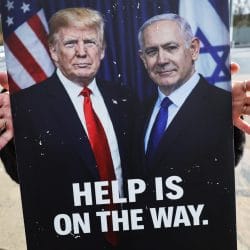
Trump and the Israeli prime minister Benjamin Netanyahu soon made it clear that the campaign now had little to do with the niceties of Iran's nuclear programme: the agenda was regime change in Tehran, and a surprise attack to decapitate the regime was an essential element. 

With Iran's air defences largely taken out in last year's 12 days of war, it was like shooting fish in a barrel. Hundreds of air, missile and drone strikes were carried out on missile launchers, military bases and other targets around the country, with inevitable "collateral damage", including a girl's primary school in the southern town of Minab where scores of children were reported killed.

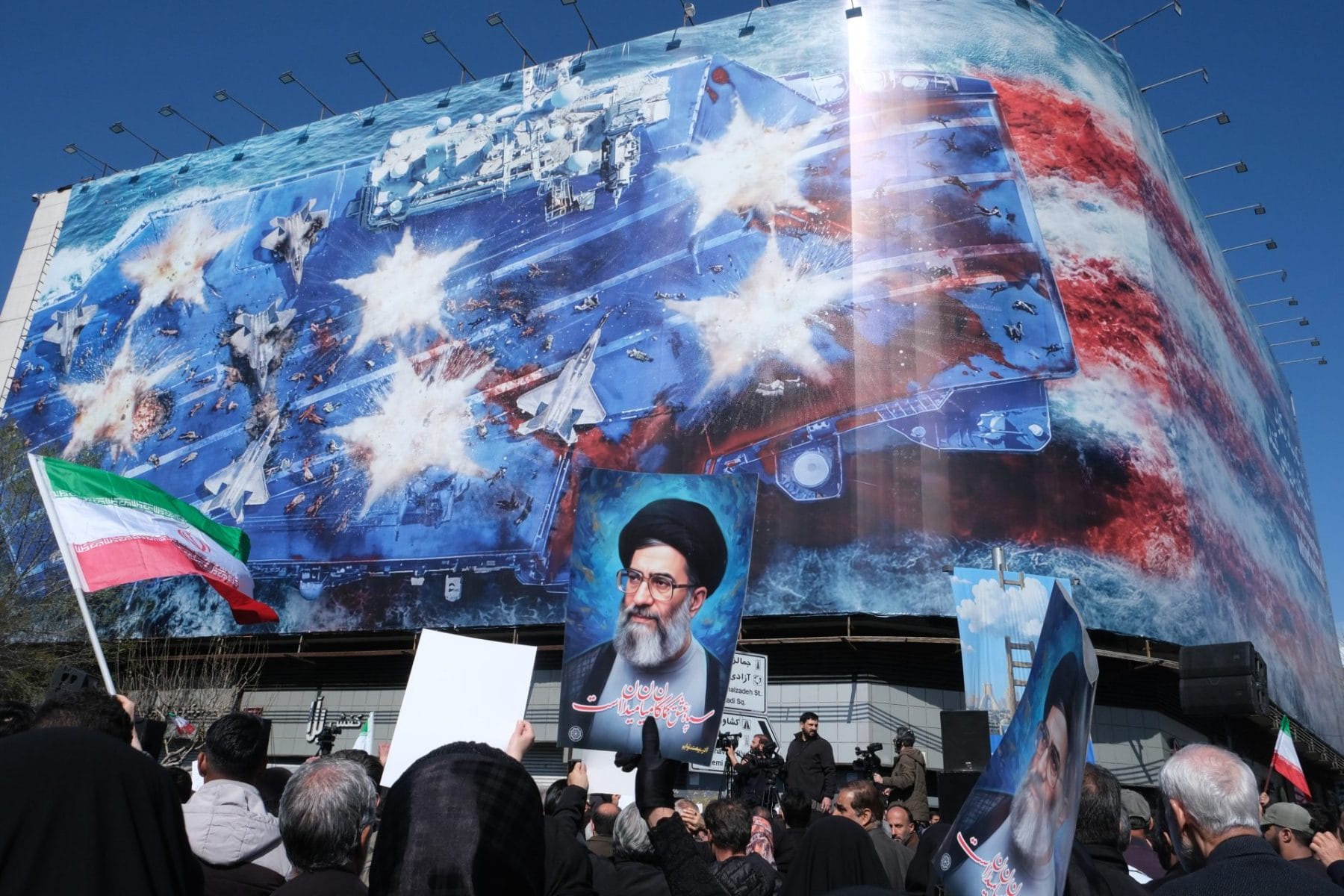
People gathered in Tehran's Revolution Square to mourn the assassination of Iran's Supreme Leader Ayatollah Ali Khamenei on March 1, 2026.

The Iranians did their best to live up to their dire warnings of deadly reprisals against Israel, and against American bases and allies on the Arab side of the Gulf and elsewhere. Missiles hailed down on airports and other installations in Kuwait, Bahrain, the UAE, Saudi Arabia and even Oman, despite its active mediation. While some U.S. bases may have been hit, so too were many civilian sites such as Dubai's iconic Burj al Arab hotel. Explosions too are being heard in Beirut, after Hezbollah fired rockets and drones at northern Israel to "avenge" Khamenei's death and the Israel Defense Forces struck back.

Air traffic was halted throughout a region rich in international hubs, sowing chaos worldwide. Iran's declaration that the strategic Strait of Hormuz was closed to shipping forced cargo shippers to suspend the voyages that transport some 20% of the world's oil and a lot of liquid gas, causing tremors through international markets. Once again, a decision taken by a tiny circle of men in Washington, Jerusalem and Tehran instantly rewired daily life, reminding us who actually gets to pull the global emergency brake.

What all this would do to Iran's relations with the Arab side of the Gulf was one of many open questions. While Oman was actively mediating, the other Arab oil states had been pressing the Americans not to allow a campaign that would predictably destabilise the region, and declaring their airspace not available for any hostilities. But any sympathy for Tehran quickly evaporated when the missiles started flying in: the Gulf Arab states closed ranks.

Trump and the Israelis made it clear that this was not one quick spectacular strike, but an ongoing campaign that would last days, perhaps even weeks. Presumably at the end, Iran would find its missile capabilities "obliterated," in Trump's favourite term, along with any nuclear activities. 

Once the bombs stop falling, Trump and Netanyahu urged, the Iranians should come out of their basements and take over a government that would be theirs for the taking. A historic opportunity that would likely not recur for generations, Iranians were told. 

But it is hard to imagine such regime change being wrought remotely from the skies. The regime lost little time in filling the leadership vacuum, setting up a three-man ruling council in line with the constitution, composed of the President, Masood Pezeshkian, the head of the Judiciary, Gholamhossein Mohseni-Ejei, and Ayatollah Alireza Arafi from the Council of Guardians. All regime loyalists, and the latter two noted hard-liners. So business as usual as far as they are concerned. But the fact is that the assassination of the Supreme Leader and the attendant bludgeoning of the regime's capabilities will inevitably usher in a new and unpredictable phase in Iran's turbulent history.

On the streets, reactions were fractured: jubilation in areas that had long chanted “Death to the dictator”, state-promote mourning in others, but also fear and a grim resignation, an understanding that power vacuums are often filled with fresh repression or civil war.

A smooth transition to a peaceful democracy is about the least likely scenario among the many possibilities. So too is an imminent return of the monarchy, with a comeback by Israeli-backed Reza Pahlavi, son of the Shah ousted by the 1979 revolution. So far there has been no sign visible to the outside world of a split in the ranks of the defenses built up by the Islamic Republic, which still has regular military forces numbering around 400,000, Revolutionary Guards of up to 190,000, and its auxiliary militia enforcers, the Basij, who may be able to mobilise around a million at street level. 

There must be much anger among regime loyalists, which may fall on the heads of any opposition protestors who imagine they can move in and take over the reins of government from the bombed-out wreckage of the Islamic Republic. The U.S. military is not likely to be able to remain engaged in the detail of defanging the regime once the main thrust of the campaign is done. But Israel likely will. Its equivalent of the CIA, the Mossad, has spent years building up formidable intelligence at street level, and will be doing its utmost to continue hamstringing the regime from within and fomenting opposition.Among the many unanswerable questions is whether all this will lead simply to chaos and fragmentation, which is probably Israel's preferred outcome, or to a more compliant regime willing to compromise with the U.S. in order to get crippling economic sanctions lifted. As Trump concedes the war might last weeks, who knows what Iran will eventually emerge from the smoke and the rubble?

The post The strike, the illusion of regime change, and what comes next appeared first on Coda Story.

  • ✇Coda Story
  • The phoney war: Will the U.S. strike a decisive blow against Iran?
    Will he or won't he? The Middle East is on tenterhooks as the U.S. continues to build up a massive and menacing military posture around Iran, threatening an attack that could trigger a conflagration whose tremors would be felt throughout the region.  If anybody hoped that the man on whose word it all hangs, President Donald Trump, might clarify his intentions in his State of the Union address on Tuesday night, they were disappointed.  Speaking 36 hours before a third round of indirect an
     

The phoney war: Will the U.S. strike a decisive blow against Iran?

Par : Jim Muir
27 février 2026 à 08:55

Will he or won't he? The Middle East is on tenterhooks as the U.S. continues to build up a massive and menacing military posture around Iran, threatening an attack that could trigger a conflagration whose tremors would be felt throughout the region. 

If anybody hoped that the man on whose word it all hangs, President Donald Trump, might clarify his intentions in his State of the Union address on Tuesday night, they were disappointed. 

Speaking 36 hours before a third round of indirect and ultimately inconclusive talks with the Iranians in Geneva on Thursday, he said, "My preference is to stop this problem through diplomacy but one thing is for certain, I will never allow the world's number one sponsor of terror, which they are by far, to have a nuclear weapon...they want to make a deal, but we haven't heard those secret (sic) words, 'We will never have a nuclear weapon.’”

In the run-up to the Geneva talks, led on the U.S. side by real estate moguls Steve Witkoff and Trump son-in-law Jared Kushner, Iranian officials voiced optimism that a deal could be struck and insisted they would be flexible on the nuclear issue. Various formulas were being bandied around, such as Iran sending abroad half of its estimated 300kg of highly enriched uranium and diluting the rest under supervision, participating in a regional consortium for peaceful enrichment and so on. 

In theory, for Iran to say "We will never have a nuclear weapon" should not be an issue — it has said all along that it is not pursuing that goal, which is banned by a fatwa. Iranian foreign minister Abbas Araghchi posted on X this week that Tehran “will under no circumstances ever develop a nuclear weapon.” Which begs the question as to why it has enriched uranium to 60% — short of weapons grade but well beyond the levels needed for peaceful civilian purposes.  

Witkoff and Kushner will be vigilant for signs of Iranian duplicity and foot-dragging. But with another set of talks ending with no deal apart from promises of more talks, both sides might simply be playing for time, Iran to delay the feared blow, and the U.S. to finish assembling the assault force, its biggest mobilization of naval and air power in the region since the 2003 invasion of Iraq.

There is strong apprehension in the region that the huge and costly U.S. buildup must mean business. American bombs and missiles would hit Iran. The Iranians would make good on their threat to make it a regional war, not a symbolic retaliation as happened in the 12-day war in June last year after American bunker-buster bombs hit Iran's nuclear facilities in Isfahan, Natanz and Fordow. This time Iranian missiles would target U.S. military assets, bases on the Arab side of the Gulf and elsewhere, and perhaps oil installations. And Israel. The Israelis would hit back hard. Hezbollah in Lebanon would do its best to join in, prompting a further massive Israeli response. 

There were ominous straws in the wind. The U.S. withdrew non-essential personnel from bases in the Gulf, and from its embassy in Beirut. The Israelis reportedly warned Lebanon that if Hezbollah joined in, they would hit back at government targets, including Beirut airport, which were unscathed throughout the earlier hostilities. They stepped up their daily attacks on suspected Hezbollah targets, including a big missile attack on February  20 on the eastern Beqaa valley which left 12 dead, including eight Hezbollahis. Since the November 2024 ceasefire, Hezbollah has not fired so much as a peashooter at Israel while well over 400 of their people have been killed in Israeli attacks on Lebanon.

Does all this mean the doomsday scenario is inexorable? Are the Americans set on a clear game plan, with identified objectives and the means to attain them?

Apparently not. Trump is reportedly receiving divided counsel from his advisers, military and political, some more hawkish and others more cautious than others. Above all, he has an eye on the looming mid-term elections in November. He was elected on a platform of ending the "forever" wars in the Middle East, yet could be on the brink of starting another one, which would not go down well with part of his MAGA base or the public in general. 

The signs are that he was hoping the swashbuckling display of power would intimidate the Iranians into buckling. Witkoff admitted Trump was puzzled that Iran had not capitulated. “Why, under this pressure, with the amount of sea power and naval power over there, why haven’t they come to us and said, ‘We profess we don’t want a weapon, so here’s what we’re prepared to do?’ And, yet, it’s sort of hard to get them to that place,” he told Fox News. Iran's Foreign Minister Abbas Araqchi explained: "It's because we're Iranian."

Trump's adrenalin was clearly set pumping by the adventure in Venezuela, where a similar military buildup culminated in the operation to abduct President Nicolas Maduro. But Iran is not Venezuela. It is a highly militarized regime which has spent 47 years preparing its internal and external defences, and which has different power bases that make it hard simply to decapitate. There is no magic bullet that might not set the region on fire. 

Taking out the Supreme Leader, Ayatollah Ali Khamene'i (who is also a religious leader, and this is Ramadan) would not be likely to bring about a change in regime behavior as in Venezuela. Bringing the regime down altogether would require a prolonged and detailed campaign that the U.S. military machine might not be able to sustain. 

That's where Israel comes in. Some White House advisers reportedly believe it would play better politically for Israel to strike first rather than the U.S., and thus force Iran to retaliate. Like Trump, Israel’s Prime Minister Benjamin Netanyahu is a man with an eye on impending elections (October at the latest) is Prime Minister Benjamin Netanyahu, who makes no secret of his ambition to see the Iranian regime brought down. Netanyahu — backed by almost the entire Israeli political spectrum — is clearly champing at the bit, but aware of the danger of being seen to drag the U.S. into a potentially messy embroilment. One reason perhaps for the unusually discreet nature of Netanyahu's sixth visit to the White House on  February 11 — in through the back door, no lovefest press appearances. 

Which may also actually have been a sign that the two allies might not be on the same strategic page. Plunging Iran into fragmentation and chaos would absolutely fit Israel's playbook, but not necessarily America's. The two are working at cross-purposes in Syria, where the Israelis are pushing against a strong central government which the U.S. is supporting, even against its erstwhile Kurdish allies in the north-east. 

If there are two constants in the current equation, they are that the Iranian people’s disillusionment and rage against the regime will not go away, and neither will Israel's desire to overthrow it. But if Trump does not share that goal, he will have to find a face-saving way to wriggle off the hook he has created with his ostentatious military buildup. 

A version of this story was published in this week’s Coda Currents newsletter.Sign up here.

The post The phoney war: Will the U.S. strike a decisive blow against Iran? appeared first on Coda Story.

❌