Vue normale

Reçu — 8 mai 2026 The Document Foundation Blog

Twenty Years On, ODF Is Still the Only Open Standard for Office Documents, and the Only One Governments Can Trust
8 mai 2026 à 01:00

Berlin, 8 May 2026 – Twenty years ago this week, on 3 May 2006, the Open Document Format cleared its Draft International Standard ballot at ISO/IEC JTC 1/SC 34 with unanimous approval. On 30 November 2006 it was published as ISO/IEC 26300. Two decades later, ODF remains what it was on the day of its ratification: the only open, vendor-neutral, freely implementable international standard for office documents in existence.

Everything else on the market is a vendor format with a standards number attached.

That distinction was contested in 2006. It is not contestable in 2026. The competing format pushed through ISO in 2008 – under a fast-track process whose abuses are now part of the documentary record of standards governance – has since splintered into a Strict variant almost no implementation actually uses and a Transitional variant that preserves, by design, the undocumented behaviours of a single vendor’s legacy products. A standard that exists to encode one company’s bugs is not a standard. It is a moat with a certificate.

ODF has no Transitional mode. It has no undocumented behaviours. It has no vendor whose commercial roadmap can quietly rewrite what conformance means. The specification is publicly available at no cost from ISO and from OASIS. The schemas are auditable. The implementations are multiple, independent, and free. This is not advocacy language. It is the working definition of a standard, and ODF is the only office-document format that meets it.

The political weather has finally caught up with the technical reality. Germany’s federal administration has mandated ODF through the Deutschland-Stack. The European Commission’s own services are under sustained pressure – including from this Foundation – to align procurement with the open-standards commitments the Commission itself has signed. Brazil has legislated open formats into its educational system through Lei 15.211/2025. The pattern is the same on every continent where public bodies have stopped to ask the only question that matters: in what format does a society keep its own records, and who decides when that format changes?
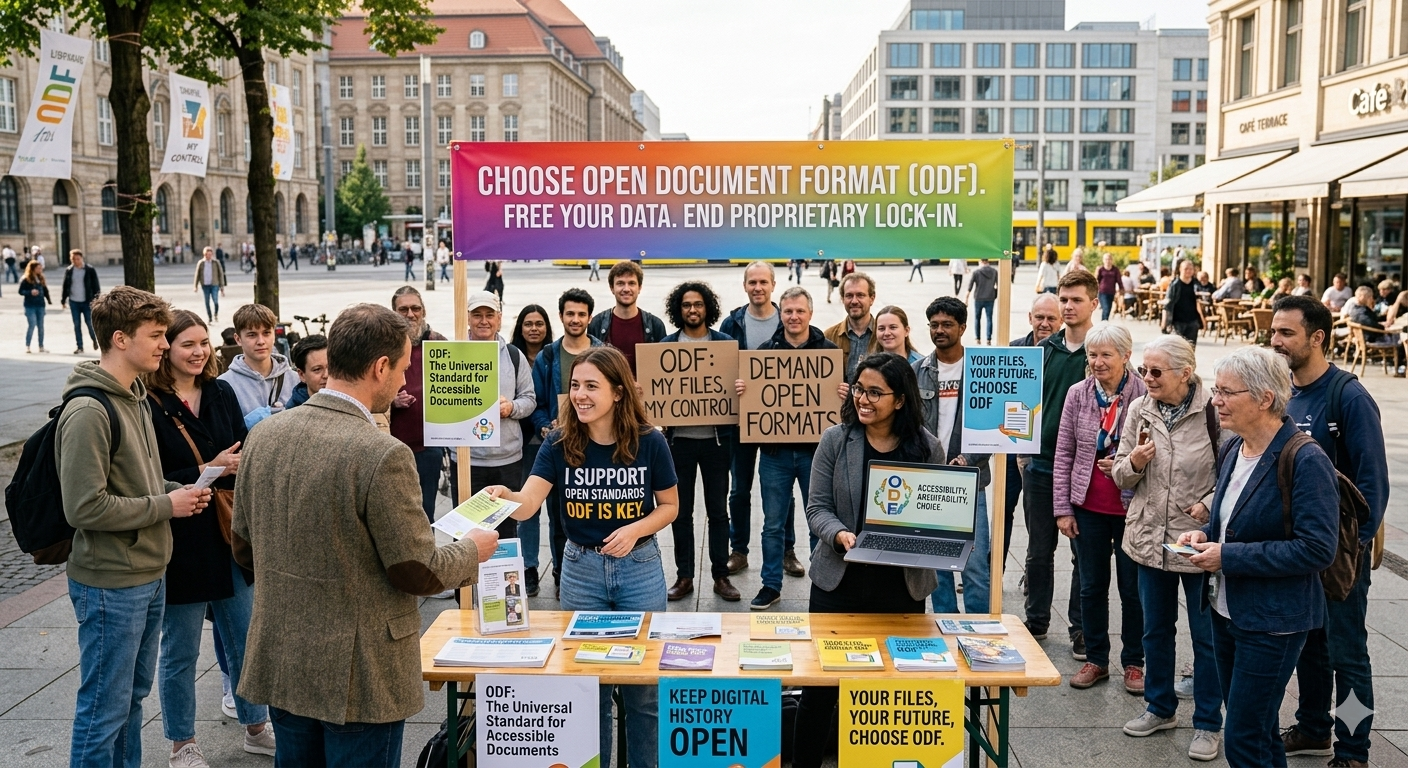
For twenty years, the answer to the second question – for any administration that chose ODF – has been: we do. For any administration that chose the alternative, the answer has been: the vendor does, and the administration will be informed.

“ODF is the document format of a public that has decided not to outsource its memory,” said Florian Effenberger, Executive Director of The Document Foundation. “The governments now mandating ODF are not making a technical choice. They are reclaiming a sovereignty they should never have surrendered.”

The implementation landscape reflects the same divide. LibreOffice, developed by The Document Foundation and a global community of contributors, uses ODF as its native format and is the reference implementation of the standard. Collabora Online extends ODF support to enterprise and cloud deployments. Together they constitute the working core of the ODF ecosystem. Other office suites – including those that market themselves with the vocabulary of openness while defaulting to a competitor’s vendor format – are not part of that ecosystem and should not be confused with it.

The Document Foundation will mark the twentieth anniversary across 2026 with a programme of publications, policy briefs, and community events. The LibreOffice Conference will dedicate a full track to ODF, coordinated with the OASIS Technical Committee, which is currently advancing version 1.4 of the specification. Material on the history, the structural design, and the policy implications of ODF will be published throughout the year on the TDF blog.

A standard is worth what it still does after the people who wrote it have moved on. ODF is read, written, and trusted by software none of its original authors imagined, on hardware none of them could have specified, in jurisdictions none of them lobbied. It has aged the way public infrastructure is supposed to age: quietly, reliably, and in everyone’s hands.

That is the anniversary worth marking. Not the certificate from 2006, but the twenty years of evidence since: evidence that the open-standards bet was the right one, that the alternative was the trap its critics warned it would be, and that the governments now choosing ODF are not innovating. They are catching up.

Reçu — 7 mai 2026 The Document Foundation Blog
  • ✇The Document Foundation Blog
  • Announcing the new LibreOffice website!
    LibreOffice’s website is the main source of information about the software (and project), and typically has 45,000 – 65,000 visitors every day. It is also the place to download the suite, of course, and make donations to support the community. Our website was looking rather old and becoming difficult to
     

Announcing the new LibreOffice website!

7 mai 2026 à 05:24
LibreOffice’s website is the main source of information about the software (and project), and typically has 45,000 – 65,000 visitors every day. It is also the place to download the suite, of course, and make donations to support the community. Our website was looking rather old and becoming difficult to
Reçu — 6 mai 2026 The Document Foundation Blog

LibreOffice at the Augsburger Linux-Infotag 2026

6 mai 2026 à 13:16
Most of the work in the LibreOffice project takes place online – in our Git repository, on mailing lists, on IRC and other places. But where possible, we like to meet in-person as well, at events around the world! Last weekend, for instance, we were at the Augsburger Linux-Infotag in
Reçu — 5 mai 2026 The Document Foundation Blog
  • ✇The Document Foundation Blog
  • Thank you, on behalf of ODF
    Recently, The Document Foundation published an open letter to European citizens. We asked Euro-Office – the new coalition forming around a European alternative for productivity – whether ODF (the Open Document Format) would be its native document format. Unfortunately, we have not yet received a reply, and this confirms –
     

Thank you, on behalf of ODF

5 mai 2026 à 08:21
Recently, The Document Foundation published an open letter to European citizens. We asked Euro-Office – the new coalition forming around a European alternative for productivity – whether ODF (the Open Document Format) would be its native document format. Unfortunately, we have not yet received a reply, and this confirms –
Reçu — 4 mai 2026 The Document Foundation Blog

LibreOffice project and community recap: April 2026

4 mai 2026 à 02:54
Here’s our summary of updates, events and activities in the LibreOffice project in the last four weeks – click the links to learn more… We started April by announcing the LibreOffice Writer Guide 26.2. This is an extensive handbook full of tutorials, tips and tricks for the software. A huge
Reçu — 30 avril 2026 The Document Foundation Blog
  • ✇The Document Foundation Blog
  • The Document Foundation Releases LibreOffice 26.2.3
    Berlin, 30 April 2026 – The Document Foundation today announces the release of LibreOffice 26.2.3, the third maintenance update to the LibreOffice 26.2 branch, which was released in early February. This update delivers targeted bug and compatibility fixes, along with stability improvements contributed by our global community. LibreOffice 26.2.3 is
     

The Document Foundation Releases LibreOffice 26.2.3

30 avril 2026 à 07:59
Berlin, 30 April 2026 – The Document Foundation today announces the release of LibreOffice 26.2.3, the third maintenance update to the LibreOffice 26.2 branch, which was released in early February. This update delivers targeted bug and compatibility fixes, along with stability improvements contributed by our global community. LibreOffice 26.2.3 is
Reçu — 29 avril 2026 The Document Foundation Blog

Insights from the InstallFest 2026 Conference in Prague

29 avril 2026 à 05:52
Petr Valach from the Czech LibreOffice community writes: On the last weekend of March 2026, the regular InstallFest 2026 conference took place. Here is a summary of the news and insights we gained at the event. New venue What every visitor noticed immediately upon entering was the change in the
Reçu — 27 avril 2026 The Document Foundation Blog

Help us to improve LibreOffice’s Swahili translation!

27 avril 2026 à 09:50
In the LibreOffice project, our goal isn’t to just make a powerful office suite – but to also make it usable for as many people as possible. And a big part of that is translating the user interface, help content and websites. LibreOffice (the app itself) is available in over
Reçu — 22 avril 2026 The Document Foundation Blog

LibreOffice Asia Conf 2025 – Panel: Lessons from Open Source Business, Part II

22 avril 2026 à 08:40
Jiajun Xu writes, following on from part 1: The annual community event LibreOffice Asia Conference was held on December 13–14, 2025 in Tokyo, Japan. One of the sessions was a panel discussion titled “Lessons from Open Source Business,” moderated by Franklin Weng, featuring three company leaders from different countries sharing
Reçu — 21 avril 2026 The Document Foundation Blog
  • ✇The Document Foundation Blog
  • Using LibreOffice for writing screenplays
    LibreOffice Writer is the suite’s word processor, and can be used for virtually any task involving… well, processing words, of course. But how about screenwriting (aka writing screenplays)? We saw a discussion on Ask LibreOffice where user Peter J. talked about his experiences in this field. Initially he described LibreOffice’s
     

Using LibreOffice for writing screenplays

21 avril 2026 à 03:48
LibreOffice Writer is the suite’s word processor, and can be used for virtually any task involving… well, processing words, of course. But how about screenwriting (aka writing screenplays)? We saw a discussion on Ask LibreOffice where user Peter J. talked about his experiences in this field. Initially he described LibreOffice’s
Reçu — 20 avril 2026 The Document Foundation Blog

LibreOffice Asia Conf 2025 – Panel: Lessons from Open Source Business, Part I

20 avril 2026 à 08:08
Jiajun Xu writes: The annual community event LibreOffice Asia Conference was held on December 13-14 2025 in Tokyo, Japan. One of the sessions was a panel discussion titled “Lessons from Open Source Business,” moderated by Franklin Weng, featuring three company leaders from different countries sharing how they run their businesses
Reçu — 19 avril 2026 The Document Foundation Blog

Welcome Vissarion Fisikopoulos, new LibreOffice developer focusing on Base

19 avril 2026 à 05:07
LibreOffice Base is the database component of the suite, and hasn’t seen a lot of development activity in recent years. So The Document Foundation – the non-profit behind the software – wants to change that! Following Neil Roberts, we now have a second new developer, Vissarion Fisikopoulos, so let’s hear
Reçu — 17 avril 2026 The Document Foundation Blog

The Foundation Is Strong: What TDF Is, Why It Matters, and Where It Is Going

17 avril 2026 à 03:26
The Document Foundation was created in 2010 with a single, non-negotiable premise: that a free, fully-featured office suite, built on open standards and governed in the public interest, is infrastructure for democracy. Not a product. Not a market position. Infrastructure, the kind that belongs to everyone and can be taken
Reçu — 16 avril 2026 The Document Foundation Blog

Video: LibreOffice at the Grazer Linuxtage 2026

16 avril 2026 à 06:04
What are we doing in the LibreOffice project? Where are we going, and how can all users (yes, even non-programmers) help to improve the software? We answered these questions – and more – at the recent Grazer Linuxtage event. Click here to watch the talk
Reçu — 15 avril 2026 The Document Foundation Blog
  • ✇The Document Foundation Blog
  • LibreOffice at Document Freedom Day in Noida, India
    Ravi Dwivedi from the Indian LibreOffice community writes: On the 29th of March 2026, we celebrated Document Freedom Day in Noida India. Thanks for Essentia.dev for the venue and sflc.in for sponsoring snacks and the cake. sflc.in is a donor-supported legal services organisation in India. The event featured a few
     

LibreOffice at Document Freedom Day in Noida, India

15 avril 2026 à 05:26
Ravi Dwivedi from the Indian LibreOffice community writes: On the 29th of March 2026, we celebrated Document Freedom Day in Noida India. Thanks for Essentia.dev for the venue and sflc.in for sponsoring snacks and the cake. sflc.in is a donor-supported legal services organisation in India. The event featured a few
Reçu — 14 avril 2026 The Document Foundation Blog
  • ✇The Document Foundation Blog
  • LibreOffice at the Chemnitzer Linux-Tage 2026
    The Chemnitzer Linux-Tage (English page) is a yearly event in Germany for fans of free and open source software. This year, the LibreOffice project was present, as Karl-Heinz Gruner describes: LibreOffice had an information booth at the event. Stickers and flyers were very popular. An excerpt from their extensive video
     

LibreOffice at the Chemnitzer Linux-Tage 2026

14 avril 2026 à 15:34
The Chemnitzer Linux-Tage (English page) is a yearly event in Germany for fans of free and open source software. This year, the LibreOffice project was present, as Karl-Heinz Gruner describes: LibreOffice had an information booth at the event. Stickers and flyers were very popular. An excerpt from their extensive video
Reçu — 13 avril 2026 The Document Foundation Blog
  • ✇The Document Foundation Blog
  • The LibreOffice Bookshelf had a Facelift.
    The LibreOffice Community has now a reshaped website to access the LibreOffice official literature.   Thanks to Juan José Gonzalez (TDF Web Technology Engineer), the bookshelf website has been redesigned to carry new aesthetics and user interface. Web visitors have now a summary of each guide and easy way to
     

The LibreOffice Bookshelf had a Facelift.

13 avril 2026 à 10:17
The LibreOffice Community has now a reshaped website to access the LibreOffice official literature.   Thanks to Juan José Gonzalez (TDF Web Technology Engineer), the bookshelf website has been redesigned to carry new aesthetics and user interface. Web visitors have now a summary of each guide and easy way to
Reçu — 11 avril 2026 The Document Foundation Blog
  • ✇The Document Foundation Blog
  • Open Letter to some Collabora Developers
    Yes, we should have published this blog post some time ago. We would like to thank Mike Kaganski, who was affected by the recent suspension of membership, for reminding us so politely of our oversight: mikekaganski.wordpress.com/2026/04/05/the-post-they-managed-to-avoid/. Had we published the post earlier, we would probably have avoided some of the
     

Open Letter to some Collabora Developers

11 avril 2026 à 09:13
Yes, we should have published this blog post some time ago. We would like to thank Mike Kaganski, who was affected by the recent suspension of membership, for reminding us so politely of our oversight: mikekaganski.wordpress.com/2026/04/05/the-post-they-managed-to-avoid/. Had we published the post earlier, we would probably have avoided some of the
Reçu — 10 avril 2026 The Document Foundation Blog
  • ✇The Document Foundation Blog
  • Q&A about Media Articles and Forum Comments
    Over the past week, a number of articles have appeared in the media and comments have been posted on forums containing questions – some explicitly stated and others implied – directed at The Document Foundation. We have done our best to gather all these questions and provide a response that
     

Q&A about Media Articles and Forum Comments

10 avril 2026 à 13:01
Over the past week, a number of articles have appeared in the media and comments have been posted on forums containing questions – some explicitly stated and others implied – directed at The Document Foundation. We have done our best to gather all these questions and provide a response that
Reçu — 9 avril 2026 The Document Foundation Blog

LibreOffice State of the Project (April 2025 – March 2026)

9 avril 2026 à 05:30
As promised, we are releasing the updated State of the Project Slide Deck, based on data extracted from the LibreOffice dashboard and the Matomo repository. During the 12 months 295 developers worked on the source code, adding 11.098 new commits (Git): 221 volunteer developers (75%) provided 1.871 commits (17%); 8
Reçu — 7 avril 2026 The Document Foundation Blog
  • ✇The Document Foundation Blog
  • The New Writer Guide 26.2 Just Arrived
    Continuing our mission to provide the best LibreOffice documentation for our end users, the Documentation Team is proud to announce the release of the latest Writer Guide for LibreOffice 26.2. Whether you’re a beginner or an expert, this guide covers all aspects of the LibreOffice Writer module—from creating simple one-page
     

The New Writer Guide 26.2 Just Arrived

7 avril 2026 à 19:49
Continuing our mission to provide the best LibreOffice documentation for our end users, the Documentation Team is proud to announce the release of the latest Writer Guide for LibreOffice 26.2. Whether you’re a beginner or an expert, this guide covers all aspects of the LibreOffice Writer module—from creating simple one-page
  • ✇The Document Foundation Blog
  • Our sense of meritocracy
    Meritocracy is one of the founding principles of the free and open-source software movement. It is also one of the most controversial terms, and the gap between the different meanings people attribute to it is, in some projects, a source of real and damaging conflict. Let us analyse the meaning
     

Our sense of meritocracy

7 avril 2026 à 04:41
Meritocracy is one of the founding principles of the free and open-source software movement. It is also one of the most controversial terms, and the gap between the different meanings people attribute to it is, in some projects, a source of real and damaging conflict. Let us analyse the meaning
❌