This is Behind the Blog, where we share our behind-the-scenes thoughts about how a few of our top stories of the week came together. This week, we discuss a new pod setup, video games, and Elon's spending habits.JASON: Exciting news: I am building a podcast studio / riso printing room / place to film videos in. I believe all of my colleagues and many people in my life have been laughing at me about this, but this also may just be the narrative I’ve created for myself to inspire me to prove th
This is Behind the Blog, where we share our behind-the-scenes thoughts about how a few of our top stories of the week came together. This week, we discuss a new pod setup, video games, and Elon's spending habits.
JASON: Exciting news: I am building a podcast studio / riso printing room / place to film videos in. I believe all of my colleagues and many people in my life have been laughing at me about this, but this also may just be the narrative I’ve created for myself to inspire me to prove the haters wrong. Since the beginning of 404 Media, I’ve worked out of my garage, but feel like I’ve been going a bit crazy sitting mostly in the same room since essentially the start of the pandemic. And so I found not a coworking space but a very affordable windowless box that I shall turn into a content palace.
I’m just going to try it for a few months to see if it makes sense or if I should return to working from the couch, but I’m quite excited about building it out. I only got it a few days ago and so at the moment it’s largely a bunch of boxes and random furniture I no longer had space at my apartment for. It’s got a drop ceiling with fluorescent lighting and landlord special laminate floors, but I also can do whatever I want to it, so I will likely do some sort of design on the walls, throw a rug down, whatever.
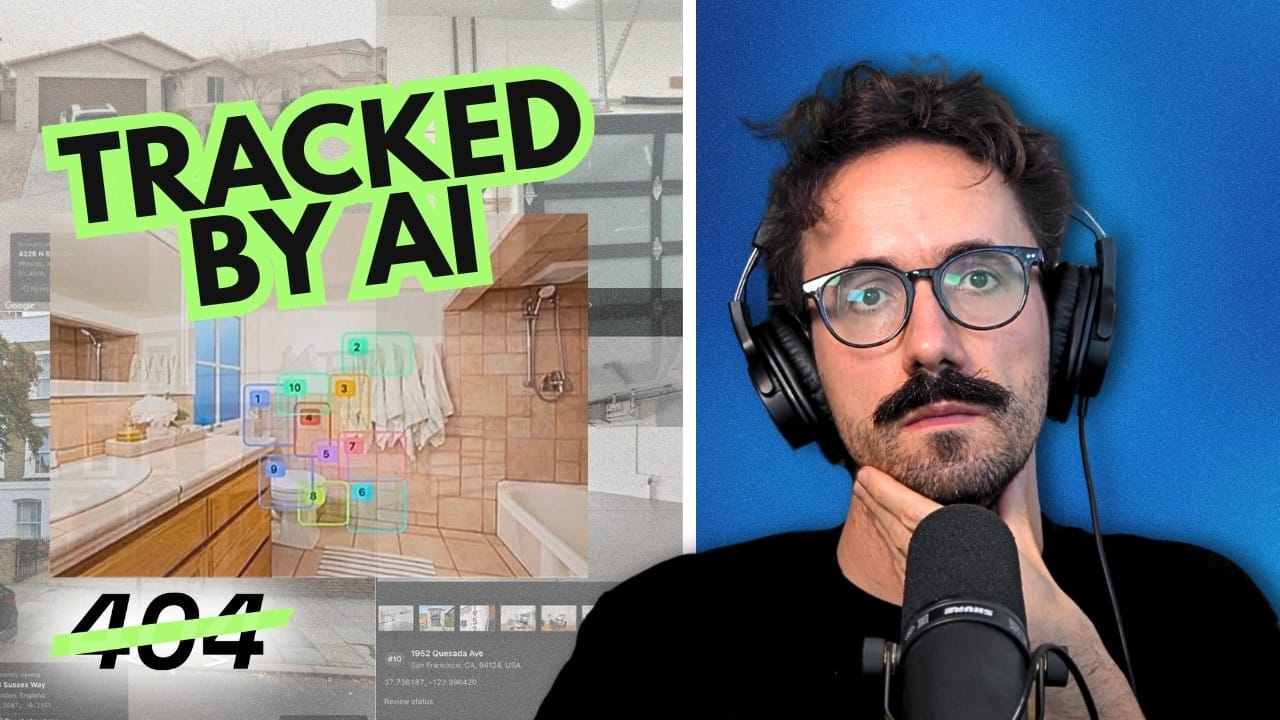
We start this week with Joseph’s article about Raven, previously known as Geospy. This is an AI tool that can geolocate photos, and now says it can pinpoint a specific house based just on one photo taken inside. After the break, Jason explains why a judge ruled a particular Flock search as unconstitutional. In the subscribers-only section, we talk about the wild AI video that has derailed a manslaughter case.
Listen to the weekly podcast on Apple Podcasts, Spotify, or YouTube. Become a pai
We start this week with Joseph’s article about Raven, previously known as Geospy. This is an AI tool that can geolocate photos, and now says it can pinpoint a specific house based just on one photo taken inside. After the break, Jason explains why a judge ruled a particular Flock search as unconstitutional. In the subscribers-only section, we talk about the wild AI video that has derailed a manslaughter case.
Listen to the weekly podcast on Apple Podcasts,Spotify, or YouTube. Become a paid subscriber for access to this episode's bonus content and to power our journalism. If you become a paid subscriber, check your inbox for an email from our podcast host Transistor for a link to the subscribers-only version! You can also add that subscribers feed to your podcast app of choice and never miss an episode that way. The email should also contain the subscribers-only link for the extended video version too. It will also be in the show notes in your podcast player.
This article was produced in collaboration with Court Watch, an independent outlet that unearths overlooked court records. Subscribe to them here.Newly filed court records show exactly what happens when messaging app Telegram provides data to U.S. authorities.A letter written by Telegram, and providing a specific user’s phone number, user ID, and IP address, reads:
This article was produced in collaboration with Court Watch, an independent outlet that unearths overlooked court records. Subscribe to them here.Police arrested a Chicago area high school maintenance worker who attempted to meet a child for sex after investigators posed as a 15-year-old boy using AI generated images.Christopher Thomas Mertens started talking to who he thought was a child through a dating app in September. According to an affidavit written by the department’s FBI Task Force O
Police arrested a Chicago area high school maintenance worker who attempted to meet a child for sex after investigators posed as a 15-year-old boy using AI generated images.
Christopher Thomas Mertens started talking to who he thought was a child through a dating app in September. According to an affidavit written by the department’s FBI Task Force Officer McKailey Scott, the investigation was done by the Livonia Undercover Resistance to Exploitation Unit (LURE), which identifies and prosecutes child sex offenders. Scott set up an account on the queer-focused dating app Taimi with “an AI generated image of a teenage-appearing male with the name ‘Caleb,’ and no age listed on the profile.
Scott wrote that an unknown user messaged “Caleb,” and they moved to Whatsapp. After a few minutes of talking, the man asked Caleb for their age, and when Scott — posing as Caleb — said he was 15, the man said “Im interested” and “Im hard now.”
The investigator used a combination of tools, including checking the man’s phone number using Thomson Reuters CLEAR and running images of his face through Clearview AI to identify him as Mertens. For days, Caleb and Mertens exchanged sexually explicit text messages and Mertens made plans to drive to meet Caleb on his day off, believing Caleb’s (non-existent) parents weren’t home. Cops used Flock to look up and track Mertens’ car and see that he was driving to the meetup spot, but Mertens was also texting Caleb the entire time to let him know he was on the way and when he arrived. When he got out of the car, Livonia police took him into custody.
Two hours after being booked, Mertens told jail attendants that he wanted to speak to Scott. When Scott got to the jail, Mertens admitted everything, including that he works at a high school in Illinois. The complaint doesn’t mention which high school.
Investigators have been generating images of children for years. One of the earliest examples of these is Sweetie, a computer generated child developed by Dutch children’s rights organization Terre des Hommes in 2013 that the organization used to talk to men online. Today, police departments at the U.S. border use AI-generated online personas designed to interact with and monitor protestors and activists, according to documents obtained by 404 Media.
In August, a 24-year-old Connecticut man was arrested after soliciting an undercover police officer who used what was reported as “age regression technology” to appear as a 14 year old in videos. He was charged with enticing a minor and criminal attempt to commit risk of injury to a child.
In 2025, a 45-year-old man was arrested after investigators used AI generated images of children to catch him distributing child sexual abuse material. He was recently sentenced to 12 years in federal prison.
And in 2024, the state of New Mexico sued Snapchat after investigators set up a fake account, including AI generated images of children, that the platform allegedly recommended to “dangerous accounts, including ones named ‘child.rape’ and ‘pedo_lover10,’ in addition to others that are even more explicit,” according to the New Mexico Department of Justice.
AI generated child sexual abuse material is a rapidly growing problem for law enforcement. The National Center for Missing and Exploited Children has reported a massive rise in generative AI child abuse material, with criminals using it to extort and entice children, and children using it to bully and harrass other children.
Livonia police did not respond to a request for comment.
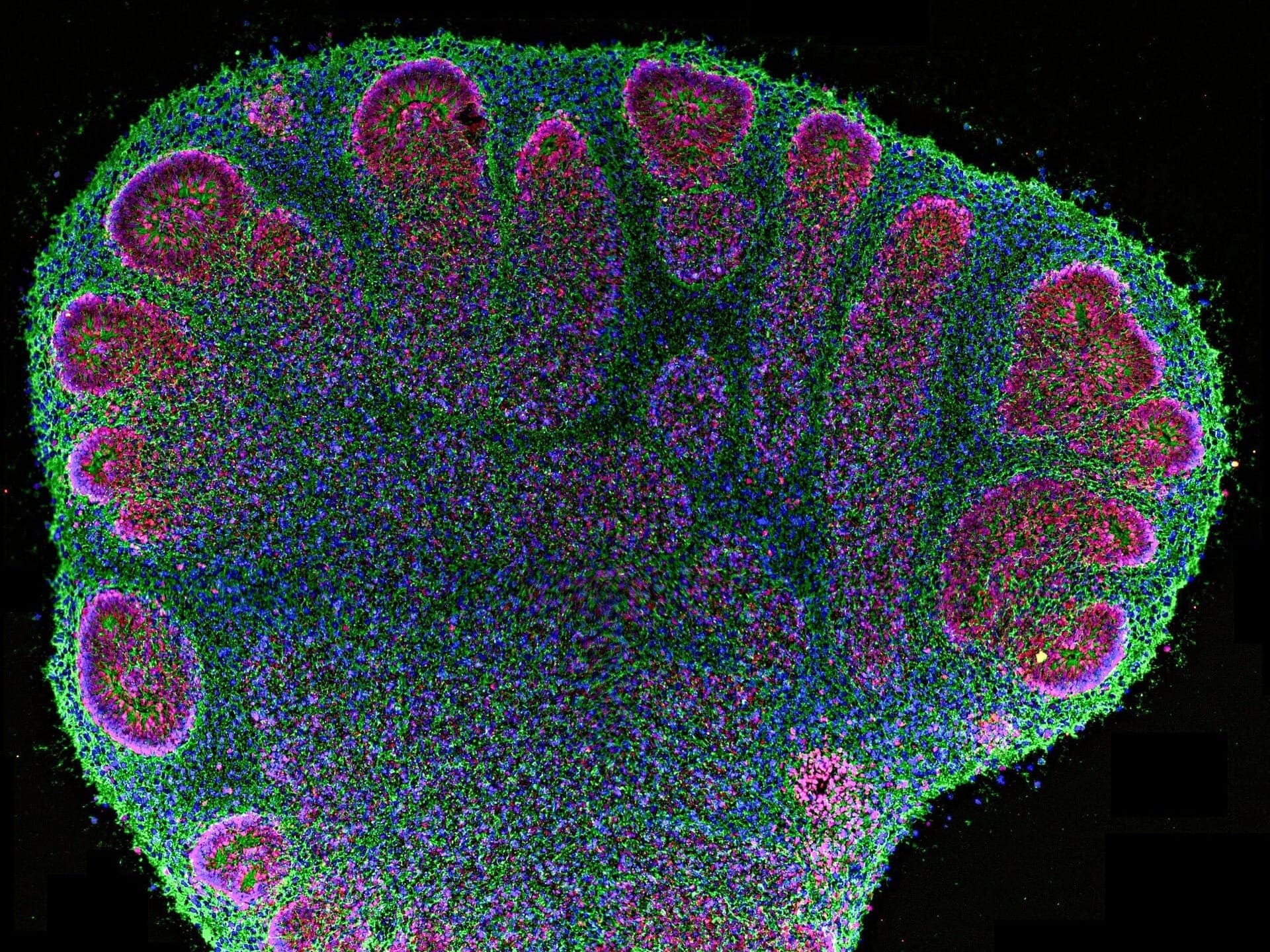
Scientists have made a breakthrough toward the mind-bending goal of creating computers made of brains by demonstrating that human neural tissue can classify letters of the Braille alphabet, according to a study published on Friday in Frontiers in Artificial Intelligence. A team transmitted electrical signals corresponding to Braille letters to human brain organoids, which are living neural tissues derived from stem cells. The results revealed that a single organoid, consisting of about 10,00
Scientists have made a breakthrough toward the mind-bending goal of creating computers made of brains by demonstrating that human neural tissue can classify letters of the Braille alphabet, according to a study published on Friday in Frontiers in Artificial Intelligence.
A team transmitted electrical signals corresponding to Braille letters to human brain organoids, which are living neural tissues derived from stem cells. The results revealed that a single organoid, consisting of about 10,000 neurons, could classify the letters with about 61 percent accuracy, while teams of three organoids reached 83 percent accuracy.
“The human brain can perform incredibly complex information processing while consuming relatively little energy, and artificial neural networks were originally inspired by biological nervous systems,” said Tianyi Liu, a PhD candidate at Bristol University who led the new study, in an email to 404 Media.
“If we've been trying to imitate biological neural networks all along, why not try using real biological neural networks directly?” she continued. “What kind of information processing capabilities might these tiny neural organoids have? Could they show some form of learning or adaptation? These are all questions we're very interested in.”
The new study falls under the emerging field of organoid intelligence, which aims to use organoids as biological “wetware” for computing applications. Previous studies have established that organoids are capable of recognizing speech Japanese vowels or even playing the classic game Pong.
Since Liu and her team specialize in how robots sense and respond to touch, they homed in on Braille as a way to convert tactile information into electrical stimuli that an organoid could receive, process, and classify.
In their experimental setup, the researchers used a tactile sensor to scan data from the 26 letters of the Braille alphabet, which is built from arrangements of raised dots. This data was converted into electrical stimulation patterns that were fed to the organoids, which are smaller than a millimeter in scale and positioned on arrays that keep them alive.
“Our original goal wasn't to prove that organoids could read Braille like humans, or that they were already ‘intelligent’ enough to understand Braille,” she added. “Rather, we wanted to use this task to explore whether real biological neural networks could participate in processing information from robotic tactile sensors.”
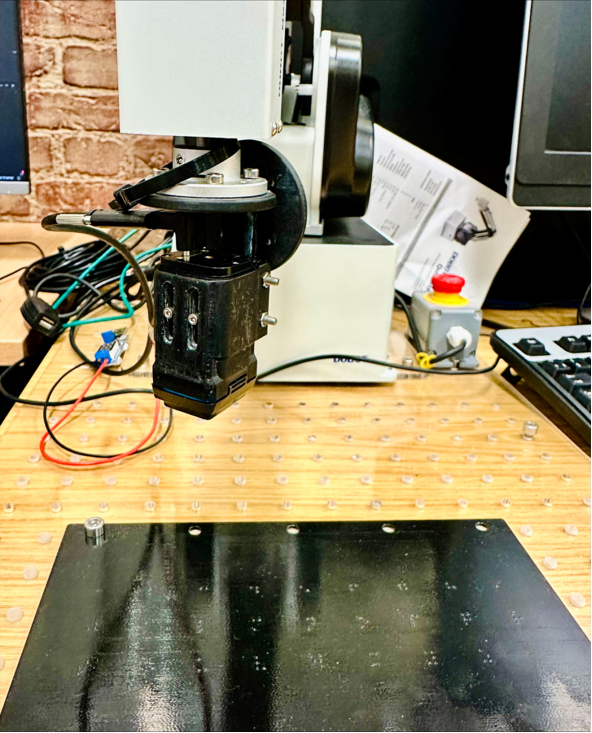
The tactile sensor used to scan Braille letters. Image: Dr Benjamin Ward-Cherrier.
In other words, the researchers aimed to discover if these stimulated inputs could be decoded by the organoids and returned back in discernable responses corresponding to the Braille letters. The results revealed that a single organoid could accurately classify the letters nearly two thirds of the time, while an "ensemble" of three organoids performed even better, with an accuracy of 83 percent.
“We still don't know the exact mechanism behind this improvement,” Liu said. “Our hypothesis is that different organoids respond to the same stimulation in similar, but not identical, ways.”
She added that “you can think of it as three people looking at the same object. Although they're all looking at the same thing, each person might notice different details. Some features might not be obvious to one person but could be quite easy for another to spot. By combining their observations, you might be able to make a more accurate and reliable judgement.”
🌘
Subscribe to 404 Media to get The Abstract, our newsletter about the most exciting and mind-boggling science news and studies of the week.
The results are undeniably trippy, conjuring up the classic scifi trope of a hyperintelligent brain-in-a-vat. But Liu emphasized that this was an open-loop experiment, meaning that the organoids only received initial inputs without getting new feedback about their performance on the tasks. For this reason, the study does not prove that the organoids actually learned Braille, or were altered in any permanent way, just that they could classify Braille letters after receiving the electrical inputs.
“In the future, if we can build closed-loop systems where neural activity from the organoids actually participates in a robot's perception, decision making, and control, while the results of the robot's interactions with its environment are fed back to the organoids, we could begin to investigate whether these biological neural networks can adapt to new tasks through ongoing interaction,” she said.
Liu also noted that while there are many potential advantages to organoid intelligence, there are plenty of limitations to biological computing systems. For example, organoids cannot be standardized, leading to natural variations that can complicate results, plus they have to be kept alive in cultures that are more difficult to maintain than electronic devices.
“Compared with established computing chips, organoid systems still have a long way to go in terms of reliability, reproducibility, and scalability,” Liu said.
Even so, organoid intelligence “gives us the opportunity to explore a way of computing that's very different from traditional computers,” she concluded.

 Connexion