The catastrophic hack of at least thousands of FBI officials’ personal data, including their addresses, phone numbers, and even their spouses, includes members of the FBI’s secretive hacking team, potentially revealing who exactly is in that unit, 404 Media has found.The findings further highlight how sensitive the stolen data is, and how valuable it may be to criminals or to foreign intelligence agencies. There is very little public information about the FBI’s hacking unit, including the ope
The catastrophic hack of at least thousands of FBI officials’ personal data, including their addresses, phone numbers, and even their spouses, includes members of the FBI’s secretive hacking team, potentially revealing who exactly is in that unit, 404 Media has found.
The findings further highlight how sensitive the stolen data is, and how valuable it may be to criminals or to foreign intelligence agencies. There is very little public information about the FBI’s hacking unit, including the operations it conducts, the tools it uses, or which agents are part of it.
💡
Do you work at the FBI? Do you know anything else about this hack? I would love to hear from you. Using a non-work device, you can message me securely on Signal at joseph.404 or send me an email at joseph@404media.co.
Scientists have discovered that the removal of Earth's magnetic field influences the lifespans of fruit flies in complex ways, a finding that sheds light on the aging process as well as the risks of future human space travel, according to a study published in the journal Aging on Wednesday. All life on Earth has evolved under the planet’s geomagnetic field, a vast bubble lined with electrical currents that is generated in the core and extends out into space. This protective magnetic shield is
Scientists have discovered that the removal of Earth's magnetic field influences the lifespans of fruit flies in complex ways, a finding that sheds light on the aging process as well as the risks of future human space travel, according to a study published in the journal Aging on Wednesday.
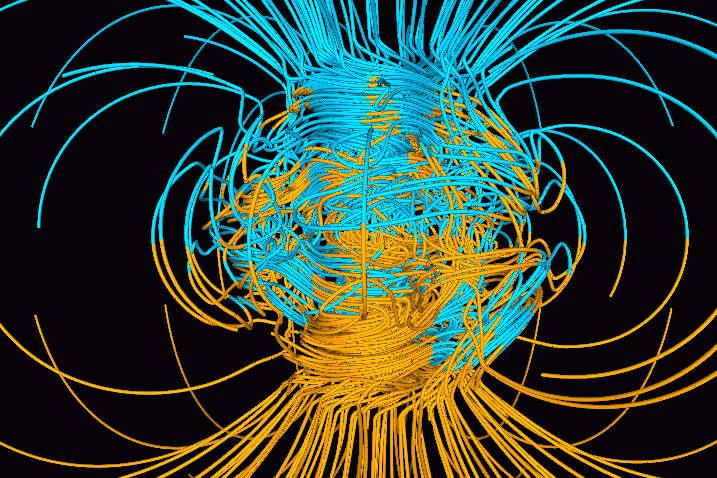
All life on Earth has evolved under the planet’s geomagnetic field, a vast bubble lined with electrical currents that is generated in the core and extends out into space. This protective magnetic shield is a major factor in Earth’s habitability, as it wards off harmful radiation from space, allowing life to flourish on the surface.
Many migratory animals—including fish, birds, and insects—can clearly sense Earth’s magnetism and use it for navigation. But much less is known about how the field interacts with living cells and their components, such as mitochondria, the famous “powerhouses” that generate most of the energy that fuels life.
To better understand this mystery, scientists observed two populations of fruit flies in a “hypomagnetic” shield system, a cylindrical benchtop apparatus that essentially blocks the influence of Earth’s magnetic field. One group contained “wild-type” healthy flies, while the other was made up of “mutant” flies carrying a gene defect called Pink1, which is associated with early-onset Parkinson’s disease in humans and specifically involves mitochondrial dysfunction.
The removal of the magnetic field’s effect extended the lifespan of the Pink1 group by 20 percent but reduced their mobility, whereas the healthy flies experienced just the opposite—reduced lifespan, but improved mobility.
“We had an idea that there would be a difference just based on the fact that we know that every organism has developed under a magnetic field,” said Jacob Reed, a PhD student in bioscience at the University of Nottingham who co-led the study, in a call with 404 Media. “But we didn't really plan that there would be this difference in the experiment.”
“I think we're the first to show that there's an effect in an organism that has a disease phenotype,” added co-lead Lisa Chakrabarti, a professor of biochemistry at the University of Nottingham, in the same call. “We're really drilling into what the differences are between having that applied pressure or relieving it.”
Diagram illustrating the experiment. Image: University of Nottingham
While there is a lot of research into the effects of hypermagnetic fields on life—meaning magnetic fields that are stronger than Earth’s—the “biological consequences of hypomagnetic fields remain poorly understood,” according to the new study.
To fill in this research gap, Reed developed an initial pilot study of diseased and healthy flies using the magnetic shielding apparatus, and was surprised to find that the Pink1 population of flies seemed to live longer.
“I was really confused at first,” Reed recalled. “I was thinking: ‘Why are these Parkinson's flies living longer than some of the wild-type flies?’ I had to double-check all of my data. From that, we realized that was what's happening and developed the experiment.”
The team observed dozens of diseased and healthy flies living in these hypomagnetic spaces over the course of their lives, which normally last about two months. In particular, they monitored shifts in the energy metabolisms and chemical outputs of mitochondria using quantum diamond sensors.
The experiment showed that the absence of Earth’s magnetic field changes how cells age and produce energy, producing clear and measurable effects on longevity. The researchers also saw shifts in locomotion by tracking how far flies climbed upward against gravity in their containers. However, it will take more research to unravel the complex mechanisms that underlie these observable changes.
“This is the early stage, where we can say there is a very real effect,” Chakrabarti said. “As soon as you take off the geomagnetic field, there are physiological effects that we can measure in the mitochondria, in the cellular physiology, and in big things like lifespan and climbing as well. It's a definite interaction between Earth's magnetic field and physiology.”
The researchers plan to build on their work by studying different organisms in hypomagnetic fields to see if they experience similar mitochondrial and behavioral changes. This work could eventually inspire therapeutic treatments for humans with various conditions, and could also help prepare astronauts for deep space missions beyond Earth’s magnetic field. It is already well-known that astronauts are exposed to harmful radiation outside of the magnetic field, but little is known about the specific impact of the absence of the field itself on human physiology.
“The link with interplanetary space travel is absolutely key,” said Chakrabarti. “There could be subtle differences that we don't really notice while we're on Earth. Unless we know what those parameters are to measure, we're going to be sending astronauts up there that are potentially going to really suffer over the short, or even or the longer, term.”
“All of this is out there at the moment, but what we're saying is that we definitely see a really reproducible and startling effect of removing the geomagnetic field,” she concluded.
Mia Hyder had never attended a public meeting before when she showed up to the city council meeting in Springfield, Missouri. After briefly speaking at a podium during a public comment period, she was arrested and dragged away in handcuffs. “Hello, my name is Mylie Hyder. I’m a Springfield, Missouri constituent, and I’m here to oppose the usage of ALPR cameras, most commonly made by Flock Safety. These cameras are not just surveillance,” Hyder started.“I’m sorry ma’am,” Springfield Mayor Jef
Mia Hyder had never attended a public meeting before when she showed up to the city council meeting in Springfield, Missouri. After briefly speaking at a podium during a public comment period, she was arrested and dragged away in handcuffs.
“Hello, my name is Mylie Hyder. I’m a Springfield, Missouri constituent, and I’m here to oppose the usage of ALPR cameras, most commonly made by Flock Safety. These cameras are not just surveillance,” Hyder started.
“I’m sorry ma’am,” Springfield Mayor Jeff Schrag said. Her mic was cut. A cop approached her at the podium.
Hyder held up both of her middle fingers while continuing to speak: “They are an invasion of our privacy,” she said.
The cop said, “You’re under arrest,” grabbed her arms, and pulled her out of the room. “I can do this all night. I get paid by the hour,” the cop added.
“Does this conclude the public hearing,” Schrag said.
“Yes sir,” a council member responded. The meeting continued with a city employee talking about sidewalk code.
Hyder was one of two people arrested in Springfield, Missouri on Monday during a city council meeting where tensions rose after the council stalled a review of the city’s Flock cameras.
Dozens of people showed up to the Springfield City Council Meeting on September 22 with plans to let city leaders know how they felt about the city’s use of automated license plate readers. There was a resolution before the council that would trigger a review of the controversial camera systems, but Schrag moved to send the resolution to committee and prevent public comment on the issue.
The move passed 5 - 3, the crowd shouted at city leaders, and Schrag ordered citizens to clear the room and shut off cameras recording the event. As people left, police detained and ticketed Noah Powell. Later in the evening Mia Hyder tried to speak out about Flock during public comments about a housing issue. Police arrested her while Schrag looked on. “Sorry ma’m,” the mayor said as police led Hyder away in handcuffs.
Springfield has 41 Flock cameras, according to the Flock Transparency Portal. City councilor Brandon Jenson had proposed a resolution to “conduct a comprehensive review of all relevant contracts” related to the ALPR cameras. The council was set to vote on Jensons’ proposed review on Monday and hear comments from the community. But when the resolution came up during the meeting, Mayor Schrag immediately pushed to send it to a committee and avoid public comment.
Jenson spoke before the vote to push the resolution to a committee. “All I’m trying to do is get people answers to some real questions that they’ve brought to us for months. And it’s a shame that it comes to this sort of, I guess, theater that I’m a part of to try to get those answers,” he said. “This isn’t how government is supposed to run. It’s just disappointing. And we’re not even allowing folks to speak who clearly came out to share their voices tonight.”
When the council voted to send the bill to committee, someone in the crowd shouted “Bullshit!” Schrag tried to move on to the next agenda item, but the crowd booed and yelled. The mayor then paused the meeting, turned off the cameras, and cleared the room.
Police detained Powell, a freelance photographer in Springfield, as people filed out of the room. “I don’t have a lot of experience getting tickets or being detained,” Powell told 404 Media. “So this is kind of new for me.”
Footage obtained by 404 Media showed several people leaving the city council meeting and yelling at city leaders. Powell said he was the only person put in handcuffs, detained, and ticketed at that moment. The Springfield Police Department did not return 404 Media’s request for comment.
“Well, I said: ‘Jeff Schrag is a cuck.’ I said: ‘Fuck you Jeff.’ I said: ‘Worthless’ and then, also, the final thing I said was: ‘Jeff Schrag has a tiny, stinky, cock,’” Powell explained. “I just let myself get handcuffed and let them do whatever power trip they wanted to do. Got my ticket and left.”
Powell said he was only in handcuffs for five minutes. “They just wanted to put on a show,” he explained. Powell added that he planned to fight the charge in court. “I’ve already sought legal representation, so we’re going to see where it gets […] I don’t think I should have been put in cuffs. I read the law, the city ordinance, and it said that I should have just been asked to leave.”
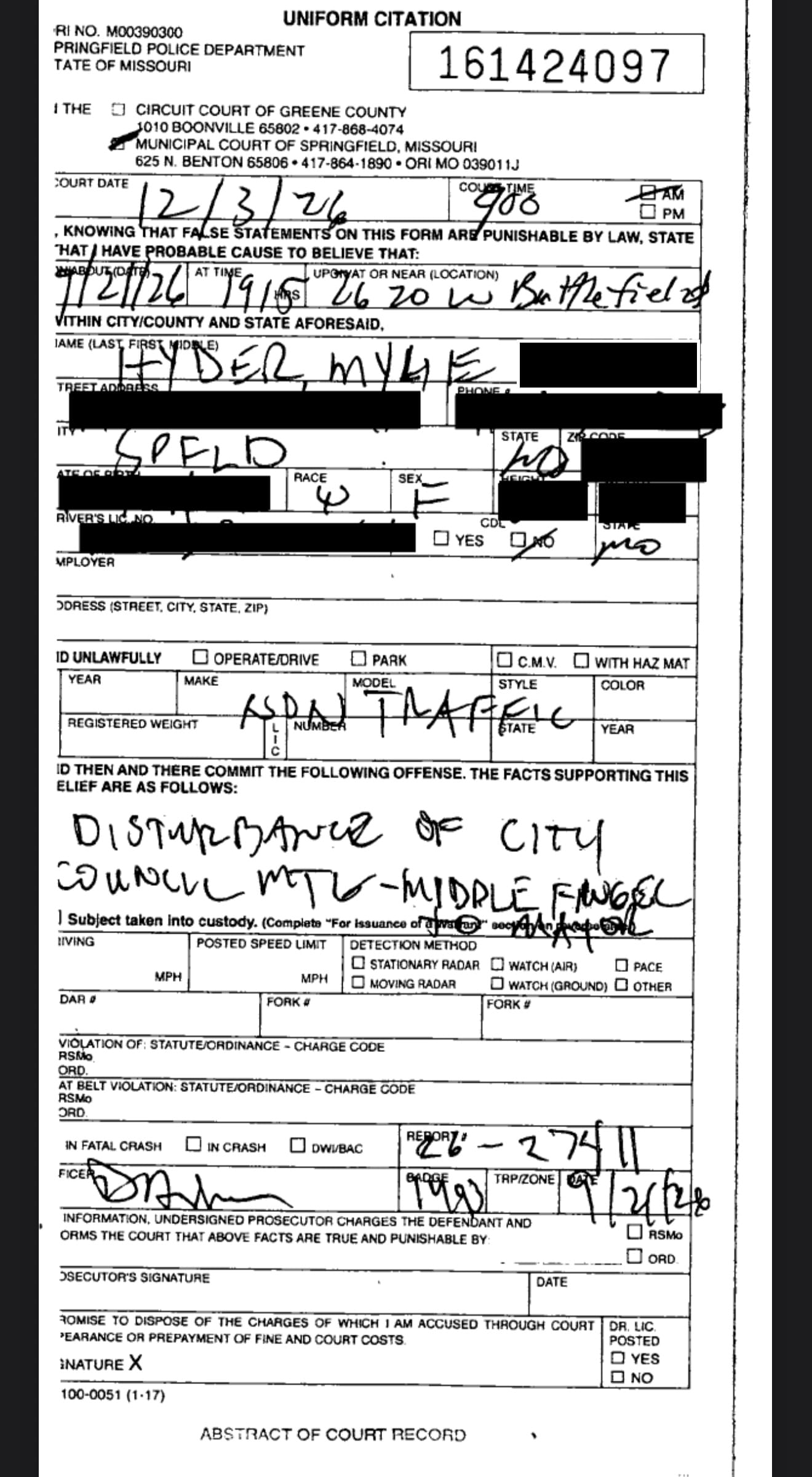
Hyder told 404 Media that she’d just moved to the area and thought that the city council meeting would be a good place to get involved in the community. She said that she’d stayed behind when Schrag cleared the room earlier in the evening.“I don’t know why I stayed. I just felt like not staying was giving up,” she said. Hyder explained that she waited until the public comment period for a different issue, filled out a form to talk, and then got up to deliver a written statement about Flock cameras. She said she didn’t flip off the city council until she saw the police officer approaching.
“After I saw the police officer out of the corner of my eye and everyone was kind of yelling at me, and there was a lot of ruckus, that’s when I pulled out the double birds,” she said.
💡
Seen something at a city council meeting? I would love to hear from you. Using a non-work device, you can message me securely on Signal at +1 347 762-9212 or send me an email at matthew@404media.co.
The police officer who arrested her said Hyder was being charged with disrupting the peace. He took her into the hallway outside of the meeting and held her in handcuffs for around five minutes before issuing her a ticket and letting her go.
Hyder told 404 Media she didn’t regret it. “I feel like being silent would have been like being complicit,” she said. “I felt like it was kind of stupid that I disturbed the peace. Okay, yeah, I did flip them off. That wasn’t a shining moment, but I did that when I was about to be arrested. When I knew my time was up.”
Hyder added she’d continue to attend city council meetings.
A copy of Hyder's ticket.
Flock Out SGF, a local group that’s lobbying against ALPRs in Springfield, told 404 Media that the resolution was meant as a compromise. “Many people came out to the council meeting and had carefully prepared statements for public comment, but no citizens were heard,” they said. “The two individuals who were arrested for voicing their concerns in the face of being silenced were not unreasonable, and we stand by their actions.”
Powell and Hyder are just the two latest American citizens detained or arrested this year for their behavior during a city council meeting. In February a farmer was arrested in Oklahoma for going over his time during a data center meeting. In Kansas, police arrested a high school teacher for clapping during public comments. In Texas, cops arrested a man in his driveway for public disturbance a week after he said “bullshit” during a county meeting.
Springfield did not return 404 Media’s request for comment.
Most people in the world who use AI feel good about the technology and believe it will be a net positive for the future, according to a new study from Gallup. This is not the case in the United States, however, which is one of the few countries surveyed where negative emotions towards AI outweigh the positive. The new survey from Gallup and Microsoft polled people in 37 different countries about AI. “The study, which will ultimately cover 140 countries, measures public engagement with AI acro
Most people in the world who use AI feel good about the technology and believe it will be a net positive for the future, according to a new study from Gallup. This is not the case in the United States, however, which is one of the few countries surveyed where negative emotions towards AI outweigh the positive.
The new survey from Gallup and Microsoft polled people in 37 different countries about AI. “The study, which will ultimately cover 140 countries, measures public engagement with AI across five dimensions. In addition to emotional response, the survey captures awareness, frequency of use, expected impact and trust,” the study said.
Most people polled — a median of 81% — were aware AI tools exist, but only a median of 43% used them daily. Gallup told 404 Media it defined a “daily user” as an employed person who used AI everyday for either work or personal reasons or an unemployed person who used the tech every day.
The study found that people had a mixed, but generally optimistic, view of artificial intelligence. “AI engagement can be viewed as an adoption ladder, moving from awareness to ever having used AI and then to more frequent use,” the survey said. Generally — but not always — the more someone used AI the more they trusted its results, the more positive they felt towards it, and the more they believed it would help make a better future.
Digging in, however, the results are more complicated. Some people who reported positive feelings towards AI also said they didn’t trust its results. “People may therefore see considerable potential in AI even while remaining uncertain about whether they can rely on the information it provides,” the survey said.
Daily users tended to trust AI “to provide accurate information,” according to the study. “The survey cannot establish whether greater trust leads people to use AI more often, whether experience with AI builds trust, or both. But the strength and consistency of the relationship suggest that trust and adoption are connected.”
Globally, most people surveyed felt good about AI and expected to improve their country. As AI adoption increased in a country, so too did positive feelings. But not in the United States, which was one of only three countries surveyed where negative emotions towards AI outweighed the positive.
Pablo Diego-Rosell, a senior scientist at Gallup, told 404 Media that he’d seen similar results in other western countries. “The Netherlands, Canada, the U.K., New Zealand, Ireland and Malta all rank near the top in terms of worry,” he said. He noted that he hasn’t seen survey results from some of the bigger European countries like Germany and France but said that worrying about AI “appears to be a uniquely Western phenomenon.”
Gallup called this the “Paradox of the Worried West.”
“The biggest unanswered question is causality. We see a very strong relationship between frequent AI use, greater trust and lower worry, but we do not know which direction that relationship runs,” Diego-Rosell said. “Does experience with AI make people more comfortable with it, or are people who already trust AI simply more willing to use it?”
“There is also a broader question about what trust in AI actually means. In this study, we measure one specific dimension: whether people trust AI to provide accurate information,” he added. “But trust in AI can also involve whether people believe it is reliable, safe, fair, transparent, protective of privacy, and likely to act in ways that serve their interests.
The west didn’t have a monopoly on negative emotions towards AI, however. The other two countries where negative emotions towards the technology outweighed the positive were Egypt and Palestine.
“One possibility is that these results partly reflect the broader emotional context in which people are evaluating AI. When people are living in environments where worry, stress or other negative emotions are already elevated, some of that broader emotional climate may shape how they react to a technology like AI,” Diego-Rosell said. “At the same time, our data do not allow us to determine how much of the response is specific to AI versus the wider circumstances people are experiencing.”
It’s possible that people in the US, Egypt, and Palestine are already anxious and worried and that this is coloring their perception of AI. Israel is waging war on Palestine, settling in its territory, and using AI to pick targets to bomb in Gaza.
Americans — where much of AI is built and first deployed — have been repeatedly told in the past few months by AI evangelists and company insiders that the technology could, literally, end all life on Earth. The constant stream of news stories about AI swarms “breaking containment” while AI experts claim there’s a one in ten chance the technology kills everyone on the planet probably had a hand in altering the American mood.
“The broader story is that public engagement with AI is much more complicated than simply being ‘for’ or ‘against’ it,” Diego-Rosell said. “People who are aware of AI are more likely to expect it to help than harm, and positive emotions outweigh negative ones. At the same time, trust in AI’s accuracy is considerably lower than optimism about its potential, and worry remains widespread in some countries. So optimism, skepticism and concern can coexist.”

 Connexion