
 Connexion
EU says Russia’s Venice pavilion could cost Biennale €2 million grant. Its commissioner is daughter of FSB general
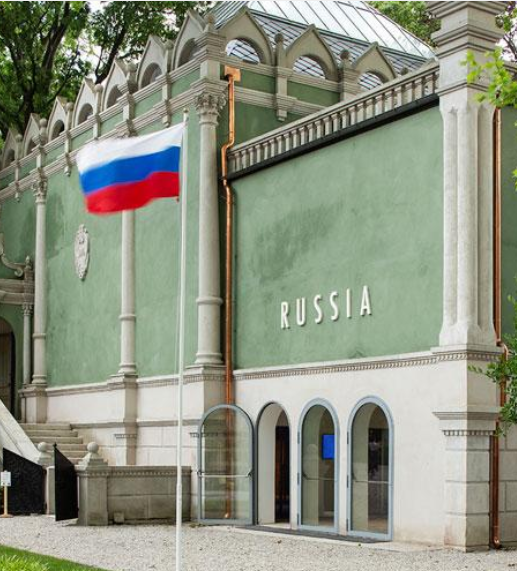
The European Commission officially recommended terminating the €2 million grant to the Venice Biennale due to the reopening of Russia's pavilion. European Commission Vice President Henna Virkkunen announced the recommendation on X.
The Russian pavilion opened at the 61st Venice Biennale in April 2026, following its absence in 2022 and 2024. Its commissioner is Anastasia Karneeva, daughter of a senior figure at the Rostec state defense corporation and a former FSB general, and is financed by the oligarch Leonid Mikhelson's Novatek company.
Ukraine sanctioned Karneeva and four other Russian cultural figures at the pavilion in April 2026 as "cultural propagandists" spreading Russian state narratives. Over 20 countries condemned Russia's participation. Seventy-one Parliamentary Assembly of the Council of Europe delegates from 29 countries called for the pavilion's cancellation.
Russia's culture: genocide
The largest Russian attack on Kyiv's cultural institutions occurred in May 2026. It damaged the National Art Museum of Ukraine (NAMU), the National Philharmonic of Ukraine, the National Music Academy of Ukraine, the National Center "Ukrainian House," the National Library of Ukraine named after Yaroslav the Wise, and the Kyiv Academic Theater of Opera and Ballet for Children and Youth.
The National "Chornobyl" Museum sustained significant damage. Numerous architectural monuments were affected, including the Kyiv Contract House and the Post Station.
Three UNESCO World Heritage Sites in Ukraine and their buffer zones have suffered damage. Damage in the historic center of Odesa is among the documented cases.
The EU's recommendation escalates from the April 2026 warning that the Commission could freeze the grant.
"The Commission officially recommends EACEA to terminate the €2 million grant to the Venice Biennale. This follows a thorough assessment of the replies from the Biennale to justify the re-opening of Russia's pavilion," Virkkunen wrote.
Ukraine called on the Biennale leadership to maintain the principled position it held from 2022 to 2024, excluding Russia.
Italian government opposes EU action
The European Commission's recommendation runs against the Italian government's position on Russian participation. Italian Deputy Prime Minister Matteo Salvini criticized Brussels' position and did not object to Russia's participation.
Veneto regional president Alberto Stefani called the EU's actions "unacceptable," arguing that art should "facilitate moments of cultural dialogue, which can become opportunities to forge connections, especially when official diplomacy cannot find solutions."
The Biennale replied to Italian Culture Minister Alessandro Giuli that there had been "no violation of the rules" in admitting Russia and that "the sanctions against the Russian Federation were fully observed."
Read also
-
Europe’s answer to the Patriot costs $700,000 a shot—and no foreign government can switch it off
-
116 Russian ships in nine days: One big export tanker needs 12–15 small ones to fill it. Ukraine is burning the small ones
-
Russia’s ex-space chief calls for “systematic zeroing out” of the Starlink satellite constellation
