Vue normale

  • ✇Euromaidan Press
  • New ground launcher means Russia no longer needs rare drone to fire its Banderol missile
    Russia may be about to fire its Banderol cruise missiles from the ground, and that could change the warning Ukraine has. Photos of a new Russian ground launcher for the S8000 "Banderol" cruise missile have appeared online, and Russia reportedly presented the launcher to Russian ruler Vladimir Putin at a closed exhibition in 2025, the Ukrainian defense outlet Defense Express reported. Until now, the only confirmed launch platform for the Banderol was the Orion strike-and
     

New ground launcher means Russia no longer needs rare drone to fire its Banderol missile

28 juillet 2026 à 16:00

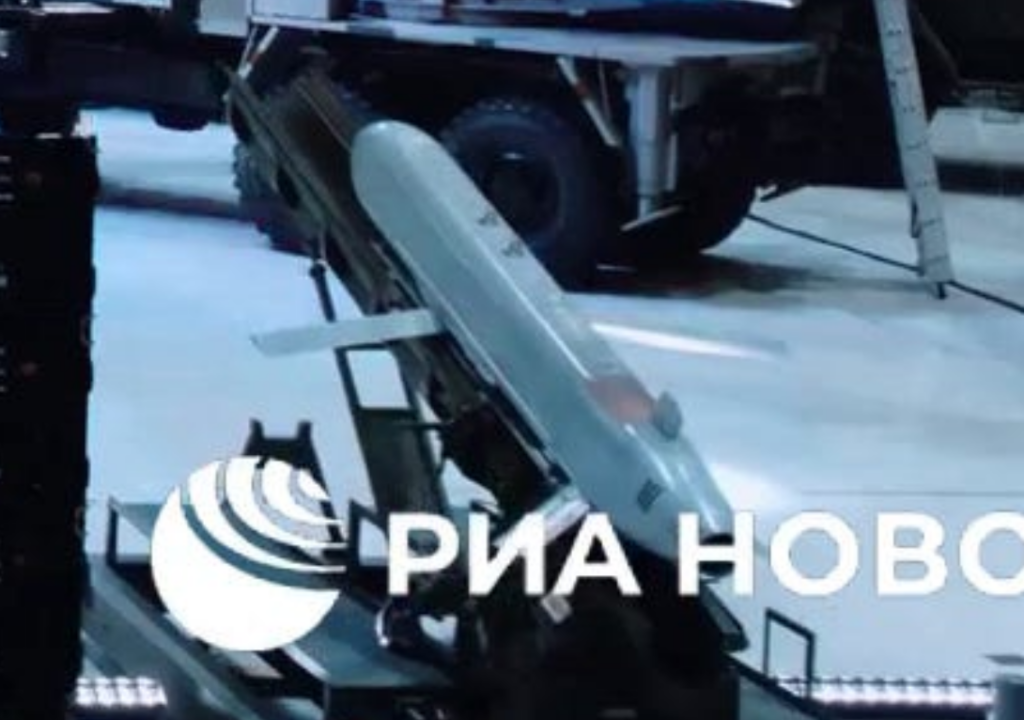
A Russian Banderol missile-drone. Credit: RIA Novosti

Russia may be about to fire its Banderol cruise missiles from the ground, and that could change the warning Ukraine has. Photos of a new Russian ground launcher for the S8000 "Banderol" cruise missile have appeared online, and Russia reportedly presented the launcher to Russian ruler Vladimir Putin at a closed exhibition in 2025, the Ukrainian defense outlet Defense Express reported.

Until now, the only confirmed launch platform for the Banderol was the Orion strike-and-reconnaissance drone, and no ground launcher for the missile had appeared online. That mattered for Ukraine's defense: the Orion is rare, with only nine confirmed losses throughout the war, and it has to be flown in first, where Ukraine can spot it in advance.

A ground launcher removes that warning. The Banderol is a fast, cheap jet-powered cruise missile that flies up to 500 km at 500 to 560 km/h with a 114.3-kg warhead, and Russia has used it in its largest combined strikes on Kyiv. The threat is that ground launchers let Russia fire Banderols without the Orion's telltale takeoff, and can be assembled in large numbers for mass attacks.

The launcher strips away the time Ukraine had to react

The second danger is volume. A single Orion can carry only one Banderol, but ground launchers can be built in dozens and used for mass attacks. That turns a missile previously limited by its scarce drone carrier into one Russia could salvo, the same shift from trickle to swarm that has made Shaheds so hard to stop.

The launcher may still be in testing, the analysts cautioned, and Russia may be trying to conceal its use. But the fact that Russia has ground launchers at all is the threat, because it changes how and how many Banderols can reach Ukraine.

The tradeoff is the range for surprise

Ground launch is not free for Russia either. Fired from a launcher on the ground, the Banderol will have a shorter range than when dropped from an Orion already at altitude and speed. Even with a booster, the missile has to accelerate and climb to its cruising height on its own, spending the energy an air launch provides for free.

The launcher's design reflects that. Judging by its construction, the missile rail can be lowered to a horizontal position, and, given its small size, the launcher could theoretically be mounted on trailers or other mobile platforms. A small solid-fuel booster is probably used to get the missile off the ground. That mobility is its own threat: a trailer-mounted launcher can hide, move, and fire from unexpected locations, trading the Banderol's maximum range for the surprise of a ground launch close to the border.

Ukrainian intelligence has mapped its 30-company foreign component supply chain, down to a Chinese jet engine available on AliExpress, and President's adviser Serhii "Flash" Beskrestnov, who first identified the missile, has called it "nothing outstanding, a budget cruise missile with a small warhead."
  • ✇Euromaidan Press
  • Look at this huge airport fire truck that Ukraine’s Emergency Service just received from Luxembourg
    Ukraine's rescuers have a powerful new firefighting truck. The vehicle fleet of Ukraine's State Emergency Service (SES) gained a Rosenbauer Panther 8×8 airport firefighting vehicle, which will soon enter service and help rescuers carry out the most difficult tasks, the SES announced. According to the UN, since the start of Russia's full-scale war, at least 16,141 civilians, including 803 children, have been confirmed killed, while 48,613 people, including 2,960 children
     

Look at this huge airport fire truck that Ukraine’s Emergency Service just received from Luxembourg

27 juillet 2026 à 13:04

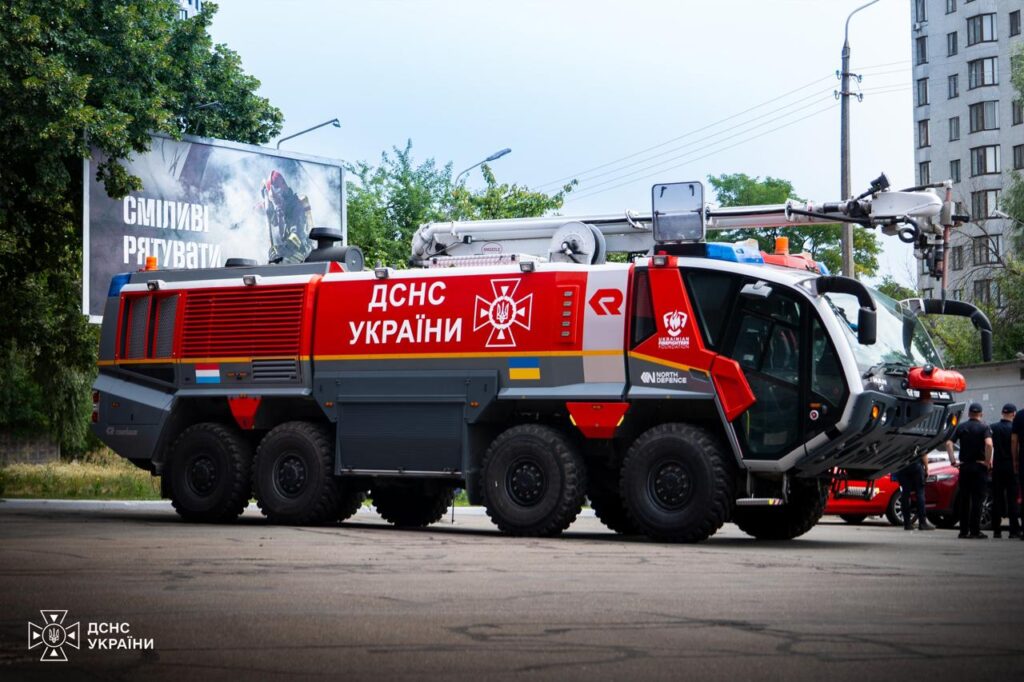
A Rosenbauer Panther 8×8 airport firefighting vehicle. Source: The Ukrainian State Emergency Service

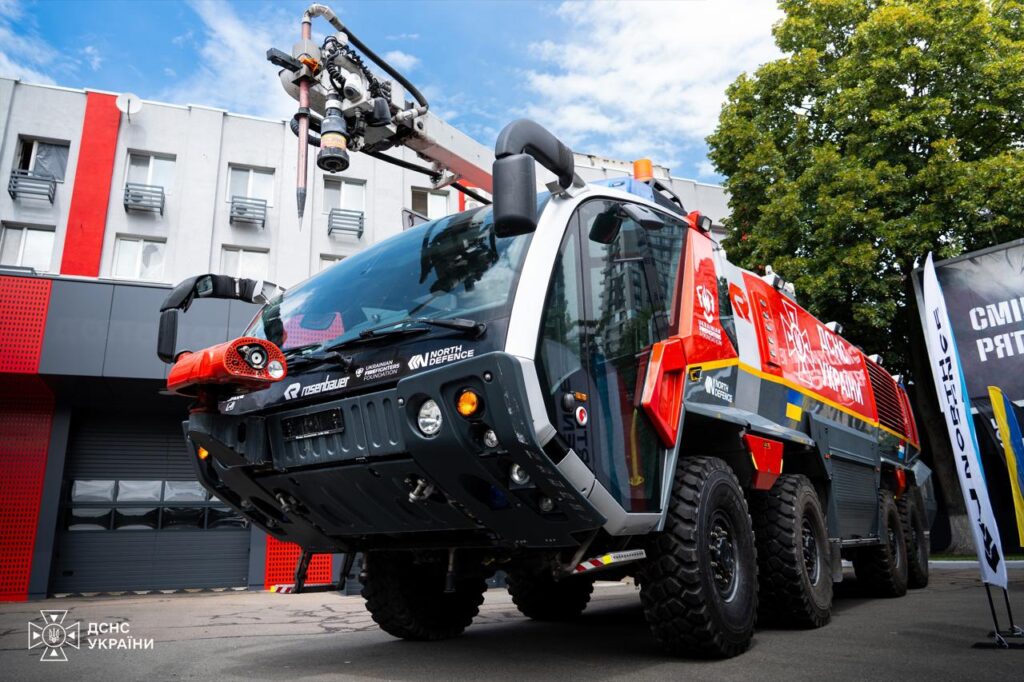
Ukraine's rescuers have a powerful new firefighting truck. The vehicle fleet of Ukraine's State Emergency Service (SES) gained a Rosenbauer Panther 8×8 airport firefighting vehicle, which will soon enter service and help rescuers carry out the most difficult tasks, the SES announced.

According to the UN, since the start of Russia's full-scale war, at least 16,141 civilians, including 803 children, have been confirmed killed, while 48,613 people, including 2,960 children, have been injured, UkrInform has reported.

The Rosenbauer Panther is a heavy airport crash-and-rescue vehicle, among the most capable firefighting machines, built to reach large fires quickly and deliver water and foam at high volume.

Donation came from Luxembourg

Its transfer to Ukraine was made possible by the charitable foundation "Ukrainian Firefighters", the company North Defence, and the Ministry of Defense of the Grand Duchy of Luxembourg, which systematically support Ukrainian emergency workers with equipment, gear, and training.

It is one more piece of European backing for the rescuers who work on the aftermath of Russian strikes on Ukrainian cities.

During the handover, Deputy Head of the SES Roman Prymush thanked the partners for their trust and constant, systematic support, saying that this help strengthens the service's ability to save lives every day.

A Rosenbauer Panther 8×8 airport firefighting vehicle. Source: The Ukrainian State Emergency Service
The rescuers who receive it work under fire

The equipment matters because of what Ukraine's emergency service now does. Beyond ordinary fires and accidents, SES crews are the ones who arrive at the sites of Russian missile and drone strikes, pulling people from collapsed buildings and fighting the fires that follow, often under the threat of a second strike aimed at the responders.

A heavy firefighting vehicle built for airport-scale fires adds capacity for exactly the large blazes that strike fuel depots, warehouses, and infrastructure. The Panther joins a steady flow of European donations of vehicles and equipment to Ukraine's rescue services.

  • ✇Euromaidan Press
  • Ukraine’s new combat robot is silent, fits in minivan, and carries MK19 grenade launcher
    Ukraine put a grenade launcher on a robot that fits in the back of a minivan. Ukraine's Defense Ministry has codified the new "Zmii Mini Strike" reconnaissance-strike ground robotic complex for fire support and destroying enemy personnel and armor. The platform's base configuration mounts an MK19 automatic grenade launcher — a weapon that delivers high kinetic energy, offers a wide range of round types, and can fire accurately from concealed positions. It runs on a silent e
     

Ukraine’s new combat robot is silent, fits in minivan, and carries MK19 grenade launcher

20 juillet 2026 à 10:24

Ukraine's Defense Ministry has codified the new "Zmii Mini Strike" reconnaissance-strike ground robotic system. Source: Ukraine's Defense Ministry

Ukraine put a grenade launcher on a robot that fits in the back of a minivan. Ukraine's Defense Ministry has codified the new "Zmii Mini Strike" reconnaissance-strike ground robotic complex for fire support and destroying enemy personnel and armor.

The platform's base configuration mounts an MK19 automatic grenade launcher — a weapon that delivers high kinetic energy, offers a wide range of round types, and can fire accurately from concealed positions.

It runs on a silent electric motor, carries day and thermal cameras, and is compact enough to fit in a minivan's luggage compartment, a pickup bed, or a standard car trailer without special transport equipment.

Ukraine develops more and more robots every month 

Its design draws on more than four years of full-scale war and analysis of how ground robots actually perform in combat, and its engineers worked with one of Ukraine's most effective combat brigades during development.

The Zmii line is not new. Earlier models are already running missions with Ukraine's Defense Forces, but this armed-strike variant is the newest entry.

The Zmii Mini Strike joins a ground-robot inventory that Ukraine is expanding almost weekly.

Silent and small is how robot survives to shoot

The silent electric motor and the compact size of the drone are survival traits rather than combat ones. A quiet robot is harder to detect by sound, and a small one is harder to spot and hit. At the same time, a platform that deploys and packs up fast spends less time exposed.

However, the connectivity can be the catch. Defense Ministry adviser Serhii "Flash" Beskrestnov has warned that ground robots operate in a far more challenging communication environment than aerial drones, because terrain, tree lines, and cover can break the control signal, and a robot that loses its link drops out of the fight. A silent, well-armed gunner is only as useful as the link that keeps it firing.

  • ✇Euromaidan Press
  • Vatican’s top diplomat visits Russian strike site in Kyiv
    The Vatican's foreign minister stood in the rubble of a Russian strike in Kyiv. Archbishop Paul Richard Gallagher, the Holy See's Secretary for Relations with States and International Organizations, visited the site of a Russian missile strike that destroyed residential buildings and killed civilians, Ukraine's State Emergency Service (SES) said on Facebook. Kyiv rescuers showed the archbishop how they work in the aftermath of Russian attacks, describing the search-and-resc
     

Vatican’s top diplomat visits Russian strike site in Kyiv

18 juillet 2026 à 15:15

Paul Richard Gallagher, the Holy See's Secretary for Relations with States and International Organizations, visited the site of a Russian missile strike in Kyiv. Source: The State Emergency Service

The Vatican's foreign minister stood in the rubble of a Russian strike in Kyiv. Archbishop Paul Richard Gallagher, the Holy See's Secretary for Relations with States and International Organizations, visited the site of a Russian missile strike that destroyed residential buildings and killed civilians, Ukraine's State Emergency Service (SES) said on Facebook.

Kyiv rescuers showed the archbishop how they work in the aftermath of Russian attacks, describing the search-and-rescue operations and the daily work of crews operating under the constant threat of repeat strikes.

Ukraine's rescuers work those sites under the threat of the double-tap, which is a Russian tactic of striking a location a second time after emergency crews arrive, which Ukraine's prosecutors have documented repeatedly.

Visit is one thread of Vatican's humanitarian engagement in Ukraine

It came days after Cardinal Matteo Zuppi, the pope's peace envoy, met Ukrainian Foreign Minister Andrii Sybiha in Kyiv on 16 July, where Sybiha pressed for a humanitarian corridor to evacuate civilians from Russian-occupied Oleshky, where UN and Human Rights Watch monitors say thousands are trapped without food or medical care.

The SES thanked the Holy See for its humanitarian aid to the Ukrainian people and for its solidarity, and said such visits are important evidence of international attention to the consequences of Russian aggression.

Vatican works humanitarian channels, not mediating role

The Holy See's engagement has focused on humanitarian work rather than mediation. Zuppi has run the Vatican's efforts on prisoner exchanges between Ukraine and Russia and on the return of Ukrainian children abducted to Russia, and the Ukrainian Greek Catholic Church has said plainly that the Vatican performs no mediating mission.

Pope Leo XIV, elected in 2025, has taken a sharper line on the war than his predecessor. Meeting Zelenskyy in December 2025, Leo appealed to Russia to make a gesture toward peace and warned that excluding Europe from peace talks on Ukraine was unrealistic.

Zelenskyy has invited him to visit Ukraine, which the pontiff said he hoped to do without committing to a date.

Russian missiles that killed 16 in Kyiv this week came from Bryansk. Partisans say they’ve burned EW towers shielding it

12 juillet 2026 à 01:50

Ukrainian partisan movement ATESH says it burned electronic warfare towers in Russia's Bryansk Oblast. Source: ATESH

Ukrainian partisan movement ATESH says it burned electronic warfare towers in Russia's Bryansk Oblast, the region Russia uses to launch ballistic missiles at Kyiv. ATESH agents targeted communication and EW nodes in the cities of Fokino and Karachev in a coordinated operation, the group reveals.

The sabotage lands in the strategically critical zone that Russia uses for ballistic strikes on the Ukrainian capital. Iskander-M ballistic missiles launched from Bryansk Oblast reach Kyiv in about two minutes of flight time.

Ukrainian Volunteer Army spokesperson Serhii Bratchuk said on Kyiv24 TV that Russia has moved its launchers up to the Bryansk border, reducing flight time to the point that the air raid siren in Kyiv sounds after the first explosions ring out in the capital. Ukraine cannot intercept most of these strikes due to an acute shortage of Patriot missiles.

The past week's Russian ballistic strikes on Kyiv have all come from Bryansk. Russia fired six Iskander-M or S-400 ballistic missiles from Bryansk on the night of 11 July, which all six struck four Kyiv districts and wounded 10 people. The first explosions were heard more than a minute and a half before the air raid siren sounded.

On 8 July, five ballistic missiles hit Kyiv. On the night of 5-6 July, 23 Iskander-M/S-400 ballistic missiles launched from Bryansk, Oryol, and Kursk struck Kyiv, killing at least 16 and injuring 58.

Fokino and Karachev protect Russia's Bryansk launch infrastructure

The towers held EW complexes designed to suppress drones and their navigation systems, per ATESH. The claims have not been independently verified. 

Fokino is a closed city in Bryansk Oblast about 100 kilometers from the Ukrainian border. Karachev is about 180 kilometers from the border. Both cities are within the zone where Russia has concentrated the ballistic-missile launchers that have been hitting Kyiv.

ATESH said the destruction of the Fokino and Karachev EW towers created a gap in Russian border defense and blinded local air defense, depriving it of the ability to target Ukrainian drones. Without EW cover in the Fokino-Karachev area, a direct tactical corridor opened for Ukrainian drones to strike deeper into the central regions of Russia. The strategic implication runs both ways: the EW towers ATESH burned also protected Russia's ballistic launchers from Ukrainian counterstrikes.

ATESH has hit Bryansk targets before. In October 2025, the group disabled a communications tower responsible for coordinating Russian occupation forces and border units in Bryansk Oblast. 

ATESH template: burn EW cover, enable Ukrainian strikes

ATESH is a Ukrainian-Crimean Tatar partisan movement founded in September 2022 in response to Russia's full-scale invasion. The group operates in occupied Ukrainian territories and in Russia itself, with members including Crimean Tatars, Ukrainians, and Russians who were mobilized into the Russian army but now work for Ukraine.

ATESH's operational template through 2026 has been consistent: burn EW towers, damage air-defense transformers, and Ukrainian drones exploit the newly created corridor. In March 2026, ATESH burned three EW towers in Novgorod Oblast, opening a route for Ukrainian drones to reach a military aircraft repair plant in Staraya Russa.

  • ✇Euromaidan Press
  • Analysts spotted missile launcher Ukraine had kept classified for three years
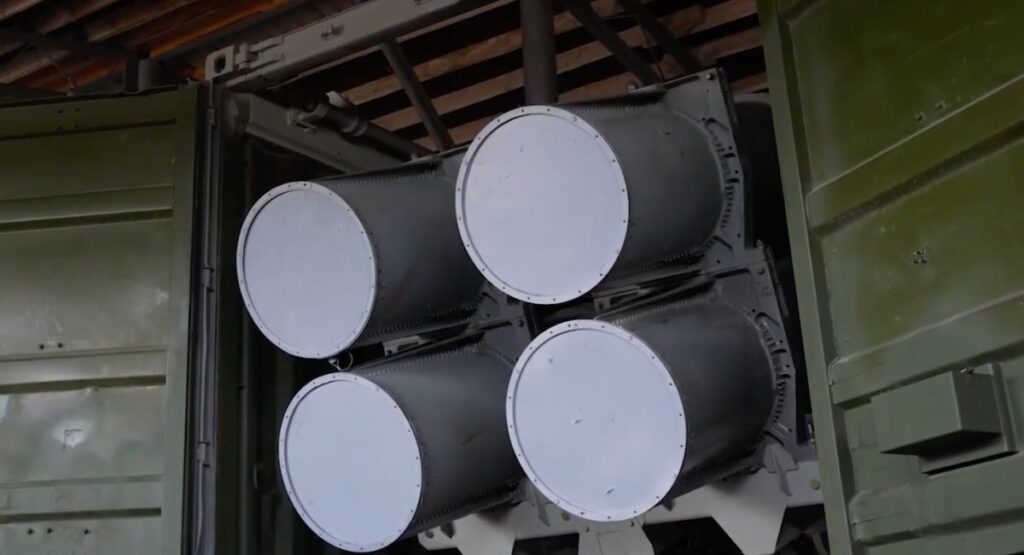
    Ukraine showed its Harpoon for the first time on 4 July. The launchers appeared in a video from Zelenskyy's working trip to Odesa Oblast, during which he held a coordination meeting with the Ukrainian Navy Command on missile and drone threats, sea threats, and Ukrainian deep strikes. The Harpoon has been in service with the Ukrainian Navy since 2022 and has destroyed Russian ships, but its launcher configuration has been classified. Defense Express experts spotted the launc
     

Analysts spotted missile launcher Ukraine had kept classified for three years

4 juillet 2026 à 15:16

Harpoon anti-ship missile launcher. Source: Defense Express

Ukraine showed its Harpoon for the first time on 4 July. The launchers appeared in a video from Zelenskyy's working trip to Odesa Oblast, during which he held a coordination meeting with the Ukrainian Navy Command on missile and drone threats, sea threats, and Ukrainian deep strikes.

The Harpoon has been in service with the Ukrainian Navy since 2022 and has destroyed Russian ships, but its launcher configuration has been classified.

Defense Express experts spotted the launchers in the released footage. In addition to the Harpoon, photos were also released showing the launcher of the Norwegian-made NSM (Naval Strike Missile) anti-ship missile system developed by Kongsberg.

Norwegian NSM deliveries to Ukraine had never been officially announced and were only reported at the media level.

Ukraine's anti-ship inventory has expanded throughout the war. Ukrainian forces used domestic Neptune missiles to sink Russia's cruiser Moskva in April 2022. The US and its allies considered both Harpoon and NSM transfers to Ukraine that same May. The Ukrainian Navy confirmed the combat debut of the Swedish RBS 15 anti-ship missile in April 2026.

Harpoon launcher shows sea-container configuration

Ukraine received a Harpoon variant installed inside a sea container, with four transport-launch canisters. Although Harpoon missiles are not young, Boeing has been modernizing the platform, and in 2025, the company tested an updated Harpoon Block II variant.

NSM origin remains unknown

The NSM launcher shown in Ukraine has a distinctive Ukrainian paint scheme that does not match any documented source country. Poland was reported in 2023 as a potential source, with Ukraine possibly buying a battery or even a battalion of the NSM Coastal Defense System from Warsaw. But the Ukrainian variant's different painting leaves the actual source unknown.

The system was jointly developed by Kongsberg and Raytheon, with a coastal-launched range of 250 km. Kongsberg has expanded its presence in Ukraine through 2025 and 2026, including NASAMS integration and a planned joint venture for interceptor missile production. 

❌