Vue lecture

One tower linked two Russian regiments near Kharkiv border. Ukrainian partisans say they disabled it 
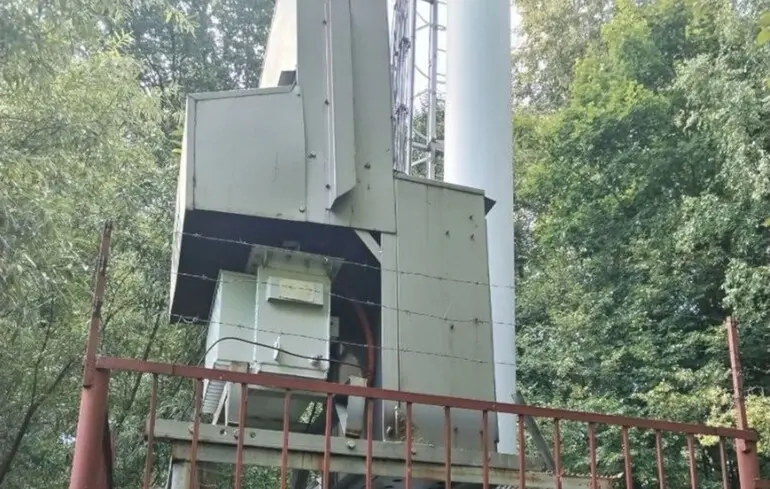
Close-up of equipment at the base of a communications tower behind a metal fence in a wooded area.

On 13 August, the Ukrainian-Crimean Tatar partisan movement ATESH said its agents had disabled a communications tower near Pylna in northern Kharkiv Oblast. The group said the damage disrupted links between two Russian motor rifle regiments near the border.

Pylna lies on the Russian border and was among the villages seized when Moscow opened the northern Kharkiv front in May 2024. The claimed tower attack is part of a wider Ukrainian resistance effort behind Russian lines. Moscow's forces still depend on infrastructure in occupied territory to communicate, move supplies, and hold the line. Ukraine’s underground fighters exploit that dependence from within, targeting communications, transport, and fuel supplies to create problems for Russian units at the front.

ATESH said the tower carried data between Russian command posts and coordinated units in the area. The movement said its loss disrupted command channels and delayed border-zone mobile groups. It did not say how agents disabled the tower or how long the interruption would last.
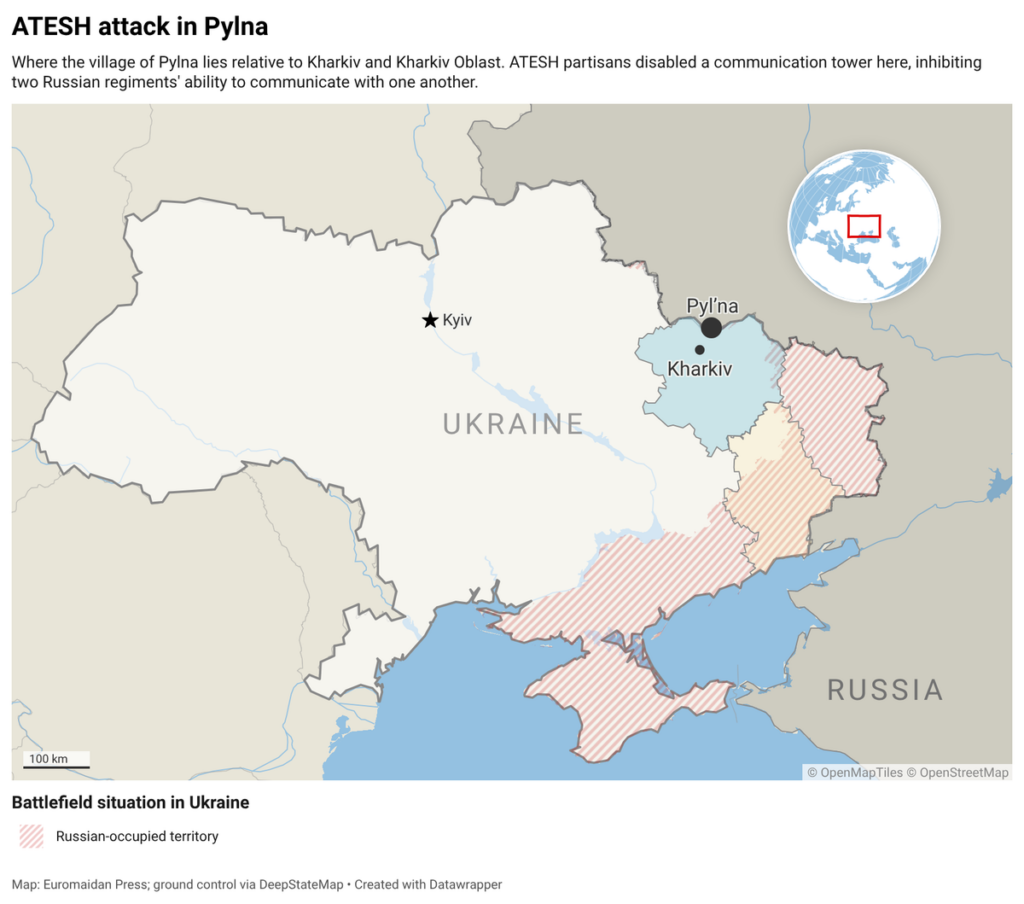
The partisans stated that the communications between Russia’s 345th and 380th motor rifle regiments were hit hardest. The regiments operate in neighboring sectors and rely on stable links for joint action and rapid responses, according to the group. ATESH claimed their offensive tempo and ability to support each other had fallen.

Neither the claimed ATESH sabotage nor its reported effects have been independently verified.

ATESH attacks on Russian supply lines

The tower claim follows ATESH’s 10 August account of sabotaging an electric locomotive near Voronezh. The group said it carried military supplies toward the Kupiansk front in Kharkiv Oblast. In June, ATESH also said agents damaged power and rail equipment near Russia’s Novomoskovsk Azot plant, whose output feeds explosives production.

ATESH has also reported intelligence work inside Russian forces. In July, the group said an agent reported a Ukrainian strike on five military fuel trucks in occupied Luhansk. Together, the claims describe a campaign against transport, fuel, and communications behind the front.

Ukrainian resistance works behind the front

The claimed tower operation is one part of the Ukrainian resistance behind Russian lines. Underground networks also gather intelligence and sustain civil defiance. 

A Euromaidan Press investigation documented groups planting explosives, tracking Russian positions, distributing leaflets, and painting Ukrainian symbols despite the threat of imprisonment and torture.

ATESH says its network includes Ukrainians, Crimean Tatars, anti-war Russians, and sources inside Russia’s military and occupation administrations. Its claims are often impossible to verify independently. Taken together, they portray a campaign to make Russia’s rear less secure while other groups preserve Ukrainian identity under occupation.
  •  

Ukraine’s newest frontline motorcycle drives over anti-vehicle mines and works as power station

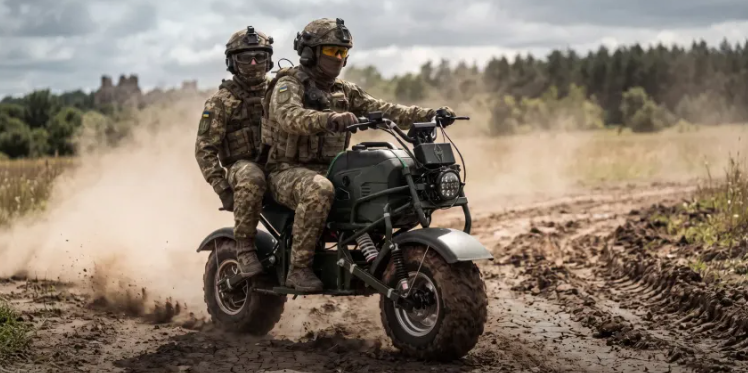
Ukraine codified the MUL.E, its first all-wheel-drive electric military motorcycle. Source: The Ukrainian Defense Ministry

Ukraine's newest frontline motorcycle can carry two soldiers, avoid the mines that kill trucks, and recharge a unit's drones. The Defense Ministry codified the MUL.E, Ukraine's first all-wheel-drive electric motorcycle, and cleared it for use in the Armed Forces, the Defense Ministry announced.

Motorcycles have become one of the most sought-after vehicles on the front, alongside pickups, giving Ukrainian troops speed and mobility where logistics are hard, roads are absent, or small groups operate.

In 2026, Ukraine's Defense Procurement Agency contracted 1,500 motorcycles for the Armed Forces, three times last year's volume, and by bringing six companies into a competitive tender, it cut the final price and saved the state budget nearly $290,000. The MUL.E is the sharper end of that push: not just cheaper transport bought in bulk, but a purpose-built machine with capabilities no internal-combustion motorcycle has.

The MUL.E was developed at a Ukrainian defense enterprise in response to soldiers' requests for high-intensity modern warfare. It carries personnel with weapons, small cargo, and wounded across all surfaces, including off-road, and can tow a loaded trailer, per the Defense Ministry.

What sets MUL.E apart

During testing, the MUL.E confirmed its stated characteristics, the Defense Ministry said. Its distinctive features are the ones a conventional military motorcycle lacks: a 2×2 all-wheel-drive design, two independent motors for survivability if one fails, near-silent operation, fast deployment and packing, long autonomous running time, and significant range.

The mine resistance is the standout. The MUL.E's wide off-road tires and all-wheel drive let it cross difficult terrain, washed-out ground, sand, deep snow, and marsh, and because it exerts low ground pressure, roughly like an infantryman's foot, it does not trigger most mines designed to destroy cars and armored vehicles. A vehicle that can drive over anti-vehicle mines without setting them off is a real advantage on a front where mining has made many routes impassable.

Bike is also power station

The MUL.E's second role is what its makers call a bike-generator. A full charge lasts nearly 100 kilometers, and unlike other electric vehicles, the MUL.E does not simply stop when its batteries run out.

Mounted on the frame is an additional gasoline generator that recharges the onboard batteries. It is detachable, so it can be lifted off and used as a power source in its own right: charging the batteries of phones, communications equipment, and FPV drones, or supplying electricity to a unit in field conditions. That turns the motorcycle into mobile infrastructure.

A small group operating far from any grid can ride the MUL.E in silently, then use it to keep their drones and radios powered.

The dual function fits Ukraine's wider drive toward electric frontline transport that is quiet and hard to detect. Ukraine approved the WOLFSTORM electric motorcycle in June 2026, an 80 km/h machine that defeats thermal and acoustic detection and carries two soldiers in full gear.

The MUL.E adds all-wheel drive, mine resistance, and a generator to that concept, extending what an electric two-wheeler can do for the small mobile groups that increasingly define how Ukraine fights.

  •  
❌