
 Connexion
Two plants make 70% of Ukraine’s steel. Russia hit both. Then ports closed, rail costs rose 30%, and the EU’s carbon tax kicked in

Russian missile strikes shut down or damaged four of Ukraine's largest steel plants in August and September, halving steel output and prompting the operator of the country's largest plant to call on the government to pass a dedicated rescue plan, RBC-Ukraine reported.
Russia's full-scale war has already cost Ukraine the Azovstal plant in Mariupol, one of its largest steel mills, and more than two years of disrupted production across the sector. The latest strikes hit plants that produce the bulk of remaining capacity, concentrated in a single month, in what the industry describes as a deep crisis for a sector that supplies 6% of the country's GDP.
Steel output halved as missiles hit plants producing 70% of Ukraine's steel
The 11 August strike on Zaporizhstal killed seven workers and injured 21 as they headed for a shelter, Metinvest said; a second ballistic strike on the plant followed on 27 August. Two died and 13 were injured at ArcelorMittal Kryvyi Rih, and five were killed at Kametstal. Russia also hit the Dnipro Metallurgical Plant. On 12 September, Russia struck both Zaporizhstal and ArcelorMittal Kryvyi Rih again with ballistic missiles.
Zaporizhstal and Kametstal, both part of the Metinvest group, stopped entirely. ArcelorMittal Kryvyi Rih—Ukraine's largest steel plant—partially shut down. Zaporizhstal and ArcelorMittal alone produce more than 70% of Ukraine's steel.
August steel production fell to 277,000 tons, down 57.3% year on year and 39.4% from July, according to Ukrmetalurhprom data cited by GMK Center. Rolled-metal output dropped to 270,000 tons.
Strikes, a port blockade, and rising costs hit at once
The strikes came on top of a Black Sea port blockade that has shut down maritime exports of iron ore and steel since late July. A 30% increase in rail tariffs took effect on 1 August. Alternative routes—rail through western border crossings, Danube ports, and roads—can carry at most 50% of what the Black Sea ports handled, GMK Center analyst Andrii Hlushchenko said. Steelmakers also have to compete with farmers for that limited rail capacity.
Rail exports of iron ore and metals dropped 2.5 times in the first 15 days of September compared with the same period last year, Ukrzaliznytsia said. Shipping iron-ore pellets through European ports costs $50–60 per ton, making many deliveries unprofitable.
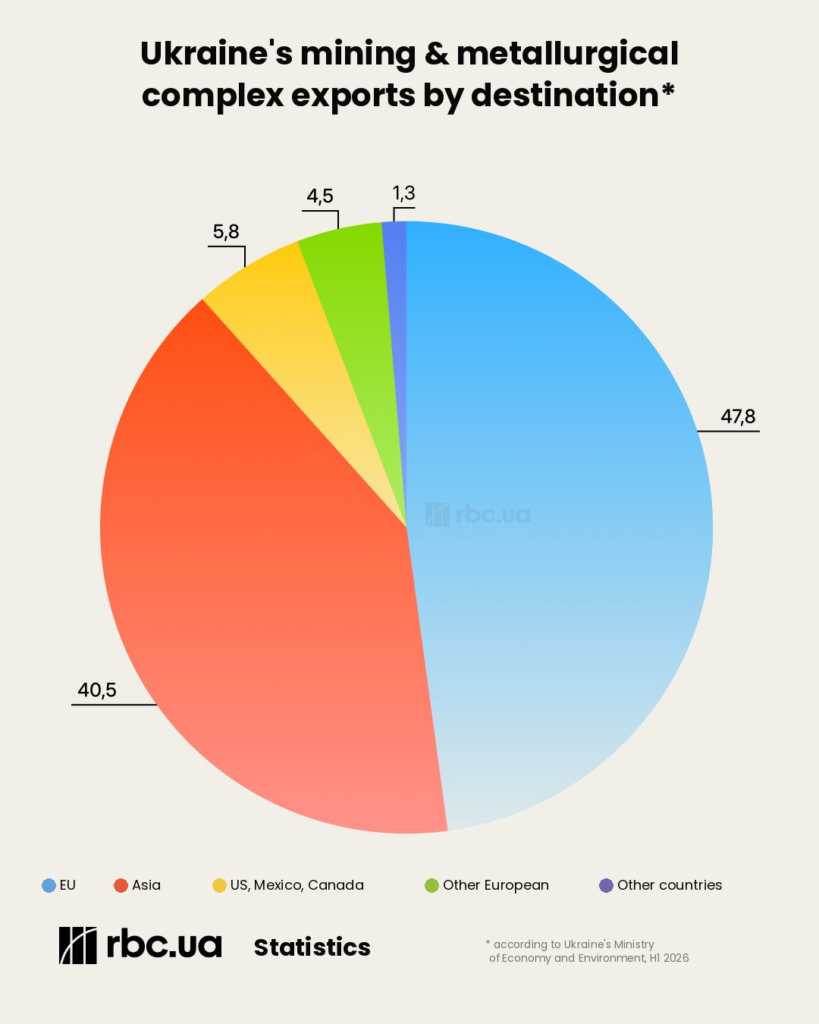
The steel sector generated 6% of Ukraine's GDP last year, brought in 13% of all foreign-currency earnings, and paid UAH 27 billion (about $606 million) into budgets between January and July. Deputy chair of the parliamentary economic committee Dmytro Kysylevskyi called the situation "a perfect storm."
Meanwhile, Türkiye re-rolls Russian slabs and sells the resulting steel on Ukraine's domestic market. China uses cheap Russian energy to undercut Ukrainian prices.
"We are effectively importing Russian metal in the form of finished products," Ukrmetalurhprom President Oleksandr Kalenkov said.
ArcelorMittal calls for a Cabinet rescue resolution
ArcelorMittal Kryvyi Rih CEO Mauro Longobardo said the government should pass a dedicated Cabinet resolution assigning specific tasks and deadlines to multiple agencies at once.
"No single agency can solve the full set of problems. Without a single document with assigned responsibilities and deadlines, each issue is dealt with in isolation and stalls," ArcelorMittal Kryvyi Rih representatives said.
The resolution should cover EU negotiations on deferring the carbon border tax (CBAM) until at least the end of martial law plus one year, restoring steel quotas to last year's level, stabilizing rail tariffs, securing long-term electricity contracts for industry, and launching anti-dumping investigations against Turkish and Chinese imports, Longobardo said.
Ukraine's Economy and Environment Ministry said it is in talks with the European Commission on easing CBAM and expanding quotas. A Cabinet source told the outlet that Black Sea trade negotiations with Russia are possible in October, after the Duma elections that ended on 20 September.
