❌

Vue normale

  • ✇404 Media
  • University Rescinds Job Offer to Activist Who Allegedly Wiped Phone Before DHS Could Search It
    Georgia State University has rescinded a job offer given to a high profile activist who is currently fighting a case in which he allegedly wiped a security-focused Android phone before Customs and Border Protection (CBP) could search it. The case, which 404 Media first covered and has now received widespread and national attention, has important ramifications for privacy and when someone can still be charged with an offense even if authorities don’t have suspicion of any specific crime.Earlie
     

University Rescinds Job Offer to Activist Who Allegedly Wiped Phone Before DHS Could Search It

17 septembre 2026 à 11:30
University Rescinds Job Offer to Activist Who Allegedly Wiped Phone Before DHS Could Search It

Georgia State University has rescinded a job offer given to a high profile activist who is currently fighting a case in which he allegedly wiped a security-focused Android phone before Customs and Border Protection (CBP) could search it. The case, which 404 Media first covered and has now received widespread and national attention, has important ramifications for privacy and when someone can still be charged with an offense even if authorities don’t have suspicion of any specific crime.

Earlier this month, activist Samuel Tunick and a group of supporters delivered a “demand letter” to the university. That letter, which Tunick shared with 404 Media, says he explained to the university he was facing a pending charge, which he describes as “an instance of textbook political repression, and a high profile civil liberties case.”

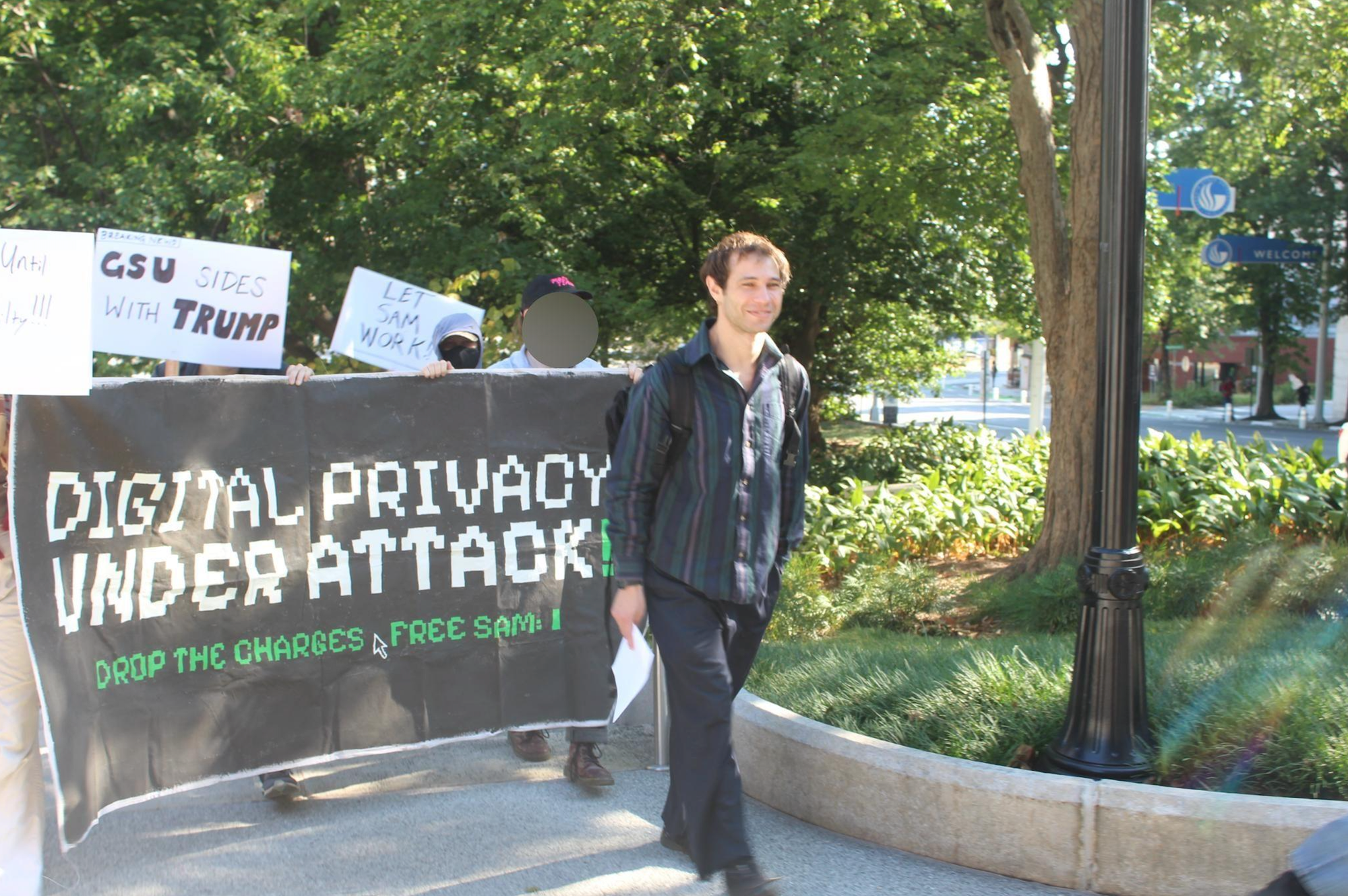
While delivering the letter, supporters held signs saying, “GSU sides with Trump,” and “Digital Privacy Under Attack!”

💡
Do you know anything else about this case? I would love to hear from you. Using a non-work device, you can message me securely on Signal at joseph.404 or send me an email at joseph@404media.co.

Tunick told 404 Media he was supposed to start his Teaching Assistant job on August 25. Then six hours before his first lab, Tunick received an automated email saying he had not passed the required background check. The letter says Tunick’s head of department asked the university for more information about the relevant hiring policy, “and she was told that there actually aren’t any.” Instead, in Tunick’s telling, “this was a subjective, and essentially arbitrary decision made for reasons that have not been made clear to me or other faculty.”

Tunick was also planning to pursue a M.S. of Geosciences at Georgia State, and was going to receive a tuition waiver and wages for his work as a Teaching Assistant. “Now I have had both my tuition waiver and source of income pulled out from under me at the drop of a hat, my economic security and academic career threatened due to a single absurd charge, to which I have pleaded ‘not guilty,’” the letter continues. 

Tunick shared screenshots of emails between him and various faculty. One sent by the department head said, “I was told that the ‘Background Check Committee’ denied the approval for your hire, the Dean of Students denied the approval, and the legal department denied your approval.” That email reiterated there is no policy to be pointed to, and that each hire “undergoes a risk assessment on a case-by-case basis.” In another email, Tunick notes he had a misdemeanor in Fulton County, but these charges were dismissed.

Georgia State University did not respond to a request for comment.

404 Media first broke news of Tunick’s case in December and published an interview with Tunick and one of his lawyers, Matthew Dodge, in July. The airport encounter that led to the charge happened in January 2025, when Tunick was returning to the U.S. after a vacation in the Dominican Republic. Department of Homeland Security (DHS) officials called the airport ahead of time and asked agents there to stop Tunick, Dodge said.

The officers asked to search Tunick’s bags and pat him down, both of which he refused. Agents searched him and found nothing improper, Dodge said. Then, the agents said they wanted to search Tunick’s phone. Tunick provided them a code, which an officer then typed into the device. Rather than unlocking the phone, the device “went to a blank screen” and displayed the logo of GrapheneOS. In other words, the code wiped the device.

GrapheneOS is a security- and privacy-focused operating system, which includes all sorts of additional features. One of those is the duress password feature that “will irreversibly wipe the device,” according to GrapheneOS’s website. 

Tunick participated in the Stop Cop City movement in Atlanta, and in a previous interview with 404 Media, Tunick put his prosecution for wiping his phone squarely in the context of other cases against the movement. Before the airport encounter, Tunick found out from his lawyer a tracker had been placed on his car. He also learned authorities subpoenaed his cellphone records and Gmail data. Tunick previously failed a background check for a job on a Christmas tree lot which involved going onto the property of a school, he previously said. When he asked the Atlanta Public Schools office about it, he was directed to the FBI.

The authorities “really just tried to dig up anything they could on me and they didn’t find anything,” Tunick previously told 404 Media. “At this point, it almost seems like it’s just intended to make my life miserable and discourage participation in any sort of advocacy or activism.”

The letter demands that Georgia State reinstate Tunick’s employment and/or the tuition waiver; provide more information about the hiring and background review process; and apply an “innocent until proven guilty” principle on hiring decisions.
  • ✇404 Media
  • Podcast: Humans Are Reading Your ChatGPT Conversations
    We start this week with Joseph’s story about the people who are reading real ChatGPT users’ prompts and conversations. He got a bunch of documents all about these contractors and saw real prompts himself. After the break, Sam tells us all about the Automattic CEO getting kicked out. Then coming back again. In the subscribers-only section, Emanuel tells us why a16z thinks enshittification is not real. Listen to the weekly podcast on Apple Podcasts, Spotify, or YouTube. Become a paid subscri
     

Podcast: Humans Are Reading Your ChatGPT Conversations

16 septembre 2026 à 10:19
Podcast: Humans Are Reading Your ChatGPT Conversations

We start this week with Joseph’s story about the people who are reading real ChatGPT users’ prompts and conversations. He got a bunch of documents all about these contractors and saw real prompts himself. After the break, Sam tells us all about the Automattic CEO getting kicked out. Then coming back again. In the subscribers-only section, Emanuel tells us why a16z thinks enshittification is not real.

Listen to the weekly podcast on Apple Podcasts, Spotify, or YouTube. Become a paid subscriber for access to this episode's bonus content and to power our journalism. If you become a paid subscriber, check your inbox for an email from our podcast host Transistor for a link to the subscribers-only version! You can also add that subscribers feed to your podcast app of choice and never miss an episode that way. The email should also contain the subscribers-only unlisted YouTube link for the extended video version too. It will also be in the show notes in your podcast player.

  • ✇404 Media
  • Hackers Stole Flock’s Camera Software, Revealing How the Company Tracks Cars and People
    This article was produced in collaboration with WIRED. You can read their version of the article here.Hackers ripped down a Flock camera above a roadway, made a near-complete copy of the data stored inside it, and shared the files with 404 Media and WIRED, revealing in new detail how exactly Flock Safety’s cameras track the movements of both vehicles and people. The hackers say they are also publishing details on how they managed to obtain the software, in the hopes that other people may copy th
     

Hackers Stole Flock’s Camera Software, Revealing How the Company Tracks Cars and People

16 septembre 2026 à 06:30
Hackers Stole Flock’s Camera Software, Revealing How the Company Tracks Cars and People

This article was produced in collaboration with WIRED. You can read their version of the article here.

Hackers ripped down a Flock camera above a roadway, made a near-complete copy of the data stored inside it, and shared the files with 404 Media and WIRED, revealing in new detail how exactly Flock Safety’s cameras track the movements of both vehicles and people. The hackers say they are also publishing details on how they managed to obtain the software, in the hopes that other people may copy them.

  • ✇404 Media
  • Inside ‘Project Lily’: The Humans Reading Your ChatGPT Chats
    OpenAI is hiring hundreds of contractors who read a massive stream of real users’ ChatGPT prompts, with the prompts sometimes including sensitive personal information, 404 Media has learned. The prompts these people review can include whole conversations between users and the chatbot, conversations that most of ChatGPT’s more than 900 million users probably don’t realize may be read by actual people.The goal of these prompt review teams is to improve the responses ChatGPT gives to its users,
     

Inside ‘Project Lily’: The Humans Reading Your ChatGPT Chats

14 septembre 2026 à 10:22
Inside ‘Project Lily’: The Humans Reading Your ChatGPT Chats

OpenAI is hiring hundreds of contractors who read a massive stream of real users’ ChatGPT prompts, with the prompts sometimes including sensitive personal information, 404 Media has learned. The prompts these people review can include whole conversations between users and the chatbot, conversations that most of ChatGPT’s more than 900 million users probably don’t realize may be read by actual people.

The goal of these prompt review teams is to improve the responses ChatGPT gives to its users, with the contractors rating and critiquing the chatbot’s generated replies. Internal documents seen by 404 Media show contractors training ChatGPT to not anthropomorphize itself, and to be less sycophantic, a key problem for OpenAI whose over-sycophantic 4o model led in part to multiple peoples’ suicides, according to various lawsuits.

💡
Do you work as a prompt reviewer for OpenAI or Anthropic? I would love to hear from you. Using a non-work device, you can message me securely on Signal at joseph.404 or send me an email at joseph@404media.co.

The news presents a major privacy risk for ChatGPT’s users, with people often using ChatGPT as a therapist, professional assistant, or digital friend, and providing it with all sorts of intimate details about their lives. The contractors don’t see ChatGPT usernames, and OpenAI says it tries to remove personal information before prompts reach the reviewers, but the company acknowledged sensitive details can still get through. 

The news also dispels the misconception that these models are improving only because of OpenAI’s mass scraping of the internet, the talent of its well-paid engineering and AI teams, or the power of its newer models. An important and overlooked part are the outside contractors paid to read and review ChatGPT responses to real prompts over and over again. Anthropic confirmed to 404 Media it is also using human review to improve its models.

“No,” someone who works with the prompts said when asked if they think ChatGPT users know that humans are reading their chats. “I don’t think they would imagine some contractor somewhere [...] is analyzing the conversations.”

❌