Cet épisode aurait dû être fait il y a longtemps mais il n'est jamais trop tard pour bien faire ! J'ai donc l'immense plaisir de recevoir le professeur et essayiste Jonathan Livernois qui nous présente sa formidable biographie de Gérald Godin. En parcourant la vie du poète, journaliste et politicien, on se rend compte que c'est tout le Québec de la deuxième moitié du XX siècle qui tournoie à travers sa vie. Crédit photo: Gabor Szilasi / BAnQ Fonds ministère de la Culture et des Communications
Cet épisode aurait dû être fait il y a longtemps mais il n'est jamais trop tard pour bien faire ! J'ai donc l'immense plaisir de recevoir le professeur et essayiste Jonathan Livernois qui nous présente sa formidable biographie de Gérald Godin. En parcourant la vie du poète, journaliste et politicien, on se rend compte que c'est tout le Québec de la deuxième moitié du XX siècle qui tournoie à travers sa vie.
Crédit photo: Gabor Szilasi / BAnQ Fonds ministère de la Culture et des Communications
To mark the release of our new book “Abundance,” my co-author Derek Thompson had me on his podcast, “Plain English,” to talk about it. We’re on book tour right now, so we’re doing a lot of talking about this book. But this conversation is different. It’s just Derek and me, and we get into the story of how the book came together, and all the people and ideas that influenced us – a kind of intellectual history of the abundance agenda. And I thought the audience of this show might find this interes
To mark the release of our new book “Abundance,” my co-author Derek Thompson had me on his podcast, “Plain English,” to talk about it. We’re on book tour right now, so we’re doing a lot of talking about this book. But this conversation is different. It’s just Derek and me, and we get into the story of how the book came together, and all the people and ideas that influenced us – a kind of intellectual history of the abundance agenda. And I thought the audience of this show might find this interesting too.
This episode of “Plain English” was recorded on March 11.
After the last election, there were all kinds of theories about where Democrats went wrong. But now, four months later, we have a lot more data – and it tells a few clear stories.David Shor is the head of data science at Blue Rose Research, a Democratic polling firm, which does an enormous amount of surveying of the electorate. A few weeks ago, Shor was walking me through a deck he made of key charts and numbers that explain the election results. And I thought this would be good to do in public.
After the last election, there were all kinds of theories about where Democrats went wrong. But now, four months later, we have a lot more data – and it tells a few clear stories.
David Shor is the head of data science at Blue Rose Research, a Democratic polling firm, which does an enormous amount of surveying of the electorate. A few weeks ago, Shor was walking me through a deck he made of key charts and numbers that explain the election results. And I thought this would be good to do in public. Because this is information that doesn’t just help explain what went wrong for Democrats in 2024. It’s a set of hard truths they need to keep in mind to mount a comeback in 2026 and 2028.
This episode is also a bit of an experiment. It works great in audio. But on YouTube, you can actually see the slides. So if you’re up for a video podcast, this is a good one to start with: https://www.youtube.com/@EzraKleinShow
This episode of “The Ezra Klein Show” was produced by Jack McCordick. Fact-checking by Michelle Harris. Mixing by Isaac Jones, with Efim Shapiro and Aman Sahota. Our executive producer is Claire Gordon. The show’s production team also includes Rollin Hu, Elias Isquith and Kristin Lin. Original music by Pat McCusker and Aman Sahota. Audience strategy by Kristina Samulewski and Shannon Busta. The executive producer of New York Times Opinion Audio is Annie-Rose Strasser.
C'est le retour d'Helen Faradji qui nous propose 5 commandements culturels pour survivre à notre époque. Avec la professeure Mélissa Thériault, on présente une réédition qu'elle a pilotée du récit de voyage de Henry David Thoreau à Montréal et Québec en 1850, un récit tout à fait étonnant même si truffé de préjugés bien gras envers le Québec de l'époque. Et le journaliste indépendant Martin Forgues analyse les probabilités d'une invasion américaine en regard de son propre passé militaire.
C'est le retour d'Helen Faradji qui nous propose 5 commandements culturels pour survivre à notre époque. Avec la professeure Mélissa Thériault, on présente une réédition qu'elle a pilotée du récit de voyage de Henry David Thoreauà Montréal et Québec en 1850, un récit tout à fait étonnant même si truffé de préjugés bien gras envers le Québec de l'époque. Et le journaliste indépendant Martin Forgues analyse les probabilités d'une invasion américaine en regard de son propre passé militaire.
It’s hard to understand the economic logic of President Trump’s tariffs. In our last episode, we tried, but with limited success. And that might be because the logic here isn’t entirely economic at all.So we wanted to spend an episode looking at Trump’s economic policies through a wider lens.Gillian Tett is a columnist at The Financial Times and a member of its editorial board. She’s also a trained anthropologist with a Ph.D. And she brings both perspectives into this conversation — exploring Tr
It’s hard to understand the economic logic of President Trump’s tariffs. In our last episode, we tried, but with limited success. And that might be because the logic here isn’t entirely economic at all.
So we wanted to spend an episode looking at Trump’s economic policies through a wider lens.
Gillian Tett is a columnist at The Financial Times and a member of its editorial board. She’s also a trained anthropologist with a Ph.D. And she brings both perspectives into this conversation — exploring Trump’s policies as economics, as well as power politics, patronage and cultural messaging — which I think makes the whole thing make a bit more sense.
This episode of “The Ezra Klein Show” was produced by Rollin Hu. Fact-checking by Michelle Harris. Mixing by Isaac Jones, with Efim Shapiro and Aman Sahota. Our supervising editor is Claire Gordon. The show’s production team also includes Elias Isquith, Kristin Lin and Jack McCordick. Original music by Pat McCusker and Carole Sabouraud. Audience strategy by Kristina Samulewski and Shannon Busta. The executive producer of New York Times Opinion Audio is Annie-Rose Strasser. Special thanks to Pat McCusker.
Wall Street thought Donald Trump was bluffing about his tariff plans. The stock market rallied after his election. But the reality has started setting in. Trump is doubling down on tariffs, even as he warned Americans that the economy may experience a “period of transition,” insisting this is just short-term pain.So what exactly is Trump’s theory here? And how much pain should we expect?Answering those questions requires a bit of a tariffs primer. And the economist Kimberly Clausing kindly agree
Wall Street thought Donald Trump was bluffing about his tariff plans. The stock market rallied after his election. But the reality has started setting in. Trump is doubling down on tariffs, even as he warned Americans that the economy may experience a “period of transition,” insisting this is just short-term pain.
So what exactly is Trump’s theory here? And how much pain should we expect?
Answering those questions requires a bit of a tariffs primer. And the economist Kimberly Clausing kindly agreed to come on the show, walk through the basics, and help me make sense of what Trump is doing here. Clausing has modeled the possible costs and consequences of the tariffs Trump has proposed, and she breaks down how much you and I might end up paying. Clausing is a senior fellow at the Peterson Institute for International Economics, a professor at U.C.L.A. and the author of “Open: The Progressive Case for Free Trade, Immigration, and Global Capital.”
This conversation contains strong language.
Note: This conversation was recorded on Wednesday, March 5.
Mentioned:
We’re taping an “Ask Me Anything” episode soon. You can email me at ezrakleinshow@nytimes.com with a question. Please use the subject like “AMA.” We’ll consider any questions that are shared by the end of the day on Tuesday March 18.
This episode of “The Ezra Klein Show” was produced by Rollin Hu. Fact-checking by Michelle Harris. Mixing by Isaac Jones, with Efim Shapiro and Aman Sahota. Our supervising editor is Claire Gordon. The show’s production team also includes Elias Isquith, Kristin Lin and Jack McCordick. Original music by Pat McCusker. Audience strategy by Kristina Samulewski and Shannon Busta. The executive producer of New York Times Opinion Audio is Annie-Rose Strasser. Special thanks to Pat McCusker.
Right-wing populism thrives on scarcity. The answer is abundance. But a politics of abundance will work only if Democrats confront where their approach has failed. This audio essay is adapted from my forthcoming book, “Abundance,” which I wrote with Derek Thompson. You can preorder it here. And learn more about our book tour here.
Subscribe today at nytimes.com/podcasts or on Apple Podcasts and Spotify. You can also subscribe via your favorite podcast app here https://www.nytimes.com/activate-ac
Right-wing populism thrives on scarcity. The answer is abundance. But a politics of abundance will work only if Democrats confront where their approach has failed.
This audio essay is adapted from my forthcoming book, “Abundance,” which I wrote with Derek Thompson. You can preorder it here. And learn more about our book tour here.
En compagnie de la journaliste Gabrielle Brassard-Lecours on décortique l'enquête de Pivot sur la couverture des médias écrits francophones québécois de la guerre en Palestine pour découvrir des choses troublantes. Le sociologue Philippe De Grosbois nous partage ses réflexions sur l'impact (ou non) des deepfakes sur les démocraties à partir du premier deepfake "célèbre" de Barrak Obama en 2018. En fin d'épisode, Fred partage un témoignage fort pertinent d'un auditeur sur les médias et la guerre
En compagnie de la journaliste Gabrielle Brassard-Lecours on décortique l'enquête de Pivot sur la couverture des médias écrits francophones québécois de la guerre en Palestine pour découvrir des choses troublantes. Le sociologue Philippe De Grosbois nous partage ses réflexions sur l'impact (ou non) des deepfakes sur les démocraties à partir du premier deepfake "célèbre" de Barrak Obama en 2018. En fin d'épisode, Fred partage un témoignage fort pertinent d'un auditeur sur les médias et la guerre commerciale.
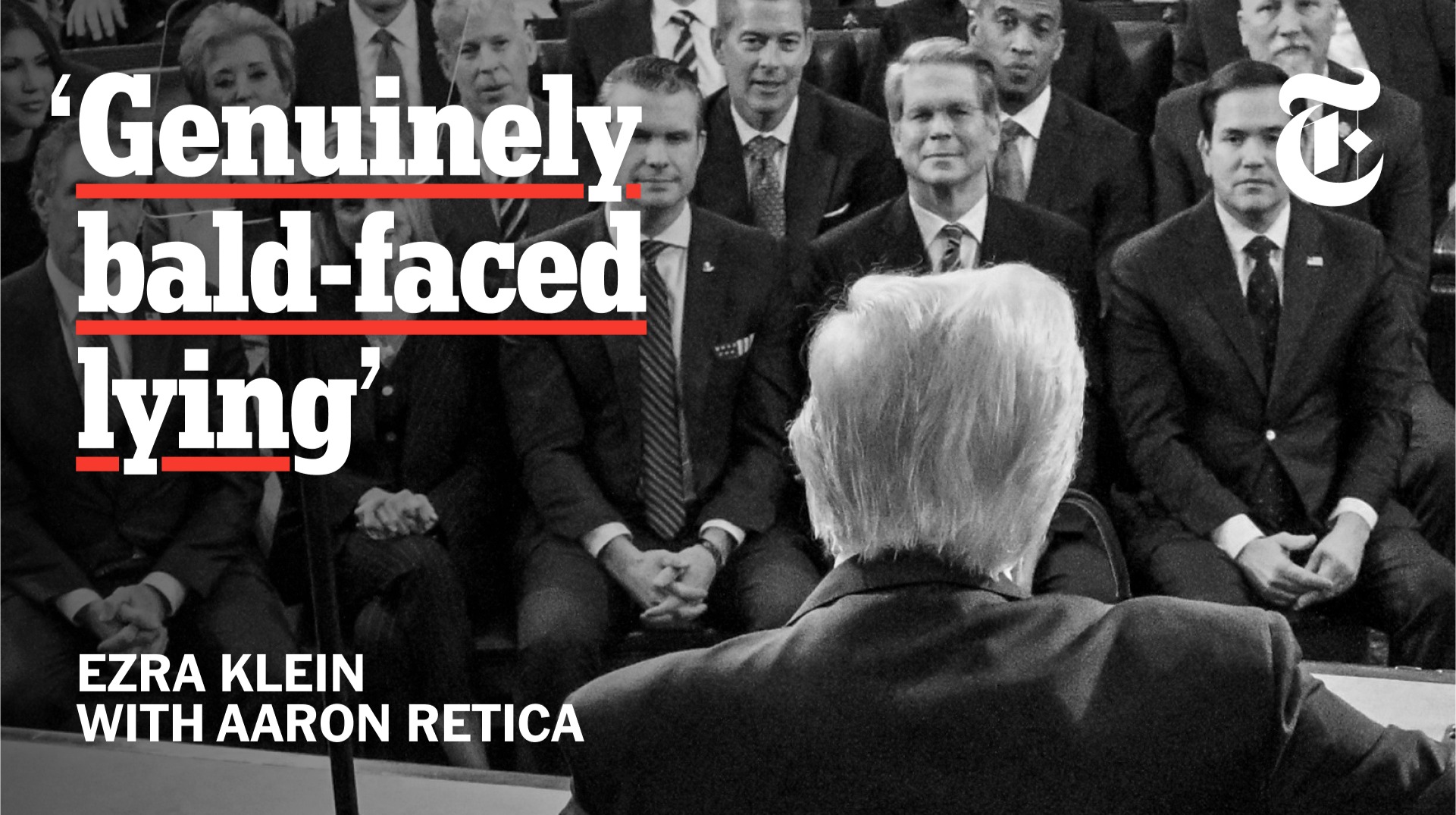
The economy has started blinking red. President Trump’s tariffs have been roiling markets. Consumer sentiment was already down. G.D.P. forecasts are predicting slower growth. And on Tuesday night Trump declared to Congress and the nation that things had never been better.Something was different about this speech. The level of baldfaced lying. The way Republicans cheered along. How uncomfortable and uncertain Democrats seemed. It was as if, watching it all, you could feel something rupturing.My e
The economy has started blinking red. President Trump’s tariffs have been roiling markets. Consumer sentiment was already down. G.D.P. forecasts are predicting slower growth. And on Tuesday night Trump declared to Congress and the nation that things had never been better.
Something was different about this speech. The level of baldfaced lying. The way Republicans cheered along. How uncomfortable and uncertain Democrats seemed. It was as if, watching it all, you could feel something rupturing.
My editor, Aaron Retica, joins me to talk through Trump’s fifth address to Congress.
This episode contains strong language.
Thoughts? Guest suggestions? Email us at ezrakleinshow@nytimes.com.
This episode of “The Ezra Klein Show” was produced by our supervising editor, Claire Gordon. Fact-checking by Michelle Harris. Mixing by Isaac Jones, with Aman Sahota. The show’s production team also includes Rollin Hu, Elias Isquith, Kristin Lin and Jack McCordick. Original music by Pat McCusker. Audience strategy by Kristina Samulewski and Shannon Busta. The executive producer of New York Times Opinion Audio is Annie-Rose Strasser.
Artificial general intelligence — an A.I. system that can beat humans at almost any cognitive task — is arriving in just a couple of years. That’s what people tell me — people who work in A.I. labs, researchers who follow their work, former White House officials. A lot of these people have been calling me over the last couple of months trying to convey the urgency. This is coming during President Trump’s term, they tell me. We’re not ready.One of the people who reached out to me was Ben Buchanan
Artificial general intelligence — an A.I. system that can beat humans at almost any cognitive task — is arriving in just a couple of years. That’s what people tell me — people who work in A.I. labs, researchers who follow their work, former White House officials. A lot of these people have been calling me over the last couple of months trying to convey the urgency. This is coming during President Trump’s term, they tell me. We’re not ready.
One of the people who reached out to me was Ben Buchanan, the top adviser on A.I. in the Biden White House. And I thought it would be interesting to have him on the show for a couple reasons: He’s not connected to an A.I. lab, and he was at the nerve center of policymaking on A.I. for years. So what does he see coming? What keeps him up at night? And what does he think the Trump administration needs to do to get ready for the AGI — or something like AGI — he believes is right on the horizon?
This episode of “The Ezra Klein Show” was produced by Rollin Hu. Fact-checking by Michelle Harris, with Kate Sinclair and Mary Marge Locker. Mixing by Isaac Jones, with Efim Shapiro and Aman Sahota. Our supervising editor is Claire Gordon. The show’s production team also includes Elias Isquith, Kristin Lin and Jack McCordick. Original music by Pat McCusker. Audience strategy by Kristina Samulewski and Shannon Busta. The executive producer of New York Times Opinion Audio is Annie-Rose Strasser. Special thanks to Switch and Board Podcast Studio.
If you’re looking for a single-sentence summation of the change in America’s foreign policy under Donald Trump, you could do worse than what Trump said on Wednesday:“The European Union was formed in order to screw the United States. That’s the purpose of it. And they’ve done a good job of it. But now I’m president.”Trump seems to loathe America’s traditional European allies even as he warms relations with Russia. He’s threatened tariffs on Canada and Mexico while softening his rhetoric on China.
If you’re looking for a single-sentence summation of the change in America’s foreign policy under Donald Trump, you could do worse than what Trump said on Wednesday:
“The European Union was formed in order to screw the United States. That’s the purpose of it. And they’ve done a good job of it. But now I’m president.”
Trump seems to loathe America’s traditional European allies even as he warms relations with Russia. He’s threatened tariffs on Canada and Mexico while softening his rhetoric on China. And he seems fixated on the idea of territorial expansion — whether it’s the Panama Canal, Greenland or even Gaza.
There is a “Trump doctrine” emerging here. It’s one that could be glimpsed dimly in Trump’s first term but is exploding to the fore in his second. What will it mean for the world? What will it mean for the United States?
Fareed Zakaria is the host of CNN’s “Fareed Zakaria GPS,” a columnist for The Washington Post and the author of the best-selling “Age of Revolutions.” He’s one of the clearest foreign policy thinkers around, and he doesn’t disappoint here.
This episode of “The Ezra Klein Show” was produced by Elias Isquith. Fact-checking by Michelle Harris, with Mary Marge Locker and Kate Sinclair. Mixing by Isaac Jones, with Aman Sahota. Our supervising editor is Claire Gordon. The show’s production team also includes Rollin Hu, Kristin Lin and Jack McCordick. Original music by Pat McCusker. Audience strategy by Kristina Samulewski and Shannon Busta. The executive producer of New York Times Opinion Audio is Annie-Rose Strasser.
En intro, Fred revient sur une semaine fertile en actualié pour ensuite nous présenter sa 4ième rencontre avec l'auteur René-Daniel Dubois. Le prétexte: Une allocution qu'il a donnée à New York en 2007 et qui nous entraîne dans son parcours scolaires à la rencontre de la révolution tranquille et des grands évènements qui ont marqué la 2ème partie du 20ème siècle et qui se répercute toujours aujourd'hui. L'épisode réussit quelque chose rarement atteint chez RDD: Une intrusion dans ses souvenirs i
En intro, Fred revient sur une semaine fertile en actualié pour ensuite nous présenter sa 4ième rencontre avec l'auteur René-Daniel Dubois. Le prétexte: Une allocution qu'il a donnée à New York en 2007 et qui nous entraîne dans son parcours scolaires à la rencontre de la révolution tranquille et des grands évènements qui ont marqué la 2ème partie du 20ème siècle et qui se répercute toujours aujourd'hui. L'épisode réussit quelque chose rarement atteint chez RDD: Une intrusion dans ses souvenirs intimes familiaux traversés par la fatalité.
In 2016, when Donald Trump won the first time, a little-known book became an unexpected phenomenon. It was “The Revolt of the Public,” self-published two years earlier by a former C.I.A. media analyst, Martin Gurri. Gurri, who is now a visiting research fellow at the Mercatus Center, argued that a revolution in how information flowed was driving political upheavals in country after country: The dynamics of modern media ecosystems naturally created distrust toward institutions and elites, and thi
In 2016, when Donald Trump won the first time, a little-known book became an unexpected phenomenon. It was “The Revolt of the Public,” self-published two years earlier by a former C.I.A. media analyst, Martin Gurri. Gurri, who is now a visiting research fellow at the Mercatus Center, argued that a revolution in how information flowed was driving political upheavals in country after country: The dynamics of modern media ecosystems naturally created distrust toward institutions and elites, and this was fueling waves of revolt against the status quo. The problem, though, was that though these dynamics could destroy existing political systems, they could not build enduring replacements.
Gurri’s book has been on my mind over the past year. In some ways, it explains 2024 better than it explains 2016. But time didn’t just change Gurri’s book; it changed Gurri. After refusing to cast a ballot for president in 2016 and 2020, he voted for Donald Trump in 2024. And in his writing for The Free Press, The New York Post and elsewhere, he’s been arguing that Trump’s second term might herald the mastery of this new informational world and the emergence of an enduring new political system.
I found myself more convinced by Gurri’s old theory than his new one. So I asked him on the show to talk about it.
(Also: If you’re interested in joining Ezra Klein on his book tour in March and April, you can see the stops and get tickets for the events here: https://www.simonandschuster.com/p/abundance-tour)
This episode of “The Ezra Klein Show” was produced by Jack McCordick. Fact-checking by Michelle Harris. Mixing by Isaac Jones, with Efim Shapiro and Aman Sahota. Our supervising editor is Claire Gordon. The show’s production team also includes Elias Isquith, Rollin Hu and Kristin Lin. Original music by Pat McCusker. Audience strategy by Kristina Samulewski and Shannon Busta. The executive producer of New York Times Opinion Audio is Annie-Rose Strasser. Special thanks to Switch and Board Podcast Studio.
En compagnie de Godefroy Laurendeau et de la négociatrice Stéphanie Vachon, on plonge dans le conflit qui oppose les éducatrices en CPE et le gouvernement du Québec pour réfléchir sur l'importance d'un réseau de garderies de qualité pour l'avenir du Québec. L'humoriste Coralie La Perrière s'est tapée une chronique de Christian Rioux et d'Emmanuelle Latraverse et s'en remet à peine. Et en fin d'épisode, Fred se vide la selle sur le déneigement des pistes cyclables. Crédit photo pour la photo util
En compagnie de Godefroy Laurendeau et de la négociatrice Stéphanie Vachon, on plonge dans le conflit qui oppose les éducatrices en CPE et le gouvernement du Québec pour réfléchir sur l'importance d'un réseau de garderies de qualité pour l'avenir du Québec. L'humoriste Coralie La Perrière s'est tapée une chronique de Christian Rioux et d'Emmanuelle Latraverse et s'en remet à peine. Et en fin d'épisode, Fred se vide la selle sur le déneigement des pistes cyclables.
Crédit photo pour la photo utilisée pour couverture: Graham Hughes/Archives La Presse Canadienne
After the elections, I started asking congressional Democrats the same question: If the elections had gone the other way, if they had won a trifecta, what would be their first big bill? In almost every case, they said they didn’t know. That’s a problem.Democrats are in the opposition now. That means fighting the worst of what Trump is doing. But it also means providing an alternative. So one thing I’m going to do this year is talk to Democrats who are trying to find that alternative — an agenda
After the elections, I started asking congressional Democrats the same question: If the elections had gone the other way, if they had won a trifecta, what would be their first big bill? In almost every case, they said they didn’t know. That’s a problem.
Democrats are in the opposition now. That means fighting the worst of what Trump is doing. But it also means providing an alternative. So one thing I’m going to do this year is talk to Democrats who are trying to find that alternative — an agenda that meets the challenges of the moment, not just one carried from the past.
Representative Jake Auchincloss of Massachusetts is the first up to bat. We spoke in January, so we don’t cover the latest Trump news. The conversation is really focused on his ideas, and he has a lot of interesting ones — about the abundance agenda, the attention economy and how Democrats should talk about policy during a second Trump term. I don’t necessarily agree with every idea he offers, but he’s definitely wrestling with that question I posed to other Democrats: What is your alternative?
This episode of “The Ezra Klein Show” was produced by Rollin Hu. Fact-checking by Kate Sinclair and Mary Marge Locker. Mixing by Isaac Jones, with Efim Shapiro and Aman Sahota. Our supervising editor is Claire Gordon. The show’s production team also includes Elias Isquith, Kristin Lin and Jack McCordick. Original music by Pat McCusker. Audience strategy by Kristina Samulewski and Shannon Busta. The executive producer of New York Times Opinion Audio is Annie-Rose Strasser.
What happens when ambition no longer checks ambition?Thoughts? Guest suggestions? Email us at ezrakleinshow@nytimes.com.You can find transcripts (posted midday) and more episodes of “The Ezra Klein Show” at nytimes.com/ezra-klein-podcast. Book recommendations from all our guests are listed at https://www.nytimes.com/article/ezra-klein-show-book-recs.This audio essay for “The Ezra Klein Show” was produced by our supervising editor, Claire Gordon. Fact-checking by Michelle Harris. Mixing by Efim S
This audio essay for “The Ezra Klein Show” was produced by our supervising editor, Claire Gordon. Fact-checking by Michelle Harris. Mixing by Efim Shapiro and Aman Sahota. The show’s production team also includes Rollin Hu, Elias Isquith, Kristin Lin and Jack McCordick. Original music by Pat McCusker. Audience strategy by Kristina Samulewski and Shannon Busta. The executive producer of New York Times Opinion Audio is Annie-Rose Strasser.
Dans cet épisode, on découvre le foisonnement de la pensée de Nour Symon, artiste visuel, poète, compositeurice et essayiste (entre autre) qui nous offre grâce à son essai Khawal: Le privilège de la beauté, une réflexion protéiforme sur l'immigration, le nationalisme, la transidentité, la neurodivergence et une foule d'autres sujets. Un essai-fleuve unique dans le paysage littéraire québécois.
Dans cet épisode, on découvre le foisonnement de la pensée de Nour Symon, artiste visuel, poète, compositeurice et essayiste (entre autre) qui nous offre grâce à son essai Khawal: Le privilège de la beauté, une réflexion protéiforme sur l'immigration, le nationalisme, la transidentité, la neurodivergence et une foule d'autres sujets. Un essai-fleuve unique dans le paysage littéraire québécois.
We are moving into the next phase of Donald Trump’s presidency. Phase 1 was the blitz of executive actions. Now comes the response from the other parts of the government — namely, the courts.A slew of judges, some of them Republican appointees, have frozen a number of the administration’s most aggressive actions: the destruction of U.S.A.I.D., the spending freeze, DOGE’s access to the Treasury payments system and the executive order to end birthright citizenship, to name just a few.The administr
We are moving into the next phase of Donald Trump’s presidency. Phase 1 was the blitz of executive actions. Now comes the response from the other parts of the government — namely, the courts.
A slew of judges, some of them Republican appointees, have frozen a number of the administration’s most aggressive actions: the destruction of U.S.A.I.D., the spending freeze, DOGE’s access to the Treasury payments system and the executive order to end birthright citizenship, to name just a few.
The administration has largely — though not entirely — been abiding by these court decisions. Over the weekend, Vice President JD Vance suggested it might stop. “Judges aren’t allowed to control the executive’s legitimate power,” he posted. Down that path lies a true constitutional crisis.
So what happens if the Trump administration simply tells the courts to shove it? And what other pushback and opposition is the administration beginning to face across the government? Quinta Jurecic, a senior editor at Lawfare, joins me to talk it through.
This episode of “The Ezra Klein Show” was produced by Rollin Hu. Fact-checking by Michelle Harris, with Kate Sinclair. Mixing by Isaac Jones, with Efim Shapiro and Aman Sahota. Our supervising editor is Claire Gordon. The show’s production team also includes Elias Isquith, Kristin Lin and Jack McCordick. Original music by Pat McCusker. Audience strategy by Kristina Samulewski and Shannon Busta. The executive producer of New York Times Opinion Audio is Annie-Rose Strasser.
On reçoit le professeur de littérature Michel Lacroix qui dans son essai Cécile et Marx: Héritages de liens et de luttes réfléchit de brillante façon sur sa migration sociale qui entrecroise une enfance sur la ferme, représentée par sa grand-mère Cécile, et une vie adulte incarnée par Karl Marx, faite d’érudition, de militantisme mais aussi de honte.Une entrevue dense qui propose des réflexions stimulantes sur le Québec d’hier et d’aujourd’hui, sur ses littératures militantes dont celle des femm
On reçoit le professeur de littérature Michel Lacroix qui dans son essai Cécile et Marx: Héritages de liens et de luttesréfléchit de brillante façon sur sa migration sociale qui entrecroise une enfance sur la ferme, représentée par sa grand-mère Cécile, et une vie adulte incarnée par Karl Marx, faite d’érudition, de militantisme mais aussi de honte.
Une entrevue dense qui propose des réflexions stimulantes sur le Québec d’hier et d’aujourd’hui, sur ses littératures militantes dont celle des femmes et sur Karl Marx, l’écrivain.
Elon Musk has been on a slash-and-burn tear through the federal government — gaining access to I.T. systems, dismantling U.S.A.I.D. and unleashing a firehose of attacks on his platform, X, accusing the bureaucracy of various conspiratorial crimes.As this all unfolds before our eyes, it’s hard to believe that Musk, not that long ago, was a conventional Obama-era liberal. How did a guy who cared about climate change and going to Mars, whose companies were buoyed by government largess, become Donal
Elon Musk has been on a slash-and-burn tear through the federal government — gaining access to I.T. systems, dismantling U.S.A.I.D. and unleashing a firehose of attacks on his platform, X, accusing the bureaucracy of various conspiratorial crimes.
As this all unfolds before our eyes, it’s hard to believe that Musk, not that long ago, was a conventional Obama-era liberal. How did a guy who cared about climate change and going to Mars, whose companies were buoyed by government largess, become Donald Trump’s most unapologetic soldier? What does he hope to do with all this power? What does Musk want?
Kara Swisher has been reporting on Musk for decades and is one of the great tech reporters of our age. She hosts the podcasts “On With Kara Swisher” and “Pivot,” with Scott Galloway, and is the author of “Burn Book: A Tech Love Story.”
This episode of “The Ezra Klein Show” was produced by Elias Isquith and Jack McCordick. Fact-checking by Michelle Harris, with Kate Sinclair and Mary Marge Locker. Mixing by Isaac Jones, with Efim Shapiro and Aman Sahota. Our supervising editor is Claire Gordon. The show’s production team also includes Rollin Hu and Kristin Lin. Original music by Pat McCusker. Audience strategy by Kristina Samulewski and Shannon Busta. The executive producer of New York Times Opinion Audio is Annie-Rose Strasser.
There are two pieces to this episode. First, a tour of what Donald Trump has done — and what he has backed down from doing — over the last few days. There’s a lesson there. Perhaps Democrats are starting to learn it.Then I wanted to hear the view of Trump’s first weeks back in office from someone on the right — someone who agrees with many of Trump’s policies, but also understands how the government works and who cares about our Constitution.Yuval Levin is the director of social, cultural and co
There are two pieces to this episode. First, a tour of what Donald Trump has done — and what he has backed down from doing — over the last few days. There’s a lesson there. Perhaps Democrats are starting to learn it.
Then I wanted to hear the view of Trump’s first weeks back in office from someone on the right — someone who agrees with many of Trump’s policies, but also understands how the government works and who cares about our Constitution.
Yuval Levin is the director of social, cultural and constitutional studies at the American Enterprise Institute. His latest book is “American Covenant: How the Constitution Unified Our Nation — and Could Again.” What struck me about our conversation is that, on the one hand, Levin is less alarmed about much of what’s happening than I am. But on the other hand, he’s a lot less impressed by what Trump is actually getting done — and how these moves are likely to work out for him — than most Democrats I know. It’s a perspective very much worth hearing.
This episode of “The Ezra Klein Show” was produced by Elias Isquith and Jack McCordick. Fact-checking by Michelle Harris. Mixing by Isaac Jones, with Efim Shapiro and Aman Sahota. Our supervising editor is Claire Gordon. The show’s production team also includes Rollin Hu and Kristin Lin. Original music by Pat McCusker. Audience strategy by Kristina Samulewski and Shannon Busta. The executive producer of New York Times Opinion Audio is Annie-Rose Strasser.
Look closely at the first two weeks of Donald Trump’s second term and you’ll see something very different than what he wants you to see.Thoughts? Guest suggestions? Email us at ezrakleinshow@nytimes.com.You can find transcripts (posted midday) and more episodes of “The Ezra Klein Show” at nytimes.com/ezra-klein-podcast. Book recommendations from all our guests are listed at https://www.nytimes.com/article/ezra-klein-show-book-recs.This audio essay for “The Ezra Klein Show” was produced by our su
This audio essay for “The Ezra Klein Show” was produced by our supervising editor, Claire Gordon. Fact-checking by Jack McCordick. Mixing by Isaac Jones. The show’s production team also includes Rollin Hu, Elias Isquith, Kristin Lin and Aman Sahota. Original music by Pat McCusker. Audience strategy by Kristina Samulewski and Shannon Busta. The executive producer of New York Times Opinion Audio is Annie-Rose Strasser. Special thanks to Aaron Retica.
La balado a le privilège de recevoir l'historien Gérard Bouchard pour une longue entrevue sur les réflexions qui l'habitent, réflexions que l'on retrouve dans son essai Visions du Québec paru aux Éditions Somme Toute.Aussi dans cet épisode, Gabrielle Brassard-Lecours de chez Pivot vient nous donner des nouvelles du journalisme indépendant; Nicholas Giguère nous présente le nouveau numéro de Lettres Québécoises et le chercheur Philippe Beaudoin vient dévoiler une initiative pour sauver Bluesky
La balado a le privilège de recevoir l'historien Gérard Bouchard pour une longue entrevue sur les réflexions qui l'habitent, réflexions que l'on retrouve dans son essai Visions du Québecparu aux Éditions Somme Toute.
Aussi dans cet épisode, Gabrielle Brassard-Lecours de chez Pivot vient nous donner des nouvelles du journalisme indépendant; Nicholas Giguère nous présente le nouveau numéro de Lettres Québécoises et le chercheur Philippe Beaudoin vient dévoiler une initiative pour sauver Bluesky d'une acquisition hostile d'Elon Musk et autres sbires !
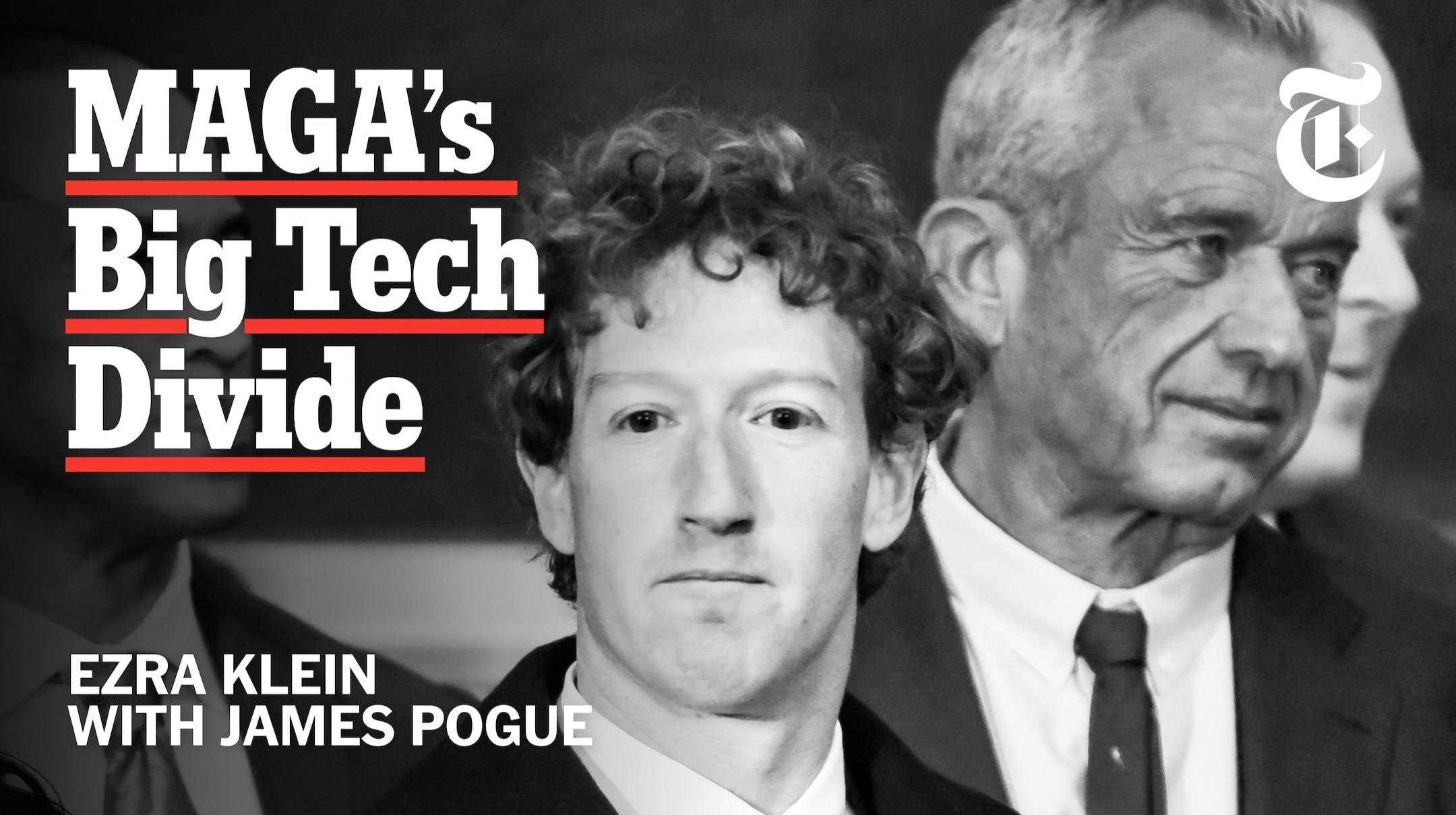
MAGA has long been hostile to Big Tech. So now that Big Tech is shifting rightward, what does that mean for MAGA?“We’re seeing a true political coalition having to navigate very, very big questions about how to keep themselves together,” James Pogue told me. He’s a contributing writer at Times Opinion who has been covering the intellectual ferment on the New Right for years. And he just published a great piece about the tensions between the techno-optimists and skeptics within the MAGA coalition
MAGA has long been hostile to Big Tech. So now that Big Tech is shifting rightward, what does that mean for MAGA?
“We’re seeing a true political coalition having to navigate very, very big questions about how to keep themselves together,” James Pogue told me. He’s a contributing writer at Times Opinion who has been covering the intellectual ferment on the New Right for years. And he just published a great piece about the tensions between the techno-optimists and skeptics within the MAGA coalition.
In this conversation, we cover a lot: How the New Right’s intellectual scene has evolved, the renewed fascination with Ted Kaczynski’s manifesto, why some of the most passionate critics of tech are also the most online, how Robert F. Kennedy Jr. fits into this world, the New Right’s ideas about masculinity and how much Donald Trump cares about any of this.
This episode of “The Ezra Klein Show” was produced by Elias Isquith. Fact-checking by Kate Sinclair and Mary Marge Locker. Mixing by Isaac Jones, with Efim Shapiro and Aman Sahota. Our supervising editor is Claire Gordon. The show’s production team also includes Rollin Hu, Kristin Lin and Jack McCordick. Original music by Pat McCusker. Audience strategy by Kristina Samulewski and Shannon Busta. The executive producer of New York Times Opinion Audio is Annie-Rose Strasser.
On the first day of President Trump’s second term, he signed a record 26 executive orders. Some of them were really big. Others feel more likely messaging memos. And still others are bound to be held up in the courts. So what does it all amount to? What exactly in America has changed?In a former life, I co-hosted a podcast called “The Weeds” with other policy wonks at Vox, including Dara Lind and Matthew Yglesias. We’ve since gone our separate ways; Lind is currently a senior fellow at the Ameri
On the first day of President Trump’s second term, he signed a record 26 executive orders. Some of them were really big. Others feel more likely messaging memos. And still others are bound to be held up in the courts. So what does it all amount to? What exactly in America has changed?
In a former life, I co-hosted a podcast called “The Weeds” with other policy wonks at Vox, including Dara Lind and Matthew Yglesias. We’ve since gone our separate ways; Lind is currently a senior fellow at the American Immigration Council, and Yglesias is the author of the Substack newsletter Slow Boring. But since this was such a big policy week, I wanted to get some of the band back together.
In this conversation, we discuss how much Trump’s immigration orders will actually change our immigration system; whether any of Trump’s orders address Americans’ concerns over prices; how serious Trump actually is about tariffs; and more.
This episode of “The Ezra Klein Show” was produced by Rollin Hu and Jack McCordick. Fact-checking by Kate Sinclair and Mary Marge Locker. Mixing by Isaac Jones, with Efim Shapiro and Aman Sahota. Our supervising editor is Claire Gordon. The show’s production team also includes Elias Isquith and Kristin Lin. Original music by Pat McCusker. Audience strategy by Kristina Samulewski and Shannon Busta. The executive producer of New York Times Opinion Audio is Annie-Rose Strasser.
On retrouve Helen Faradji, Coralie La Perrière et Godefroy Laurendeau alors qu'on discute d'aliments hautement transformés, du nouveau monde post-20 janvier et du film The Brutalist avec Adrian Bodry. Avec l'autrice Camille Giguère-Coté et l'essayiste Mathieu Bélisle on présente la pièce Le show beige présentée au Théâtre La Licorne et en fin d'épisode, Fred explique sa décision de ne pas partager un plateau télé avec Stéphane Bureau.
On retrouve Helen Faradji,Coralie La Perrière et Godefroy Laurendeau alors qu'on discute d'aliments hautement transformés, du nouveau monde post-20 janvier et du film The Brutalist avec Adrian Bodry. Avec l'autrice Camille Giguère-Coté et l'essayiste Mathieu Bélisle on présente la pièce Le show beige présentée au Théâtre La Licorne et en fin d'épisode, Fred explique sa décision de ne pas partager un plateau télé avec Stéphane Bureau.
There’s a quieter transition happening beneath the pageantry of this week’s inaugural events — a transition not of power per se but of the rules around how power in Washington works. And the new rules look very different from the old ones.In this conversation, I’m joined by Aaron Retica, an editor at large for New York Times Opinion (and my column editor), to discuss what President Trump’s inaugural address and first round of executive orders signal about the administration to come. We talk abou
There’s a quieter transition happening beneath the pageantry of this week’s inaugural events — a transition not of power per se but of the rules around how power in Washington works. And the new rules look very different from the old ones.
In this conversation, I’m joined by Aaron Retica, an editor at large for New York Times Opinion (and my column editor), to discuss what President Trump’s inaugural address and first round of executive orders signal about the administration to come. We talk about the end of birthright citizenship and the renegotiation of American belonging, why Trump is so fixated on Greenland and the Panama Canal, his retro-futurist vision of American power, the unsettling arrival of a new tech oligarchy and more.
This episode of “The Ezra Klein Show” was produced by Claire Gordon. Fact-checking by Kate Sinclair. Mixing by Isaac Jones, with Efim Shapiro and Aman Sahota. Our supervising editor is Claire Gordon. The show’s production team also includes Rollin Hu, Elias Isquith, Kristin Lin and Jack McCordick. Original music by Pat McCusker. Audience strategy by Kristina Samulewski and Shannon Busta. The executive producer of New York Times Opinion Audio is Annie-Rose Strasser.
Troisième rencontre avec le dramaturge René-Daniel Dubois. On devait se pencher avec lui sur ses archives numérisées mais évidemment, la discussion a dévié vers de succulentes anecdotes sur les Plouffe, sur l'animation de l'émission La Tour de Babel en 1999 et une foule d'autres sujets ! Aussi dans cet épisode, une discussion Frédérique Dubé, présidente du C.A. de la revue Nuit Blanche en pleine tourmente.
Troisième rencontre avec le dramaturge René-Daniel Dubois. On devait se pencher avec lui sur ses archives numérisées mais évidemment, la discussion a dévié vers de succulentes anecdotes sur les Plouffe, sur l'animation de l'émission La Tour de Babel en 1999 et une foule d'autres sujets !
Aussi dans cet épisode, une discussion Frédérique Dubé, présidente du C.A. de la revue Nuit Blanche en pleine tourmente.
Trump is a master at wielding attention. He’s been owning news cycles and squatting in Americans’ minds for much of the last decade. And for his second term he has an ally in Elon Musk, a man with a similar uncanny skill set.Trump and Musk seem to have figured out something about how attention works in our fragmented media age — and how to use it for political and cultural power — that Democrats simply haven’t. So what is it? What do they understand about attention that their opponents don’t?Chr
Trump is a master at wielding attention. He’s been owning news cycles and squatting in Americans’ minds for much of the last decade. And for his second term he has an ally in Elon Musk, a man with a similar uncanny skill set.
Trump and Musk seem to have figured out something about how attention works in our fragmented media age — and how to use it for political and cultural power — that Democrats simply haven’t. So what is it? What do they understand about attention that their opponents don’t?
We discuss what Hayes sees as a revolution happening to our attention, which he compares to the Industrial Revolution in its scale and impact; why the old rules about attention in politics no longer apply; the key insight Trump had about attention that fueled his rise; why Musk didn’t really overpay for Twitter; and how Democrats can compete in this new attentional world.
This episode of “The Ezra Klein Show” was produced by Jack McCordick. Fact-checking by Michelle Harris. Mixing by Isaac Jones, with Efim Shapiro and Aman Sahota. Our supervising editor is Claire Gordon. The show’s production team also includes Rollin Hu, Elias Isquith and Kristin Lin. Original music by Pat McCusker. Audience strategy by Kristina Samulewski and Shannon Busta. The executive producer of New York Times Opinion Audio is Annie-Rose Strasser.
Joe Biden wanted to show Americans that there was a better path than Trumpism. He worked to build a “foreign policy for the middle class.” He centered industrial policy. He took a more competitive tack with China. He kept America out of wars. The hope was that if Americans saw foreign policy serving their interests, then that would dim the appeal of someone like Donald Trump.Then Trump won again — stronger than ever.Jake Sullivan is Biden’s national security adviser and one of the key architects
Joe Biden wanted to show Americans that there was a better path than Trumpism. He worked to build a “foreign policy for the middle class.” He centered industrial policy. He took a more competitive tack with China. He kept America out of wars. The hope was that if Americans saw foreign policy serving their interests, then that would dim the appeal of someone like Donald Trump.
Then Trump won again — stronger than ever.
Jake Sullivan is Biden’s national security adviser and one of the key architects of this foreign policy for the middle class. In this conversation, I ask him to walk me through why he thinks the country is better off today than it was four years ago. We discuss the status of America’s relationship with China and the risk of a future war; whether the U.S. should have used its leverage to force Ukraine to the negotiating table; how the enormous arms support of Israel serves U.S. interests; what Trump’s re-election says about Bidenism; and more.
This episode of “The Ezra Klein Show” was produced by Rollin Hu. Fact-checking by Michelle Harris. Mixing by Isaac Jones, with Efim Shapiro and Aman Sahota. Our supervising editor is Claire Gordon. The show’s production team also includes Elias Isquith, Kristin Lin and Jack McCordick. Original music by Pat McCusker. Audience strategy by Kristina Samulewski and Shannon Busta. The executive producer of New York Times Opinion Audio is Annie-Rose Strasser.
The preview we’ve had into Donald Trump’s second administration already feels, by American standards, disturbingly abnormal: Picking a former “Fox and Friends” host for defense secretary. Billionaire after billionaire trekking to Mar-a-Lago to curry favor with the president-elect. The Washington Post withholding an opposing endorsement. Meta ending its third-party fact-checking.But all of this is actually pretty normal — not in the U.S. but in many other countries. Researchers call them personal
The preview we’ve had into Donald Trump’s second administration already feels, by American standards, disturbingly abnormal: Picking a former “Fox and Friends” host for defense secretary. Billionaire after billionaire trekking to Mar-a-Lago to curry favor with the president-elect. The Washington Post withholding an opposing endorsement. Meta ending its third-party fact-checking.
But all of this is actually pretty normal — not in the U.S. but in many other countries. Researchers call them personalist regimes, in which everything is a transaction with the leader, whether it’s party politics or policymaking or the media. It’s a style of politics that follows different rules, but there are still rules. And understanding personalist politics, and their tried-and-true playbook, is a way to help make the next four years legible.
Today’s guest is one of the leading scholars on personalist regimes, in both their democratic and their authoritarian forms. Erica Frantz is a political scientist at Michigan State University and a the co-author, with Andrea Kendall-Taylor and Joseph Wright, of “The Origins of Elected Strongmen: How Personalist Parties Destroy Democracy From Within.” In this conversation, we discuss what personalist regimes are and how they operate, the personalist qualities of Trump and the signs of democratic backsliding that Frantz thinks Americans need to track in the coming weeks and years.
This episode of “The Ezra Klein Show” was produced by Elias Isquith. Fact-checking by Michelle Harris. Mixing by Isaac Jones, with Efim Shapiro and Aman Sahota. Our supervising editor is Claire Gordon. The show’s production team also includes Rollin Hu, Kristin Lin and Jack McCordick. Original music by Pat McCusker. Audience strategy by Kristina Samulewski and Shannon Busta. The executive producer of New York Times Opinion Audio is Annie-Rose Strasser.
I like to begin each year with an episode about something I’m working through more personally. And at the end of last year, the thing I needed to work through was a pretty bad case of burnout.So I picked up Oliver Burkeman’s latest book, “Meditations for Mortals: Four Weeks to Embrace Your Limitations and Make Time for What Counts.” Burkeman’s big idea, which he also explores in his best seller “Four Thousand Weeks: Time Management for Mortals,” is that the desire to be more productive, to squee
I like to begin each year with an episode about something I’m working through more personally. And at the end of last year, the thing I needed to work through was a pretty bad case of burnout.
So I picked up Oliver Burkeman’s latest book, “Meditations for Mortals: Four Weeks to Embrace Your Limitations and Make Time for What Counts.” Burkeman’s big idea, which he also explores in his best seller “Four Thousand Weeks: Time Management for Mortals,” is that the desire to be more productive, to squeeze out the most from each day, to try to feel on top of our lives, is ultimately insatiable. He argues that addressing burnout requires a shift in outlook — accepting that our time and energy are finite, and that there will always be something more to do. In other words: What if you began with a deeper appreciation of your own limits? How, then, would you live?
Burkeman’s book is structured as 28 short essays on this question. In this conversation, I ask him to walk me through some of them. We discuss what burnout is; what it means to accept your limitations and let go of control; the messages children absorb about productivity and work; navigating the overwhelm of information and news; and more.
This episode of “The Ezra Klein Show” was produced by Kristin Lin. Fact-checking by Michelle Harris, with Mary Marge Locker. Mixing by Isaac Jones, with Efim Shapiro and Aman Sahota. Our supervising editor is Claire Gordon. The show’s production team also includes Rollin Hu, Elias Isquith and Jack McCordick. Original music by Pat McCusker. Audience strategy by Kristina Samulewski and Shannon Busta. The executive producer of New York Times Opinion Audio is Annie-Rose Strasser.
Avec le professeur Jonathan Livernois du département de littérature, théâtre et cinéma de l'Université Laval, on replonge dans l'univers des Bye Byes des années 60, 70, 80 et 90 et on discute de leurs aspects historiques, politiques, sociologiques et culturels. Mais surtout, on tente de donner le goût de revisiter ces épisodes qui sont des éléments importants de la culture télévisuelle québécoise et qui parfois restent encore brûlants d'actualité.
Avec le professeurJonathan Livernoisdu département de littérature, théâtre et cinéma de l'Université Laval, on replonge dans l'univers des Bye Byes des années 60, 70, 80 et 90 et on discute de leurs aspects historiques, politiques, sociologiques et culturels. Mais surtout, on tente de donner le goût de revisiter ces épisodes qui sont des éléments importants de la culture télévisuelle québécoise et qui parfois restent encore brûlants d'actualité.
I have a tendency to end the year feeling pretty worn out. And that’s partly because I struggle to rest properly throughout the year, to build rest into a routine and stick to it. That’s how I was feeling at the end of 2022, when we originally taped this episode. And it’s certainly how I’m feeling at the end of this year, so this felt like a valuable episode to revisit. Judith Shulevitz’s wonderful book, “The Sabbath World: Glimpses of a Different Order of Time,” draws out lessons from the Jewi
I have a tendency to end the year feeling pretty worn out. And that’s partly because I struggle to rest properly throughout the year, to build rest into a routine and stick to it.
That’s how I was feeling at the end of 2022, when we originally taped this episode. And it’s certainly how I’m feeling at the end of this year, so this felt like a valuable episode to revisit.
Judith Shulevitz’s wonderful book, “The Sabbath World: Glimpses of a Different Order of Time,” draws out lessons from the Jewish ritual of the Sabbath that everyone can benefit from, regardless of whether you’re Jewish or religious at all. The Sabbath, as commonly practiced, involves taking a day a week off from work, turning off your phone and spending a lot of time with family and your community. To Shulevitz, there’s a radicalism in this ritual — a stinging critique of the speed at which we live our lives, the ways we choose to spend our time and how we think about the idea of rest itself. She sees the Sabbath as more than just taking a break from the world, but also as an act of creating a different one. I left the conversation feeling awed by how such an ancient practice can contain wisdom that feels so urgent right now. I hope you enjoy — and that at the end of this year, you find time for some true rest.
This episode of “The Ezra Klein Show” was produced by Emefa Agawu. Fact-checking by Michelle Harris, Mary Marge Locker and Kate Sinclair. Our senior engineer is Jeff Geld, with additional mixing by Isaac Jones and Aman Sahota. The show’s production time also includes Rollin Hu, Elias Isquith, Kristin Lin and Jack McCordick. Original music by Pat McCusker. Audience strategy by Kristina Samulewski and Shannon Busta. The executive producer of New York Times Opinion Audio is Annie-Rose Strasser.
There’s a lot to process as 2024 draws to a close. In our end-of-year Ask Me Anything, the supervising editor of “The Ezra Klein Show,” Claire Gordon, joins Ezra in the studio to ask your questions – on politics, and lots of not-politics too. Ezra talks about the ways this year has affected him personally: how his views on government have changed; his efforts to stave off burnout; and his off-again, on-again relationship with social media. They also discuss the making of the show: the accusation
There’s a lot to process as 2024 draws to a close.
In our end-of-year Ask Me Anything, the supervising editor of “The Ezra Klein Show,” Claire Gordon, joins Ezra in the studio to ask your questions – on politics, and lots of not-politics too. Ezra talks about the ways this year has affected him personally: how his views on government have changed; his efforts to stave off burnout; and his off-again, on-again relationship with social media.
They also discuss the making of the show: the accusation that certain episodes have “normalized” Donald Trump; how we’re going to approach covering the next administration; the story behind our new theme music; and what’s going on with that arm tattoo.
Thank you to the listeners who sent in questions, and to everyone who’s tuned in this year. Without you, this year would have been a lot lonelier. (We also wouldn’t have jobs.) We’ll be re-airing one of our favorite episodes this Friday (on the art of rest). And then we’ll be back here with new episodes in 2025. Wishing you a great end to 2024. Happy new year!
This episode of “The Ezra Klein Show” was fact-checked by Michelle Harris. Mixing by Isaac Jones, with Efim Shapiro and Aman Sahota. Our supervising editor is Claire Gordon. The show’s production team also includes Rollin Hu, Elias Isquith, Kristin Lin and Jack McCordick. Original music by Pat McCusker. Audience strategy by Kristina Samulewski and Shannon Busta. The executive producer of New York Times Opinion Audio is Annie-Rose Strasser.
On reçoit l'essayiste Learry Gagné pour son excellent L'anti-wokisme en débats où il décortique avec brio le discours anti-woke qui pullule dans les médias généralistes québécois; L'humoriste Coralie La Perrière nous confie toute la complexité de ses paradoxes féministes depuis qu'elle a vu le film The Substance. On termine l'épisode avec une pépite de Noël tout droit sortie de la France hippie des années 70.
On reçoit l'essayiste Learry Gagné pour son excellent L'anti-wokisme en débatsoù il décortique avec brio le discours anti-woke qui pullule dans les médias généralistes québécois; L'humoriste Coralie La Perrière nous confie toute la complexité de ses paradoxes féministes depuis qu'elle a vu le film The Substance. On termine l'épisode avec une pépite de Noël tout droit sortie de la France hippie des années 70.
In 2022, President Biden signed the Inflation Reduction Act, ushering in, by some estimates, nearly half a trillion dollars of investment in green energy and manufacturing. But what will happen to this huge investment as Donald Trump enters office?Jigar Shah is one of the best people to answer this question. As the director of the Loan Programs Office at the Department of Energy, he has spent his career finding new ways to finance green infrastructure. And he’s more optimistic than you might exp
In 2022, President Biden signed the Inflation Reduction Act, ushering in, by some estimates, nearly half a trillion dollars of investment in green energy and manufacturing. But what will happen to this huge investment as Donald Trump enters office?
Jigar Shah is one of the best people to answer this question. As the director of the Loan Programs Office at the Department of Energy, he has spent his career finding new ways to finance green infrastructure. And he’s more optimistic than you might expect about the road ahead.
In this conversation, guest host Robinson Meyer, a contributing writer for New York Times Opinion and the founding executive editor of Heatmap News, asks Shah for a progress check on decarbonization. They discuss what has changed about the economics and financing of clean energy; what has worked well in the green energy transition, as well as the trade-offs it has entailed; and what may or may not change as Trump enters office.
This episode of “The Ezra Klein Show” was produced by Rollin Hu [Who]. Fact-checking by Michelle Harris, with Mary Marge Locker and Kate Sinclair. Mixing by Isaac Jones, with Efim Shapiro and Aman Sahota. Our supervising editor is Claire Gordon. The show’s production team also includes Elias Isquith, Kristin Lin and Jack McCordick. Original music by Pat McCusker. Audience strategy by Kristina Samulewski and Shannon Busta. The executive producer of New York Times Opinion Audio is Annie-Rose Strasser.
Donald Trump will enter office at a time when presidential power has significantly expanded, because of a string of Supreme Court decisions in recent years. These decisions can be understood to have two functions: They give presidents a “sword” to act more decisively and unilaterally, and a “shield” that protects them from prosecution against actions taken in their official capacity. What will these capacities mean for Trump’s second term — especially as he has promised to radically transform th
Donald Trump will enter office at a time when presidential power has significantly expanded, because of a string of Supreme Court decisions in recent years. These decisions can be understood to have two functions: They give presidents a “sword” to act more decisively and unilaterally, and a “shield” that protects them from prosecution against actions taken in their official capacity. What will these capacities mean for Trump’s second term — especially as he has promised to radically transform the federal government?
Gillian Metzger is a professor at Columbia Law School who has studied the presidency, the administrative state and the Supreme Court’s relationship to both. In this conversation, guest-hosted by Kate Shaw, a New York Times Opinion contributing writer and law professor, Metzger discusses two key Supreme Court cases — the Trump immunity case, which gave presidents broad protections from prosecution, and the Loper Bright Enterprises case, which overturned the Chevron doctrine, expanding judicial power. Shaw and Metzger also cover how much leeway Trump actually has to take some of the bolder executive actions he’s floated, including ending birthright citizenship; what still remains uncertain about the federal government’s regulatory powers in the post-Chevron regime; and more.
This episode of “The Ezra Klein Show” was produced by Elias Isquith. Fact-checking by Michelle Harris, with Mary Marge Locker. Mixing by Isaac Jones, with Efim Shapiro and Aman Sahota. Our supervising editor is Claire Gordon. The show’s production team also includes Rollin Hu, Kristin Lin and Jack McCordick. Original music by Pat McCusker. Audience strategy by Kristina Samulewski and Shannon Busta. The executive producer of New York Times Opinion Audio is Annie-Rose Strasser.
Le sociologue Philippe De Grosbois s'interroge sur le concept de chambre d'écho et se demande si elles existent vraiment et au profit de qui. Philippe Beaudoin se joint à la discussion pour expliquer tout ce qui se cache derrière les réseaux sociaux: Algorithmes, code open source, modération et structures de financement. On termine l'épisode avec Valérie Lefevbre-Faucher qui nous présente le #345 de la revue Liberté.
Le sociologue Philippe De Grosbois s'interroge sur le concept de chambre d'écho et se demande si elles existent vraiment et au profit de qui. Philippe Beaudoin se joint à la discussion pour expliquer tout ce qui se cache derrière les réseaux sociaux: Algorithmes, code open source, modération et structures de financement. On termine l'épisode avec Valérie Lefevbre-Faucher qui nous présente le #345 de la revue Liberté.
This election felt like the peak of the TV-ification of politics. There’s Trump, of course, who rose to national prominence as a reality-TV character and is a master of visual stagecraft. And while Trump’s cabinet picks in his first term were described as out of central casting, this time he wants to staff some positions directly from the worlds of TV and entertainment: Pete Hegseth, his choice to run the Pentagon, was a host on “Fox and Friends Weekend”; his proposed education secretary, Linda
This election felt like the peak of the TV-ification of politics. There’s Trump, of course, who rose to national prominence as a reality-TV character and is a master of visual stagecraft. And while Trump’s cabinet picks in his first term were described as out of central casting, this time he wants to staff some positions directly from the worlds of TV and entertainment: Pete Hegseth, his choice to run the Pentagon, was a host on “Fox and Friends Weekend”; his proposed education secretary, Linda McMahon, was the former C.E.O. of W.W.E.; Mehmet Oz, star of the long-running “The Dr. Oz Show,” is his pick to run Medicare and Medicaid; and he’s tapped Elon Musk, one of the most powerful figures in American culture, to lead a government efficiency effort.
Two years ago, we released an episode that helps explain why politics and entertainment are converging like this. It’s with my old Vox colleague Sean Illing, host of “The Gray Area,” looking at the work of two media theorists, Marshall McLuhan and Neil Postman, who uncannily predicted what we’re seeing now decades ago.
And so I wanted to share this episode again now, because it’s really worth stepping back and looking at this moment through the lens of the media that’s shaping it. In his book “The Paradox of Democracy,” Illing and his co-author, Zac Gershberg, put it this way: “It’s better to think of democracy less as a government type and more as an open communicative culture.” So what does our communicative culture — our fragmented mix of cable news, X, TikTok, YouTube, WhatsApp and podcasts — mean for our democracy?
This episode of “The Ezra Klein Show” was produced by Rogé Karma. Fact-checking by Michelle Harris, Rollin Hu, Mary Marge Locker and Kate Sinclair. Mixing by Sonia Herrero, Carole Sabouraud and Isaac Jones. Our production team also includes Elias Isquith, Kristin Lin, Jack McCordick and Aman Sahota. Audience strategy by Kristina Samulewski and Shannon Busta. The executive producer of New York Times Opinion Audio is Annie-Rose Strasser.
This is our first bonus content of the paywall era, a subscriber-only, election-themed “ask me anything.” If you haven’t subscribed and would like to, you can do that directly through Apple Podcasts and Spotify, or click here. If you don’t want to subscribe, you’ll still have an end-of-year “ask me anything” coming down your feed — a mix of politics and things in life that, thankfully, aren’t politics.And if you do subscribe, thank you so much for supporting the show. We hope you enjoy this litt
This is our first bonus content of the paywall era, a subscriber-only, election-themed “ask me anything.” If you haven’t subscribed and would like to, you can do that directly through Apple Podcasts and Spotify, or click here. If you don’t want to subscribe, you’ll still have an end-of-year “ask me anything” coming down your feed — a mix of politics and things in life that, thankfully, aren’t politics.
And if you do subscribe, thank you so much for supporting the show. We hope you enjoy this little extra for your money.
Thank you, also, to everyone who sent in questions. We read them all and wish we had time to get to more of them.
But in the time that we had, the show’s supervising editor, Claire Gordon, quizzed Ezra with listeners’ questions on the meaning of “the working class,” whether an election that seemed to hinge on the economy could qualify as postmaterialist, the lessons he worries the Democrats will overlearn, his response to L.G.B.T.Q. voters who fear political backlash, what the election means for Israel’s war in Gaza, how blue cities should respond to their apparent electoral rebuke and more.
Thoughts? Guest suggestions? Email us at ezrakleinshow@nytimes.com.
This episode of “The Ezra Klein Show” was fact-checked by Michelle Harris and Mary Marge Locker. Mixing by Isaac Jones, with Efim Shapiro and Aman Sahota. Our supervising editor is Claire Gordon. The show’s production team also includes Rollin Hu, Elias Isquith, Kristin Lin and Jack McCordick. Original music by Pat McCusker. Audience strategy by Kristina Samulewski and Shannon Busta. The executive producer of New York Times Opinion Audio is Annie-Rose Strasser.
On reçoit l'historien Eric Bédard qui vient présenter le nouveau volume des Figures marquantes de notre histoire et qui discute d'épistémologie en histoire avec le chroniqueur et médiéviste Maxime Laprise. La journaliste indépendante Gabrielle Brassard-Lecours vient présenter les grands dossier qui occupe le média Pivot ce mois-ci et on termine l'épisode avec Pat Bélisle et Julie Kiopini, deux facteur.trices en grève qui nous partagent leur vision du conflit et de leur métier. Crédit photo: Cen
On reçoit l'historien Eric Bédard qui vient présenter le nouveau volume des Figures marquantes de notre histoireet qui discute d'épistémologie en histoire avec le chroniqueur et médiéviste Maxime Laprise. La journaliste indépendante Gabrielle Brassard-Lecours vient présenter les grands dossier qui occupe le média Pivotce mois-ci et on termine l'épisode avec Pat Bélisle et Julie Kiopini, deux facteur.trices en grève qui nous partagent leur vision du conflit et de leur métier.
Crédit photo: Centre d'archives de la région de Thetford - Fonds Daniel Lessard et Adobe Stock
It was possible to see Donald Trump’s first election victory as some kind of fluke. But after the results of this election, it’s clear that America is living in the Trump era. And for Americans who’ve struggled to process this fact, you have lots of company around the world. From Hungary to Brazil, right-wing figures with openly authoritarian goals have been voted into power, to the concern of many of the people who live there.A political phenomenon that spans countries like this — especially co
It was possible to see Donald Trump’s first election victory as some kind of fluke. But after the results of this election, it’s clear that America is living in the Trump era. And for Americans who’ve struggled to process this fact, you have lots of company around the world. From Hungary to Brazil, right-wing figures with openly authoritarian goals have been voted into power, to the concern of many of the people who live there.
A political phenomenon that spans countries like this — especially countries with such different levels of wealth, political systems and cultures — requires an explanation that spans countries, too.
So we wanted to re-air this episode that originally published in November 2022, because it offers exactly that kind of theory. Pippa Norris is a political scientist at Harvard’s Kennedy School of Government. She’s written dozens of books on topics ranging from comparative political institutions to right-wing parties and the decline of religion. In 2019, she and Ronald Inglehart published “Cultural Backlash: Trump, Brexit and Authoritarian Populism,” which gives the best explanation of the far right’s rise that I’ve read. And it feels so much more relevant now in this country, after Trump’s decisive election.
In this conversation, we discuss what Norris calls the “silent revolution in cultural values” that has occurred across advanced democracies in recent decades, why the “transgressive aesthetic” of leaders like Trump and Brazil’s Jair Bolsonaro is so central to their appeal, the role that economic anxiety and insecurity play in fueling right-wing backlashes and more.
Thoughts? Email us at ezrakleinshow@nytimes.com. (And if you're reaching out to recommend a guest, please write “Guest Suggestion" in the subject line.)
This episode of “The Ezra Klein Show” is produced by Emefa Agawu, Annie Galvin, Jeff Geld and Roge Karma. Fact-checking by Michelle Harris, Mary Marge Locker and Kate Sinclair. Original music by Isaac Jones. Mixing by Jeff Geld. Audience strategy by Shannon Busta. Special thanks to Kristin Lin and Kristina Samulewski.
Unlock full access to New York Times podcasts and explore everything from politics to pop culture. Subscribe today at nytimes.com/podcasts or on Apple Podcasts and Spotify.
This episode of “The Ezra Klein Show” was produced by Rogé Karma. Fact-checking by Michelle Harris, Mary Marge Locker and Kate Sinclair. Mixing by our senior engineer, Jeff Geld. Our supervising editor is Claire Gordon. The show's production team also includes Rollin Hu, Elias Isquith, Kristin Lin, Jack McCordick and Aman Sahota. Original music by Pat McCusker. Audience strategy by Kristina Samulewski and Shannon Busta.
Right after the election, I talked about how the results reminded me of 2004. George W. Bush won re-election that year — and unlike four years earlier, the popular vote, too. Democrats were truly, undeniably in the wilderness. But two years later, they found their way out. Democrats won the House for the first time in 12 years. And two years after that, with the election of Barack Obama, they completed their trifecta. Does that comeback story have any lessons for Democrats today?Rahm Emanuel is
Right after the election, I talked about how the results reminded me of 2004. George W. Bush won re-election that year — and unlike four years earlier, the popular vote, too. Democrats were truly, undeniably in the wilderness. But two years later, they found their way out. Democrats won the House for the first time in 12 years. And two years after that, with the election of Barack Obama, they completed their trifecta. Does that comeback story have any lessons for Democrats today?
Rahm Emanuel is the person to ask. He helped orchestrate that 2006 Democratic victory as the chair of the Democratic Congressional Campaign Committee. He was Obama’s first chief of staff. And before that, Emanuel was a senior adviser to President Bill Clinton. Emanuel has been a central player in most of the biggest Democratic victories of the past few decades. And people like David Axelrod and Steve Israel have been floating his name to lead the Democratic National Committee to help guide Democrats out of the wilderness once more. But Emanuel is also a controversial figure in the party. And the eras of Democratic politics he represents have complicated legacies and aren’t remembered with unanimous warmth.
In this conversation, Emanuel argues that Democrats have fallen out of touch with what Americans actually want. We discuss why Democrats lost this November, what lessons they’ve forgotten from the Obama and Clinton years and how he would plot a Democratic comeback today.
This episode of “The Ezra Klein Show” was produced by Elias Isquith. Fact-checking by Michelle Harris, with Kate Sinclair. Mixing by Isaac Jones and Aman Sahota. Our supervising editor is Claire Gordon. The show’s production team also includes Rollin Hu, Kristin Lin and Jack McCordick. Original music by Pat McCusker. Audience strategy by Kristina Samulewski and Shannon Busta. The executive producer of New York Times Opinion Audio is Annie-Rose Strasser. And special thanks to Switch and Board Podcast Studio.
Dans cet épisode, Antoine Casgrain, ex-conseiller politique à Québec Solidaire et maintenant chroniqueur à la balado nous offre une analyse sociologique fort intéressante sur le traitement médiatique et politique des "affaires" Bouazzi et Bedford. Godefroy Laurendeau nous revient avec sa chronique mensuelle où il réfléchit à l'apport (ou pas) du capitalisme dans une réelle transition verte en plus de profiter de sa tribune pour détruire l'idée d'un TGV Montréal-Toronto.
Dans cet épisode, Antoine Casgrain, ex-conseiller politique à Québec Solidaire et maintenant chroniqueur à la balado nous offre une analyse sociologique fort intéressante sur le traitement médiatique et politique des "affaires" Bouazzi et Bedford. Godefroy Laurendeau nous revient avec sa chronique mensuelle où il réfléchit à l'apport (ou pas) du capitalisme dans une réelle transition verte en plus de profiter de sa tribune pour détruire l'idée d'un TGV Montréal-Toronto.
There are a lot of different opinions about how the Democratic Party should rebuild after the blow of Donald Trump’s victory. And for the next two episodes, we’re going to showcase two very different ones.Faiz Shakir was Bernie Sanders’s 2020 campaign manager, and he believes that Democrats need to embrace a Sanders-style class-first populism. This question of whether Sanders or a candidate like him could have beaten Trump loomed over Democratic post-mortems of the 2016 election, and they’ve rea
There are a lot of different opinions about how the Democratic Party should rebuild after the blow of Donald Trump’s victory. And for the next two episodes, we’re going to showcase two very different ones.
Faiz Shakir was Bernie Sanders’s 2020 campaign manager, and he believes that Democrats need to embrace a Sanders-style class-first populism. This question of whether Sanders or a candidate like him could have beaten Trump loomed over Democratic post-mortems of the 2016 election, and they’ve reared up again this year, as Democrats have continued to lose working-class voters. As Sanders put it in a blistering statement: “It should come as no great surprise that a Democratic Party which has abandoned working-class people would find that the working class has abandoned them.”
But some Democrats have been frustrated with this criticism. President Biden has been arguably the most economically populist president of the modern era. And the Democrats who have been winning in redder parts of the country aren’t democratic socialists. So I wanted to have Shakir on for a lively debate. Shakir worked not just for Sanders; he was also a senior adviser to the Senate majority leader Harry Reid and to Nancy Pelosi. And he’s currently the founder and executive director of More Perfect Union, a media outlet focused on issues affecting America’s working class.
This episode of “The Ezra Klein Show” was produced by Rollin Hu. Fact-checking by Michelle Harris, with Kate Sinclair. Mixing by Isaac Jones, with Aman Sahota and Efim Shapiro. Our supervising editor is Claire Gordon. The show’s production team also includes Elias Isquith, Kristin Lin and Jack McCordick. Original music by Pat McCusker. Audience strategy by Kristina Samulewski and Shannon Busta. The executive producer of New York Times Opinion Audio is Annie-Rose Strasser. And special thanks to Switch and Board Podcast Studio.
Dans cet épisode, Helen Faradji réfléchit au clivage entre jeunes hommes masculinistes et jeunes femmes votant massivement à gauche et ce que ça donnera pour la suite du monde. On reçoit l'historienne Catherine Larochelle pour son dernier essai: Marie-Louise et les petits chinois d'Afrique paru chez Mémoire d'Encrier et s'en suit une discussion riche sur le racisme, le nationalisme et son rôle d'historienne hors des grands canons nationaux. On termine l'épisode avec Katrie Chagnon et Rebecca Lec
Dans cet épisode, Helen Faradji réfléchit au clivage entre jeunes hommes masculinistes et jeunes femmes votant massivement à gauche et ce que ça donnera pour la suite du monde. On reçoit l'historienne Catherine Larochelle pour son dernier essai:Marie-Louise et les petits chinois d'Afrique paru chez Mémoire d'Encrieret s'en suit une discussion riche sur le racisme, le nationalisme et son rôle d'historienne hors des grands canons nationaux.
On termine l'épisode avec Katrie Chagnon et Rebecca Leclerc qui viennent nous présenter le nouveau # de Spirale ayant pour thème "L'hygiène de vie"
The core conflict in our politics right now is over institutions. Democrats defend them, while Republicans distrust them, and seek, in some cases, to eliminate them.This is really bad. It’s bad for institutions when Republicans are elected, because of the damage they might inflict. And it’s bad for institutions when Democrats are elected, because when you’re so committed to protecting something, it’s hard to be clear-eyed or honest about all the ways it’s failing. And when Democrats won’t admit
The core conflict in our politics right now is over institutions. Democrats defend them, while Republicans distrust them, and seek, in some cases, to eliminate them.
This is really bad. It’s bad for institutions when Republicans are elected, because of the damage they might inflict. And it’s bad for institutions when Democrats are elected, because when you’re so committed to protecting something, it’s hard to be clear-eyed or honest about all the ways it’s failing. And when Democrats won’t admit to the problems that so many Americans can see and feel, that creates a huge opening for the right. So, what are Democrats missing?
Steven Teles is a political scientist and director of the Center for Economy and Society at Johns Hopkins, and a senior fellow at the Niskanen Center. Jennifer Pahlka is the founder of Code for America and the author of one of my favorite books on why government doesn’t deliver, “Recoding America: Why Government is Failing in the Digital Age and How We Can Do Better.” She’s also a senior fellow at Niskanen.
In this conversation, we discuss how and why the country has become polarized over institutions; the ways this was supercharged during the pandemic; the reasons government agencies are so focused on process, often at the expense of outcomes; how a second Trump administration will probably distract from some much needed institutional reforms; and more.
This episode of “The Ezra Klein Show” was produced by Jack McCordick. Fact-checking by Michelle Harris, with Kate Sinclair. Mixing by Isaac Jones and Aman Sahota. Our supervising editor is Claire Gordon. The show’s production team also includes Rollin Hu, Elias Isquith, and Kristin Lin. Original music by Pat McCusker. Audience strategy by Kristina Samulewski and Shannon Busta. The executive producer of New York Times Opinion Audio is Annie-Rose Strasser.
I’ve been watching since the election to see what timeline we’re in. And Donald Trump’s first wave of selections for appointees were pretty straightforward. But then came the turn: Pete Hegseth, a former “Fox & Friends” host, to helm the Pentagon; Tulsi Gabbard for director of national intelligence; and the real gut-punch, the former representative Matt Gaetz for attorney general.In the parts of government that can be weaponized most dangerously — the military, the intelligence services, the
I’ve been watching since the election to see what timeline we’re in. And Donald Trump’s first wave of selections for appointees were pretty straightforward. But then came the turn: Pete Hegseth, a former “Fox & Friends” host, to helm the Pentagon; Tulsi Gabbard for director of national intelligence; and the real gut-punch, the former representative Matt Gaetz for attorney general.
In the parts of government that can be weaponized most dangerously — the military, the intelligence services, the Department of Justice — Trump is putting true lackeys and loyalists in charge. I fear we’ve entered the bad timeline.
Anne Applebaum is a Pulitzer Prize-winning historian, a staff writer at The Atlantic, and the author of a new book, “Autocracy, Inc.: The Dictators Who Want to Run the World.” In this conversation, we discuss how she’s been processing Trump’s picks, what to make of Elon Musk’s role in Trump’s inner circle, the indicators to look out for when governments slide in an autocratic direction, the appeal and excitement of autocratic regimes that often get missed in our history books, the relationship between autocracies and futurists, the politics of performance and more.
This episode of “The Ezra Klein Show” was produced by Elias Isquith. Fact-checking by Michelle Harris, with Kate Sinclair and Mary Marge Locker. Our senior engineer is Jeff Geld, with additional mixing by Isaac Jones and Aman Sahota. Our supervising editor is Claire Gordon. The show’s production team also includes Rollin Hu, Kristin Lin and Jack McCordick. Original music by Pat McCusker. Audience strategy by Kristina Samulewski and Shannon Busta. The executive producer of New York Times Opinion Audio is Annie-Rose Strasser. And special thanks to Switch and Board Podcast Studio.
The Democratic Party has been hemorrhaging nonwhite and working-class voters. There are a lot of theories about why that has been happening, blaming it on the party’s ideas or messaging or campaign tactics. But I think the problem might be deeper than that — rooted in the structure of the Democratic Party itself.Michael Lind is a columnist at Tablet magazine, a co-founder of New America and the author of “The New Class War: Saving Democracy From the Managerial Elite.” He argues that the Democrat
The Democratic Party has been hemorrhaging nonwhite and working-class voters. There are a lot of theories about why that has been happening, blaming it on the party’s ideas or messaging or campaign tactics. But I think the problem might be deeper than that — rooted in the structure of the Democratic Party itself.
Michael Lind is a columnist at Tablet magazine, a co-founder of New America and the author of “The New Class War: Saving Democracy From the Managerial Elite.” He argues that the Democratic Party in recent years has become more beholden to special-interest nonprofits, which claim to represent large constituencies but actually reflect the interests of the donor class. In this conversation, we discuss why he thinks the nonprofit complex became so powerful, how that might have led to a disconnect between the Democratic Party and its core voter base and what he thinks Democrats could do to course correct.
This episode of “The Ezra Klein Show” was produced by Rollin Hu. Fact-checking by Kate Sinclair and Mary Marge Locker. Our senior engineer is Jeff Geld, with additional mixing by Aman Sahota and Isaac Jones. Our supervising editor is Claire Gordon. The show’s production team also includes Elias Isquith and Kristin Lin. Original music by Pat McCusker. Audience strategy by Kristina Samulewski and Shannon Busta. The executive producer of New York Times Opinion Audio is Annie-Rose Strasser.

 Connexion